








A hygienist finishes a thorough perio appointment, hands off a chart that feels complete, and two weeks later the SRP claim comes back denied. The CHO is left with a choice: spend an hour building an appeal or write off the revenue. Most practices do both, depending on the day.
The perio disease was real, the treatment was appropriate, and the hygienist did her job. The claim failed because the record didn't reflect what was found, and that compounds when charting varies from one hygienist to the next.
Why SRP claims get denied
Payers aren't usually rejecting the clinical need. They're rejecting the record.
The most common denial triggers are predictable: probing depths recorded inconsistently or without radiographic correlation, narrative notes that describe findings in general terms rather than site-specific measurements, and missing evidence that disease severity meets the payer's threshold for medical necessity. When those elements aren't present in the original submission, the claim fails — regardless of what was found in the patient's mouth.
The charting variability problem makes this worse at scale. In a group practice, a hygienist with five years of experience and one with five months will document the same clinical findings differently. That inconsistency doesn't just affect individual claims. It creates audit risk. Payers reviewing a practice's billing patterns look for documentation that holds up across providers, not just on a case-by-case basis. Inconsistent records across hygienists signal exactly the kind of pattern that invites scrutiny.
How AI-assisted documentation changes the claim
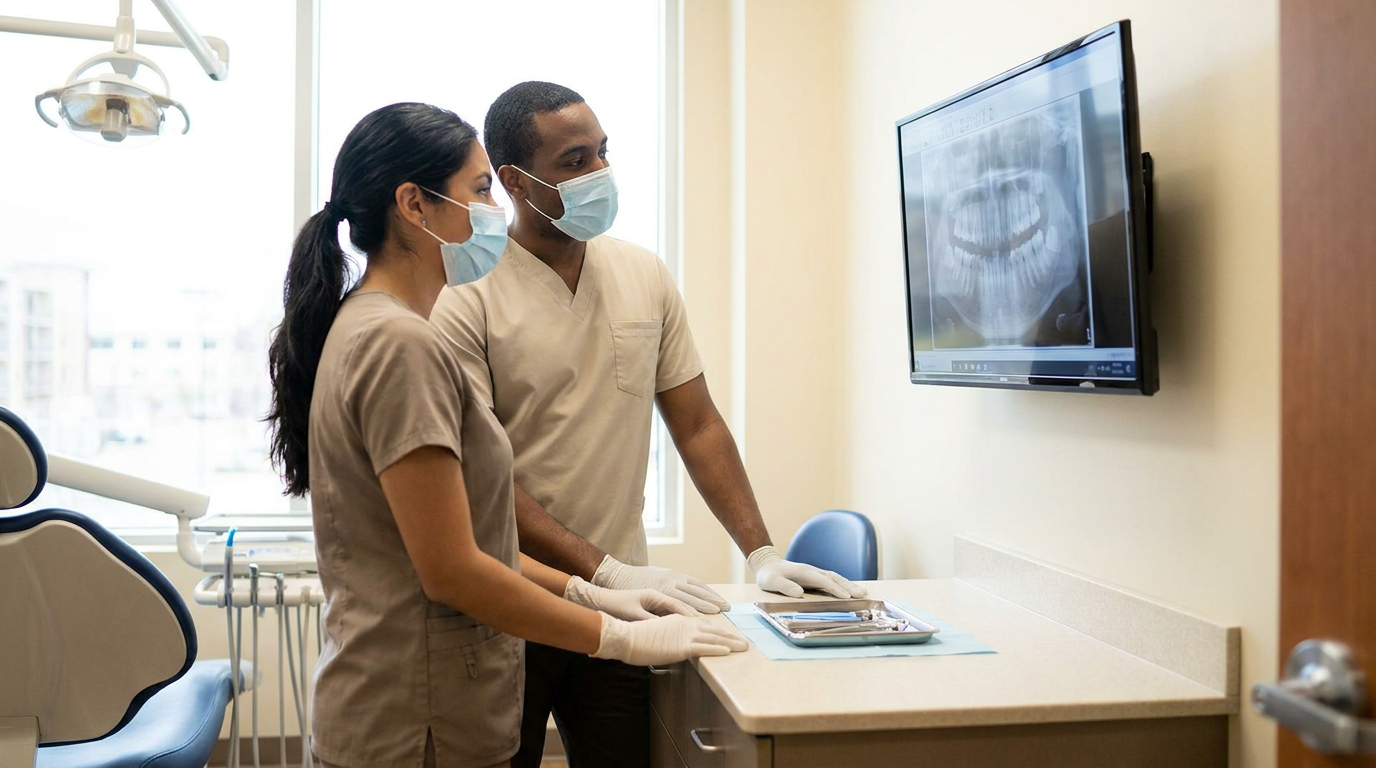
Vision AI detects and measures the radiographic findings payers want to see — bone levels, calculus deposits, disease extent — and surfaces them at the point of care, automatically. The hygienist doesn't have to decide what to include in the narrative. The objective findings are already there.
That matters for two reasons. First, it removes the documentation gap between what's visible on the radiograph and what ends up in the chart. Payers require radiographic evidence to support SRP approval. When that evidence is captured, measured, and tied directly to the clinical note, the submission is harder to deny on documentation grounds. Second, it standardizes what gets recorded. Every hygienist working with Vision AI is drawing from the same AI-assisted analysis, the same measurements, the same radiographic findings, the same structure. Hygienist-to-hygienist variability doesn't disappear, but the documentation floor rises across the board.
For a CHO tracking SRP production per hygienist, denial rate, and appeal success, that floor matters. When documentation is consistently payer-compliant, the metrics that reflect it start to move.
Less rework, more time delivering care
The appeal process is expensive in ways that don't always show up in the denial rate. A hygienist who spends 45 minutes reconstructing a claim after the fact isn't delivering care during that time. A CHO who's auditing charts to find the gap that caused a denial isn't coaching. The administrative cost of rework is real, and it falls on the people whose time is hardest to replace.
When documentation is built to payer standards from the start, rework drops. Hygienists aren't going back to add missing measurements or rewrite narratives. Appeals, when they happen, are faster to build because the supporting evidence was captured at the appointment. And hygienist adoption of perio protocols improves when the documentation process isn't the hardest part of running the protocol. Lower friction at the chart means more consistent execution on the clinical side.
That's also where CHO coaching gets sharper. AI-generated data surfaces which hygienists are producing documentation that clears payer review and which ones aren't — giving leaders something specific to work with rather than a pattern they have to infer from denial reports.
The fix lives upstream
SRP denials feel like a billing problem. The denial rate moves when you invest in how claims are built, not how appeals are written.
Vision AI gives hygiene teams the radiographic evidence, the consistent charting, and the insurer-ready documentation to get SRP claims approved the first time. That means more production, less rework, and hygienists spending their time where it belongs.
Book a Demo to see how Vision AI changes SRP documentation at scale.
Frequently Asked Questions
What documentation do payers typically require to approve an SRP claim?
Most payers require site-specific probing depths (typically 4mm or greater with bleeding on probing), radiographic evidence of bone loss or calculus, a diagnosis of generalized or localized periodontitis, and a clinical narrative supporting medical necessity. Requirements vary by payer, but the common thread is objective, site-specific findings tied to the radiograph.
How does dental AI help standardize perio charting across hygienists?
Vision AI analyzes radiographic images at the point of care and surfaces consistent measurements — bone levels, calculus deposits, disease extent — that become part of the clinical record. Because every hygienist is working from the same AI-assisted analysis, documentation structure and completeness become more uniform across the team, regardless of individual experience level.
Can AI-generated clinical notes be used to support SRP insurance appeals?
Yes. AI-assisted documentation that captures objective radiographic findings and ties them to site-specific charting gives practices a stronger evidentiary record to draw from when building an appeal. The value is that this evidence was captured at the time of the appointment, not reconstructed after a denial.
How does Vision AI connect radiographic findings to SRP case documentation?
Vision AI detects and measures findings on dental radiographs — including bone levels and calculus — and surfaces them alongside the clinical record. That connection between the radiograph and the chart is what payers look for when evaluating medical necessity for SRP. When it's present and consistent, the claim is easier to approve and harder to deny.