
 Agent Ivy










Updated: September 2026
You attract dentists to a DSO by making the clinical environment the differentiator—not another compensation band.
Key takeaways
When compensation converges, candidates compare environments, not offer letters.
Vacant chairs and slow productivity ramps cost DSOs measurable production before a hire reaches baseline.
FDA-cleared diagnostic AI gives new providers a consistent baseline from day one and shortens time-to-productivity.
Pilot 3–5 locations first; production-per-practice data is the proof point for recruiting and PE conversations.
Every DSO competing for the same pool of graduating residents and experienced clinicians has landed at roughly the same compensation structure. When the numbers converge, candidates stop comparing offers and start comparing environments. The DSOs filling chairs faster right now are winning on clinical infrastructure, not on an extra percentage point of collections.
A location producing $80,000 per month loses about $2,700 for every day a provider seat sits vacant. Across 50 locations with time-to-fill measured in weeks, that gap compounds fast.
Time-to-fill is one variable. Time-to-productivity is often larger. A for 90 days at a location with $75,000 monthly capacity represents a revenue gap that doesn’t close until that provider reaches diagnostic confidence in an unfamiliar patient population. The ramp is a function of the environment they walk into on day one.
DSOs that treat both variables as levers recover revenue that others write off. Cut time-to-fill by two weeks and shorten the productivity ramp from 90 days to 60, and the EBITDA impact runs across every location in the portfolio. PE buyers notice that number. They also notice when it’s missing.
Why is compensation no longer the differentiator?
Every DSO competing for the same pool of graduating residents and experienced clinicians has landed at roughly the same compensation structure. When the numbers converge, candidates stop comparing offers and start comparing environments. The DSOs filling chairs faster right now are winning on clinical infrastructure, not on an extra percentage point of collections.
A location producing $80,000 per month loses about $2,700 for every day a provider seat sits vacant. Across 50 locations with time-to-fill measured in weeks, that gap compounds fast.
Time-to-fill is one variable. Time-to-productivity is often larger. A for 90 days at a location with $75,000 monthly capacity represents a revenue gap that doesn’t close until that provider reaches diagnostic confidence in an unfamiliar patient population. The ramp is a function of the environment they walk into on day one.
DSOs that treat both variables as levers recover revenue that others write off. Cut time-to-fill by two weeks and shorten the productivity ramp from 90 days to 60, and the EBITDA impact runs across every location in the portfolio. PE buyers notice that number. They also notice when it’s missing.
Why does every DSO look the same without a differentiated clinical environment?
Most DSOs lose the recruiting conversation before the offer goes out, because every practice looks identical to a candidate walking through the door. Same equipment. Same workflows. Same promise of a great team and strong production incentives. The offer letter is the last thing that separates one DSO from another, and by 2024, those numbers have converged too.
The candidates most DSOs are competing for, recent graduates in particular, aren’t just comparing compensation. They’re asking a harder question: where will I feel confident practicing?
New graduates don’t have an attending to consult. They’re walking into an unfamiliar patient population with no established baseline and no reliable way to know what they’re missing. Diagnostic uncertainty is real, and it’s the main reason new hires underperform in the first 60 to 90 days. The determines how fast that uncertainty goes away.
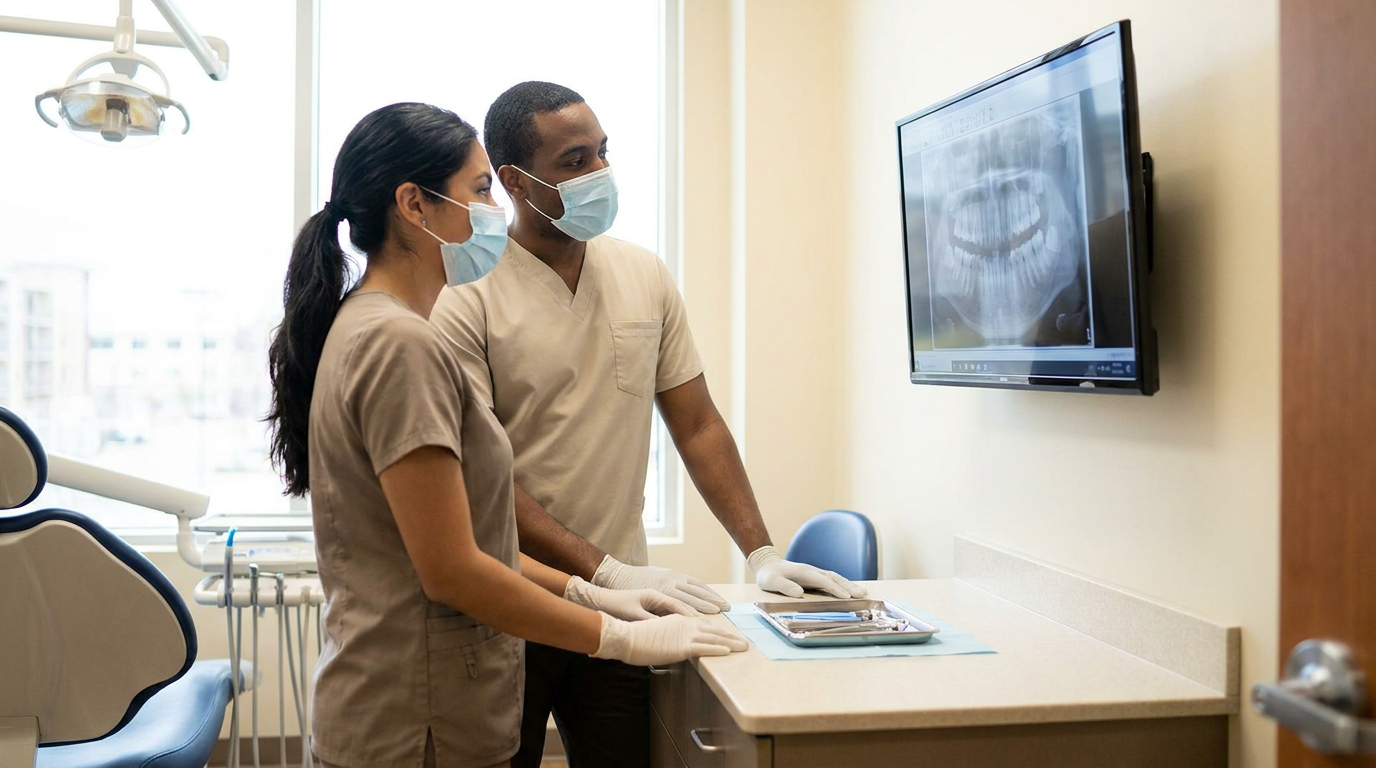
Overjet changes that environment. Vision AI surfaces caries and bone level findings that a new provider would otherwise take months of patient volume to calibrate against, while leaving clinical judgment where it belongs. The provider gets a consistent diagnostic baseline from day one, which is what shortens the ramp and what a recruiting candidate can verify before accepting an offer.
Overjet is the only dental AI platform with FDA clearance for both caries detection and bone level quantification. A candidate can confirm that independently. That turns the clinical environment from a talking point into a credential, the kind of evidence that moves a provider from consideration to commitment because they don’t have to take the DSO’s word for it.
Treatment acceptance runs 15 to 25 percent higher in Overjet-enabled practices. The diagnostic environment surfaces complete case presentations consistently, so a new hire reaches production targets faster because the environment is doing structural work that would otherwise take months to develop.
What production numbers back the recruiting claim?
The production gains from a standardized diagnostic environment aren’t location-specific. They replicate wherever the standard is deployed, which is what makes this a same-store growth story.
The runs across three to five locations before any full deployment commitment. from those locations is the internal proof point the COO brings to the CEO before the recruiting narrative is used externally. Daily utilization tracking with same-day intervention when adoption drops means the pilot generates clean data. Dental groups running this model have reported a 10x average ROI.
Once the COO has adoption data from the pilot, scaling to 25 locations in 90 days produces same-store growth without a single new acquisition. The board narrative becomes specific: production per practice lifted across the pilot offices, the system is replicable, and the DSO is the only operator in its market with FDA-cleared diagnostic AI for both caries detection and bone level quantification. That’s a position a PE audience can evaluate on its own terms.
What should you do next?
The pilot is the starting point. Three to five locations, a defined measurement period, production-per-practice as the primary metric. The COO runs the execution. The CEO takes the output into the next PE conversation as a recoverable revenue number tied to a repeatable system.
Schedule a call to learn how Overjet supports DSOs building this system.
FAQs
Does the COO need to run a full deployment before seeing any data?
No. The pilot covers three to five locations with production-per-practice as the primary metric. The COO has outcome data before any full deployment commitment, which is what justifies both the recruiting narrative and the scale decision.
How do we bring up FDA clearance in a recruiting conversation without it sounding like marketing?
State it as fact and let the candidate verify it. FDA clearance for both caries detection and bone level quantification is a specific, regulatory credential. Candidates can confirm it independently before accepting an offer. That’s what makes it a proof point rather than a claim. They don’t have to trust your word.
What does the productivity ramp look like for a new hire in an Overjet-enabled practice?
Shorter than in a standard practice. New providers get a consistent diagnostic baseline from the first week. That’s the main reason new hires underperform early: diagnostic uncertainty in an unfamiliar patient population, and this removes it. Treatment acceptance runs 15 to 25 percent higher. The environment does structural work that would otherwise take months of patient volume to develop.
How do I present this to our PE board as a same-store growth story rather than a technology initiative?
Lead with production-per-practice data from the pilot, not with a technology description. Tell the board you have a repeatable system that lifts production at existing locations, the COO has measured it, and you’re the only DSO in your market with FDA-cleared diagnostic AI for both caries detection and bone level quantification. That’s a revenue story with a measurable number behind it.