







Incomplete periodontal charting puts SRP and periodontal maintenance claims at risk and leaves perio diagnoses without the documentation to support them. Payers and clinicians both depend on the perio chart: insurers use it to adjudicate SRP and periodontal maintenance claims, and hygienists use it to track disease progression across appointments.
How to Read a Perio Chart
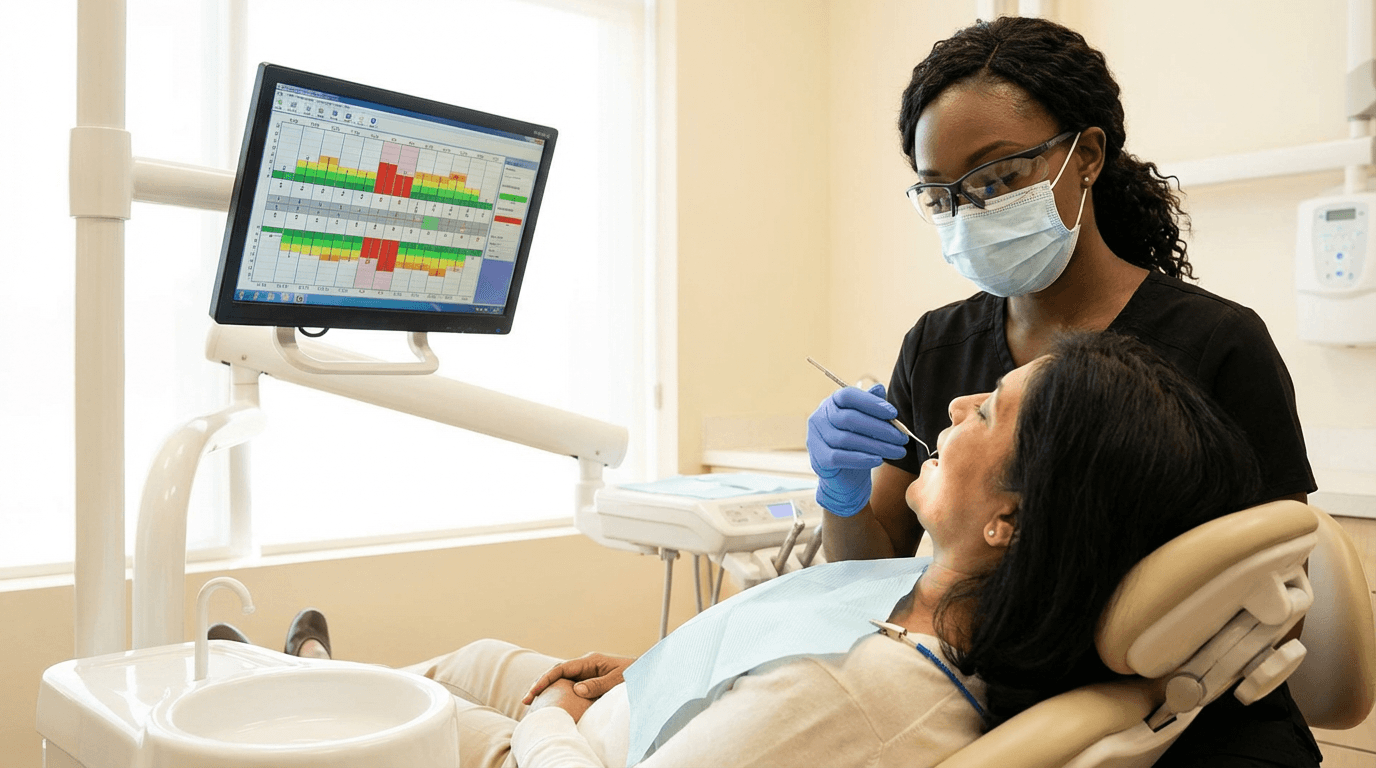
Probing depths are recorded in millimeters at six surfaces per tooth, and depths of 4mm or greater signal potential pathology worth tracking. Bleeding on probing is marked site-by-site and is one of the clearest indicators of active inflammation. A chart without BOP data is an incomplete clinical record.
Furcation classifications (Class I, II, III) tell the clinician how far disease has progressed into the root structure of multi-rooted teeth. Mobility scores and recession measurements complete the picture. Color coding varies by software, but the clinical meaning is standardized: red or filled circles typically indicate bleeding, and deeper pockets are often shaded to draw attention to areas of concern.
The Periodontal Charting Codes That Affect What You Get Paid
D4341 and D4342 cover scaling and root planing by quadrant. Both require documented probing depths to support medical necessity. D4342 applies specifically to quadrants with fewer than four teeth.
D4910 (periodontal maintenance) is one of the highest-volume recurring codes on a hygiene schedule. Payers audit it. A chart that shows disease history, prior active treatment, and current probing depths is what keeps those claims clean. D0180 (comprehensive periodontal evaluation) requires a full-mouth probing record. Practices that abbreviate charting on this code are billing without the documentation to back it up.
Overjet's AI-powered analysis flags radiographic bone levels and calculus that correlate with clinical findings in the perio chart. When a payer questions an SRP claim, that second data layer is the difference between a clean approval and a back-and-forth.
What a Full Periodontal Charting Appointment Looks Like
A complete full-mouth perio chart covers 168 probing sites across 28 teeth. At a realistic pace, that's eight to twelve minutes of continuous measurement and recording before the hygienist has moved to anything else in the appointment.
The standard workflow requires two people or one person stopping to type between measurements. Either way, something slows down.
Overjet Voice AI removes the keyboard from this step entirely. Your hygienist calls out measurements the same way she always has. The chart fills itself. No second person required, no pause between probing and recording. In practices with multiple hygienists, every provider charts the same way, every time. The workflow makes provider consistency automatic.
Why Your Existing Charting Workflow Is Harder to Defend Than You Think
If a hygienist is calling out numbers while an assistant types, that assistant isn't doing anything else. If the hygienist is self-charting, she's stopping her hands to hit keys, and neither version is free.
Voice AI removes one physical step from the clinical workflow. Your hygienist still probes. She still calls out the number. Calling it out is the whole job now. Dr. Alap Choksey of Corner Dental put it directly: "It's really freed up team members to do other things than just charting. It's allowing us to be more patient-centric and really focus in on the conversation."
For practices running two to five hygienists, the time recovered adds up across every perio appointment on the schedule.
How Overjet Connects the Perio Chart to the Radiograph
Overjet's FDA-cleared AI detects and measures bone levels and calculus on radiographs, catching bone loss not yet reflected in probing depths and surfacing findings that add clinical context to the perio chart. For practices actively managing payer relationships, this means the clinical record and the radiographic record are telling the same story. That's exactly what a payer wants to see before approving an SRP claim.
Book a demo to see how Overjet Voice AI cuts charting time per appointment.
Periodontal Charting FAQs
What periodontal charting codes are required to support SRP claims?
D4341 and D4342 cover scaling and root planing by quadrant. Both require documented probing depths to support medical necessity. D4342 applies specifically to quadrants with fewer than four teeth.
How many probing sites are in a full-mouth periodontal chart?
A complete full-mouth perio chart covers 168 probing sites across 28 teeth. Probing depths are recorded in millimeters at six surfaces per tooth.
What documentation does D4910 periodontal maintenance require?
D4910 (periodontal maintenance) is one of the highest-volume recurring codes on a hygiene schedule. Payers audit it. A chart that shows disease history, prior active treatment, and current probing depths is what keeps those claims clean.