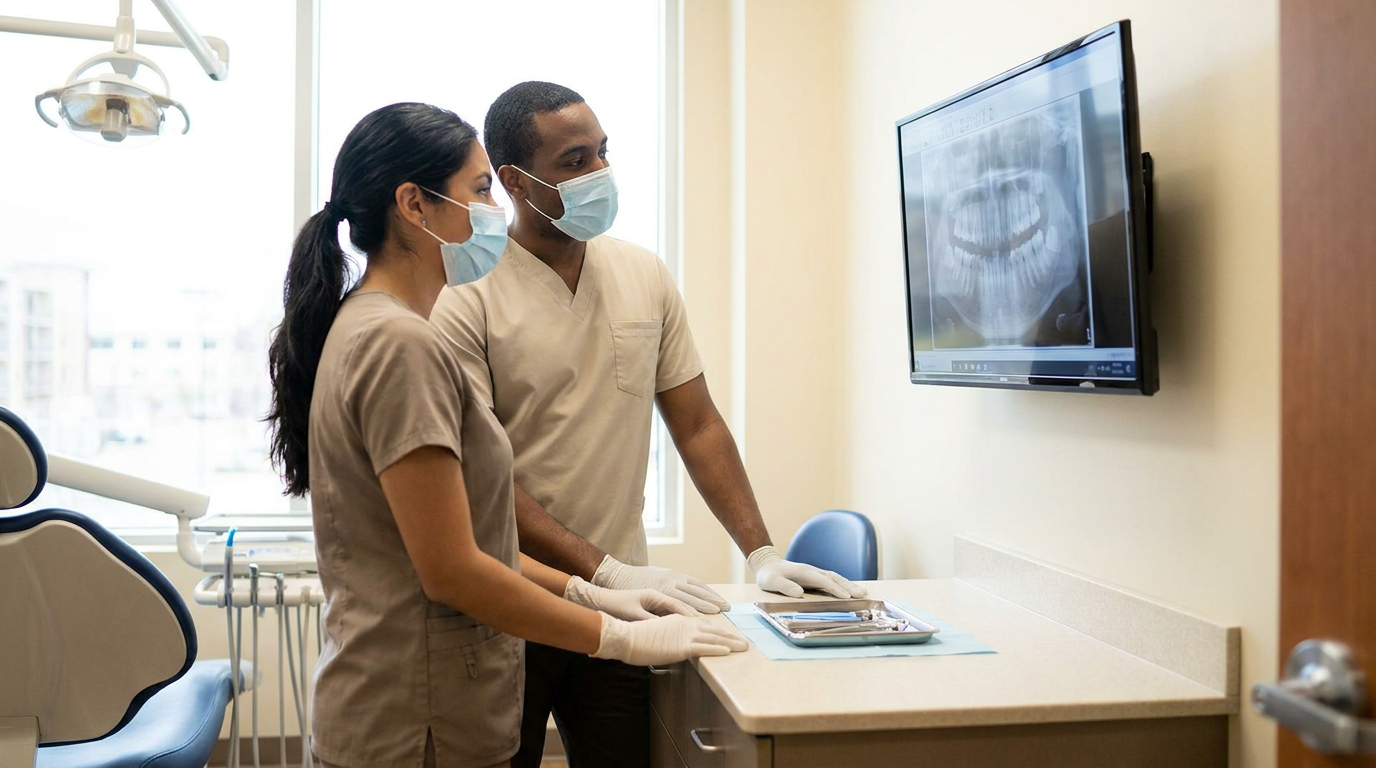








You're looking at a bitewing. There's something there. Could be early interproximal decay, could be an artifact. In a multi-doctor practice, you might walk it down the hall. In a solo practice, you make the call yourself. Either way, you're working without a net.
That's the situation Vision AI was built for. It reviews every x-ray with the same AI-assisted analysis, every time, so the findings that are easy to second-guess get a second set of eyes whether or not another clinician is available.
The problem with "gut check" dentistry
Solo practitioners already know this feeling. A grey-area finding, no colleague to consult, and a patient in the chair waiting for an answer. Most of the time, clinical instinct is enough. But instinct isn't consistent, not across a long day, not across providers, not across locations.
In multi-doctor practices, the problem takes a different shape. Two providers look at the same x-ray and reach different conclusions. There's no tiebreaker. The patient gets one answer or the other based on who happened to be in that room that day.
Patients are noticing. More of them arrive having already researched their symptoms, and more of them ask whether the recommended treatment is really necessary. A practice with AI-assisted review built in doesn't have to fumble that question.
How Vision AI reviews every image
Vision AI detects and measures findings on dental radiographs, caries, bone levels, calculus, and more, with sub-millimeter precision. It runs on every x-ray, not just the ones that already look questionable. The clinician still diagnoses. The AI surfaces what's there and quantifies it so the diagnosis starts from objective data.
That consistency is backed by 11 FDA clearances, more than any other dental AI company. When Vision AI flags a finding, it isn't an alert that something might be wrong. It's a measurement, with the clinical specificity to support what comes next.
What comes next includes the patient conversation. The same visualization that surfaces the finding can be turned toward the patient, showing them what you're seeing in a format they can understand. Case acceptance at practices using Vision AI is up 25% on average, and patients seeing the evidence directly is a big part of why.
Documentation follows the same path. When a finding is detected and visualized, that record exists, for insurance submissions, for continuity across providers, for the chart that protects the practice if a question comes up later.
What patients are starting to expect
A patient challenging a diagnosis is asking whether what they were told was right. That's a reasonable question, and at most practices the honest answer is that it depended on who they saw and what that provider noticed that day.
Vision AI changes that answer. When AI reviews every image, every finding was flagged, measured, and documented before the treatment conversation started. Patients who arrive skeptical tend to leave more certain. Practices that can point to a consistent clinical review process build the kind of trust that shows up in referrals.
Book a demo
Consistent AI-assisted review used to mean finding another clinician. Vision AI runs on every x-ray, without adding steps to how your practice already works. Book a Demo to see how it fits.
FAQs
What is AI-assisted radiograph review in dentistry?
AI-assisted radiograph review is an automated analysis of dental x-rays by FDA-cleared software that detects and measures clinical findings — caries, bone loss, calculus, and others — independent of the treating clinician's initial read. Every image gets a consistent look, regardless of who's in the chair or how busy the schedule is.
How does Overjet Vision AI review dental radiographs?
Vision AI analyzes dental radiographs and detects findings with sub-millimeter precision, backed by 11 FDA clearances. It runs on every image automatically, surfacing what's present and quantifying it so the clinician can review objective data before making a diagnosis. The AI detects and measures, the dentist diagnoses.
Can AI-assisted review help when providers in the same practice disagree on a diagnosis?
Yes. When two providers reach different conclusions on the same image, Vision AI provides a consistent, objective data point, the same analysis it would run for any clinician, on any x-ray. It doesn't replace clinical judgment, but it gives both providers something concrete to work from instead of two competing reads with no reference point.
Do patients question dental diagnoses they receive?
Increasingly, yes. Patients who research symptoms before appointments often arrive with questions about whether a recommended treatment is necessary. A practice using Vision AI can show patients the AI-detected findings directly, the same visualization the clinician reviewed, which tends to answer the question more effectively than a verbal explanation alone.