




The Challenge: Rigid Templates, Lost Context, Lost Revenue
Total Dental Care of Lake Norman isn't a small shop. The practice runs 16 operatories staffed by 3 doctors and 8 assistants, covering everything from oral surgery and implants to holistic dentistry and ortho. Hygienists see patients in staggered 30-minute blocks. The pace is relentless.
For years, the team relied on manual note-taking and fill-in-the-blank templates to keep up. In theory, the templates kept things consistent. In practice, they left gaps—especially when it came to capturing what the patient actually said during the visit. The clinical shorthand got the basics down, but the context around a patient's concerns, symptoms, and history was routinely lost in the shuffle.
That missing context created two problems. First, it weakened the clinical record. Second, it cost the practice money. Incomplete narratives meant insurance carriers kicked claims back for additional information—or denied them outright.
Clinic Manager Kimberly Popp saw the downstream effects daily. Before Overjet Voice, she recalls, the team was "constantly backtracking" — chasing down doctors to finish notes, filling in missing details after the fact, and spending time at the end of the day on charting catch-up that should have been handled in the room.
"It used to be that we would have to go to the doctors and say, 'Hey, you didn't get that note done for our 2:00 o'clock.' It was constant backtracking to make sure every little detail was there."
The Solution: Overjet Voice Across Every Operatory
Total Dental Care deployed Overjet Voice in all 16 operatories, replacing manual documentation with an AI-powered clinical listening tool. Voice works by capturing the natural conversation between provider and patient, filtering out the small talk, and generating a detailed clinical narrative in real time.
The practice had two goals: take the documentation burden off clinical staff and build notes robust enough to stand up to insurance scrutiny.
What changed in the workflow
The AI learned each provider's style. Voice was trained to recognize the specific terminology and rhythms of each doctor—particularly important for Dr. Davidson's complex oral surgery cases, where precise language matters.
Templates gave way to narratives. Rather than checking boxes, the AI captures the full clinical picture, including the patient's own words. Popp points to this as one of the biggest shifts: "The notes are very detailed. We used to have templates where we just filled in the blanks, but this captures the patient side of the story—which is really nice, because sometimes that part was being missed."
Hygienists stayed focused on the patient. Perio charting—calling out pocket depths and bleeding points—now happens through voice commands that the AI records in seconds. Hygienists no longer have to stop, turn to a screen, and type.
The Impact: Faster Reimbursement, Stronger Records, Happier Staff
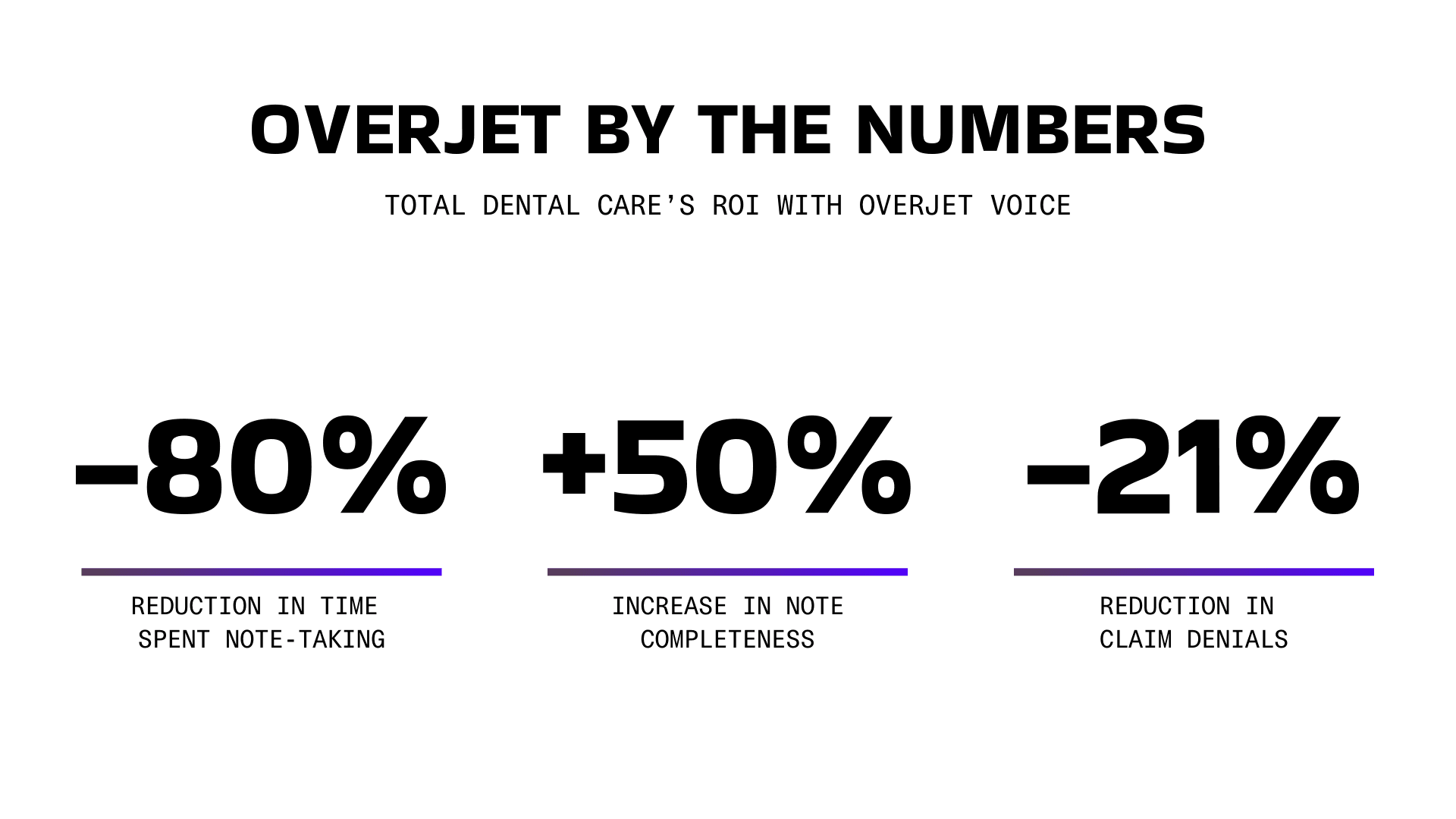
The difference between the old workflow and the new one shows up most clearly in the revenue cycle. Cordero, who manages the practice's insurance relationships, used to spend a significant portion of her week fielding requests from carriers who wanted more detail or rejected claims for thin documentation. With AI-generated narratives now backing every claim, those follow-up requests have dropped sharply—and denials are down 21%.
"The amount of claims that have come back to me pending additional information, or denied because of incomplete narratives—that has come down significantly."
The quantitative results tell a clear story: the practice cut note-taking time by 80% and saw a 50% jump in note completeness. But the qualitative changes matter just as much. Assistants and hygienists aren't staying late to finish charting. Popp no longer has to track down doctors for missing notes. And the clinical record now reflects what actually happened in the room—not just the parts that fit neatly into a template.
The team also credits Overjet's onboarding and ongoing support as a major factor in the rollout's success. Adopting AI across 16 rooms with a large clinical staff is no small undertaking, and both Cordero and Popp describe the support experience as "phenomenal."
Why It Matters
For large, high-volume practices, documentation isn't just a compliance checkbox—it's the foundation of the revenue cycle. When notes are incomplete, carriers push back. When carriers push back, reimbursement slows down. Total Dental Care's experience shows what happens when you close that gap: fewer denials, faster payments, and a clinical team that can focus on patients instead of paperwork.
Ready to learn more about how Overjet Voice can support your practice?
Book a demo here.