







The Documentation Gap Is Costing You Before Billing Sees It
Your hygienists are doing the clinical work correctly. The perio findings are real, the SRP is indicated, and the treatment is delivered, yet the claim still comes back denied.
SRP claims fail at first submission when probing documentation is incomplete, periodontal diagnosis codes are inconsistently applied, or CDT mapping doesn't align with payer criteria. The clinical work and the documentation are separate problems, and most DSOs are solving only one of them.
When there's no shared standard embedded in the charting workflow, hygienists across your locations produce different documentation outcomes from the same clinical work. One office captures SRP consistently while another with a similar patient mix doesn't, and the difference is rarely clinical skill. The denial queue grows, appeals consume time that should go to clinical coaching, and hygiene production targets absorb write-offs that were never inevitable.
What Inconsistent Perio Documentation Actually Costs
Perio screening inconsistency suppresses hygiene production at every location where a case goes undetected or underdocumented. The cost includes denied claims, SRP cases that were never captured because the documentation didn't support a diagnosis, and treatment that was accepted but never billed cleanly enough to survive payer review.
Ninety-one percent of dentists found more periodontal disease with AI-assisted detection. That figure means hygienists working at the current documentation standard are leaving diagnosable perio cases undocumented across your locations. Each one is a missed SRP opportunity and a gap in the clinical record that can't be defended on appeal.
No shared standard travels with the hygienist from location to location. Probing depth thresholds, periodontal diagnosis codes, and CDT mapping are applied differently by different clinicians, and the charting workflow doesn't correct for that variability before the claim is submitted. By the time billing identifies the denial pattern, the documentation window has closed.
SRP denial rates are a documentation consistency problem. They're measurable by location using perio screening data, which is where the correction path begins.
The Benefits of Standardizing Documentation at the Point of Care
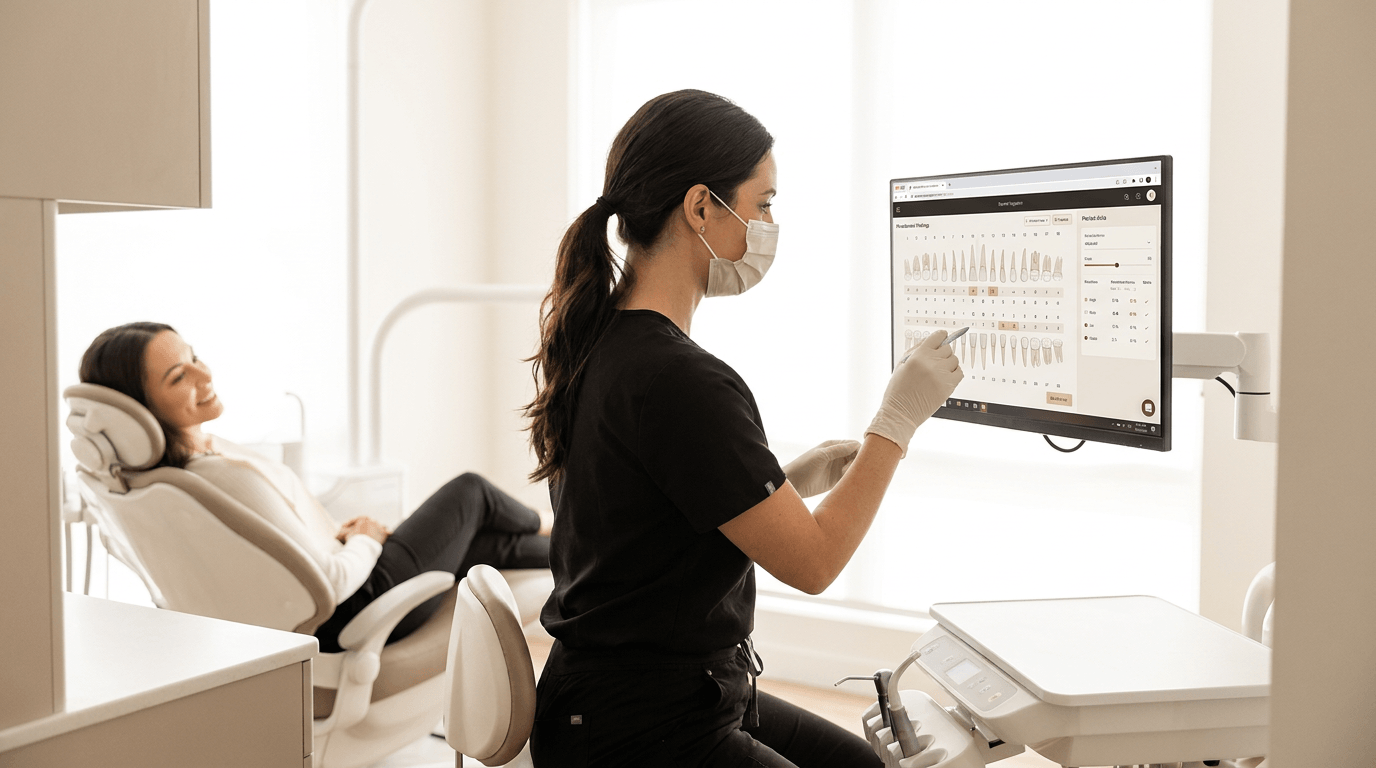
Standardizing perio documentation and CDT mapping inside the existing charting workflow prevents SRP denials before submission. Hygienists who receive real-time guidance on probing, diagnosis, and coding produce claims that pass on first submission without adding steps to the appointment.
Overjet's hygiene-first checker is FDA-cleared and integrates with the existing charting workflow to give hygienists real-time guidance on probing documentation, periodontal diagnosis, and CDT code mapping before the claim is submitted. FDA clearance means the detection and measurement standard embedded in the workflow meets the clinical evidence threshold required for use in patient care decisions. That's the same threshold payers apply when reviewing medical necessity.
The checker operates at 0.35mm precision in probing measurement. Documentation at that level of specificity meets payer criteria for medical necessity and removes the most common basis for SRP denial. Every hygienist at every location works from the same probing standard, so the claim that leaves one office is built the same way as the claim that leaves another.
This works with existing hygiene protocols. The guidance appears at the moment of documentation, inside the system hygienists are already using, without a parallel workflow or a separate login.
Increase First-Pass Claim Acceptance and Decrease Appeals
A hygiene-first checker embedded in the charting workflow gives every hygienist the same CDT mapping guidance at the point of care, so claims are standardized before submission. The consistency is measurable: perio screening rates and SRP case capture are trackable by location from the first week of use, along with first-pass claim acceptance.
When documentation is standardized at the point of care, claims reach the payer complete on first submission and the appeals queue shrinks without additional administrative staffing. DSOs using this approach see claims decisions move five times faster, because complete documentation doesn't require back-and-forth with the payer to establish medical necessity.
The 15 to 25% increase in treatment acceptance associated with AI-assisted visualization compounds the production impact. Hygienists who can show patients their perio findings in real time close more SRP cases, and those cases are documented to the standard required for clean billing from the moment of diagnosis.
First-pass claim acceptance rates and appeals volume connect hygiene production targets to documentation quality. Both are trackable from day one, so the ROI is a measurement, not a projection.
Reduce Your SRP Denial Rate
If your SRP denial rate is above 5%, the correction starts in the charting workflow, at the moment a hygienist documents probing findings and assigns a periodontal diagnosis.
Perio screening consistency is now measurable across your offices. The data will show you which locations are capturing SRP cases at the rate their patient mix supports and which aren't. That comparison is the internal case for standardization, and it's available before any implementation decision is made.
Schedule a call to see how Overjet's hygiene-first checker integrates with your current workflow and what your perio screening data looks like across locations.
Here's What Hygiene Leaders Ask Us Most
How does this reduce SRP denials specifically?
Most SRP denials originate in incomplete probing documentation or CDT codes that do not align with the documented periodontal diagnosis. The checker flags those gaps before the claim is submitted, so the documentation that reaches the payer is complete on first pass.
What makes the probing standard defensible to payers?
Overjet is FDA-cleared, and the probing measurement operates at 0.35mm precision. That level of specificity meets the medical necessity threshold payers apply when reviewing SRP claims, which removes the most common documentation basis for denial.
How do we measure whether it is working?
First-pass claim acceptance rates, SRP case capture by location, and appeals volume are all trackable from the first week. Perio screening consistency across locations is measurable before and after implementation, so the comparison is direct.