








Updated: September 2026
To increase dental case acceptance, lead with a visual instead of a verbal explanation: show patients their condition on an annotated X-ray, explain it in plain language, present transparent cost and payment options, and keep the presentation consistent across every provider. Most patients hesitate because they cannot see or understand the problem, not because they disagree with the diagnosis.
Dental case acceptance is the rate at which patients agree to the treatment a dentist recommends. It is one of the most important drivers of practice growth, because diagnosing a condition is only half the work; patients must also trust the diagnosis and commit to the plan.
In this article, you'll learn what stops patients from accepting treatment, which strategies actually raise acceptance, the specific chairside tactics and scripts that work, and how AI-powered imaging supports each step.
Key takeaways
Most barriers to acceptance are about communication, not clinical need.
Practices using Overjet report a 25% increase in case acceptance (Overjet Patient Survey 2025).
72% of patients say they would be more likely to accept treatment when shown AI findings on their own X-ray (Overjet Patient Survey 2025).
Routine treatment typically closes around 70–80%; comprehensive plans over $3,000 often sit at 30–50% (DentistryIQ).
Show the X-ray first, name the condition plainly, state the consequence of waiting, quantify it, then offer a payment path.
With platforms like Overjet Dental AI, practices can improve how they communicate with patients, build trust, and raise case acceptance.
Practices using Overjet report a 25% increase in case acceptance after making annotated imaging a standard part of every consultation. In Overjet's 2025 patient survey, 85% of patients said they would feel more confident in a diagnosis they could see for themselves. Source: [Overjet Patient Survey 2025](https://www.overjet.com/blog/the-overjet-patient-survey-what-do-we-really-think-about-the-dentist-).
What stops patients from accepting treatment?
Most barriers to case acceptance are not clinical. They come from how information is communicated, understood, and trusted: confusing explanations, no visual evidence, doubts about the diagnosis, and mixed messages between providers.
Improving dental case acceptance begins with recognizing the key reasons why patients often hesitate or decline treatment.
One major obstacle is confusing communication. Dentists and team members are often fluent in clinical terminology, but patients may find medical jargon overwhelming. When patients don't fully grasp their diagnosis or the urgency of treatment, they are far less likely to move forward.
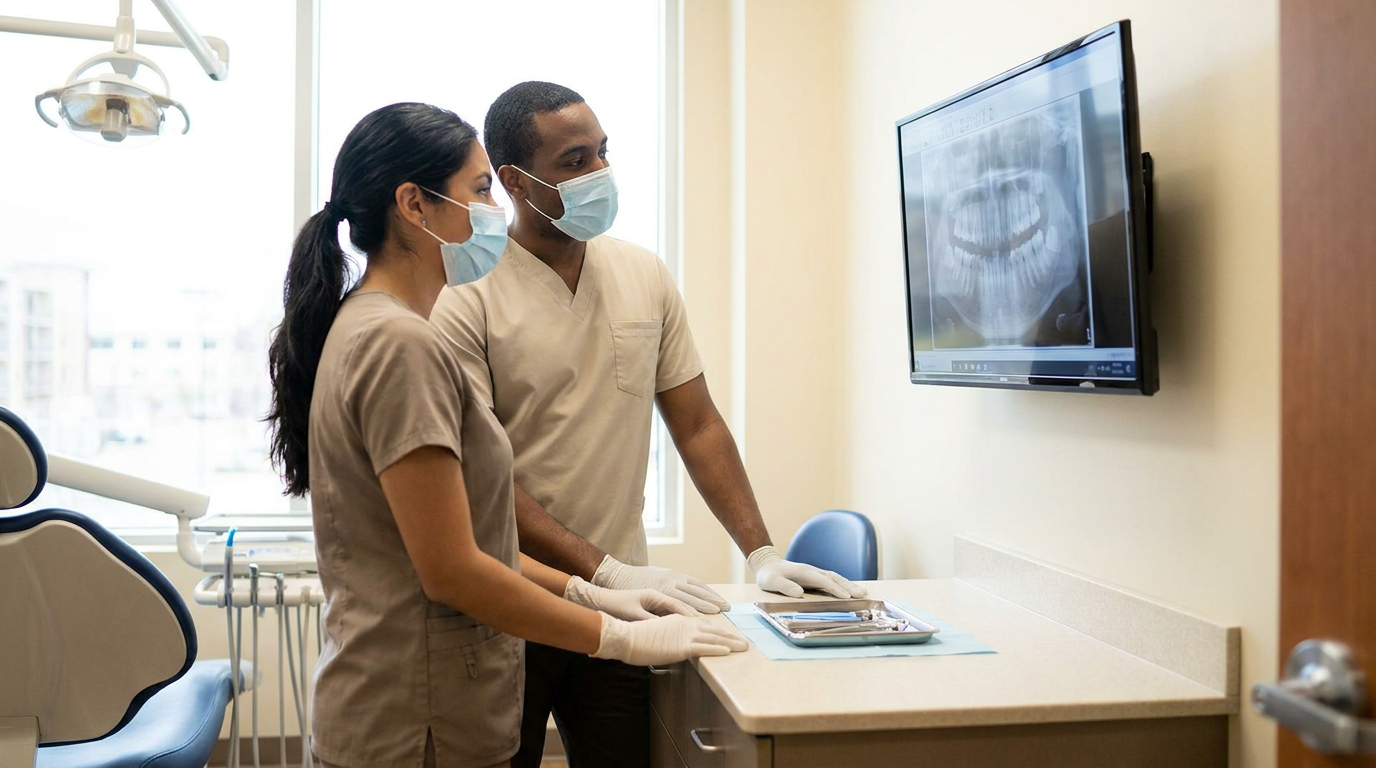
Another common challenge is the lack of visual evidence. Simply describing a problem verbally or pointing to a gray shadow on an X-ray isn't enough. If patients can't clearly see and understand the issue for themselves, they may doubt whether treatment is truly necessary.
Trust gaps also play a significant role. If the diagnosis feels subjective or varies between different providers, patients may become skeptical. They might look for another provider's review—or worse, delay care altogether.
Lastly, provider inconsistency can undermine confidence. When explanations and treatment recommendations vary between clinicians within the same practice or DSO, it creates confusion and erodes patient trust in the practice's standards.
Barriers to acceptance and how Overjet addresses them
Barrier to acceptance | What it sounds like | How Overjet addresses it |
|---|---|---|
Confusing explanation | "I didn't really follow what they said" | Plain-language summary paired with the annotated X-ray |
Can't see the problem | "It just looks like a gray smudge" | Color-coded overlays mark decay, bone loss, and calculus |
Doubts the diagnosis | "Is this really necessary?" | Exact measurements give objective radiographic evidence |
Mixed messages between providers | "My last dentist never mentioned this" | The same AI analysis standardizes findings across every provider |
Overcoming these barriers requires more than good intentions—it requires better communication strategies and smarter tools, like AI-powered imaging solutions from Overjet that make diagnosis clear, consistent, and trusted.
Which strategies actually raise case acceptance?
The strategies that move the needle are simplifying communication, using visuals, building trust through transparency, standardizing presentations across providers, and educating patients on the cost of waiting. Boosting dental case acceptance doesn't require a complete overhaul of your practice—it starts with implementing a few targeted, high-impact strategies. When teams focus on communication, consistency, and patient education, they create an environment where patients feel informed, empowered, and confident in accepting treatment recommendations.
Here are the proven methods that drive results:
Simplify Communication
Patients don't need complex terminology—they need clarity. Using plain language to explain diagnoses and treatments helps patients better understand their conditions and the necessity of recommended care without feeling overwhelmed.
Use Visuals
A picture is worth a thousand words. Incorporating visual aids, especially annotated dental images, allows patients to see the problem areas themselves. This direct visualization fosters a stronger emotional connection and a greater sense of urgency to proceed with treatment. For the full method, see our guide to AI dental X-ray analysis.
Build Trust Through Transparency
Objective evidence builds credibility. By presenting findings in a clear, consistent, and data-supported manner, providers position themselves as trusted advisors rather than just salespeople.
Standardize Treatment Presentations
Consistency is key. Training all providers and treatment coordinators to deliver diagnoses and treatment options using a standardized approach minimizes confusion and reinforces patient trust across the organization.
Empower Patients with Knowledge
Patients are more likely to act when they understand the consequences of inaction. Taking time to educate patients about the progression of dental disease and the benefits of timely, preventive care empowers them to make informed, confident decisions.
By combining these strategies—and using tools like Overjet's AI-enhanced imaging—practices can dramatically increase case acceptance while delivering a superior patient experience.
A 5-step chairside script for case presentation
Use this sequence in every consultation. Each step is liftable on its own, and each comes with a sample line you can say verbatim.
Show before you tell. Open the annotated X-ray first. Script: "Let me show you exactly what I'm seeing on your X-ray."
Name the condition in plain words. Script: "This dark area is decay that has reached the layer under the enamel."
State the consequence of waiting. Script: "If we wait, this is likely to reach the nerve and need a root canal instead of a filling."
Quantify it. Script: "The bone level here has dropped 3 millimeters compared to healthy."
Offer the path, not just the price. Script: "Here are three ways patients usually handle the cost of this."
How Overjet's Dental AI Helps Increase Case Acceptance
Overcoming the barriers to case acceptance requires more than just better communication—it demands smarter tools that enhance understanding, build trust, and deliver objective radiographic evidence. This is where Overjet Dental AI excels.
By transforming how diagnostic information is presented and discussed with patients, Overjet helps practices break through the confusion and skepticism that often lead to treatment delays or refusals.
Key Ways Overjet Boosts Case Acceptance:
AI-Powered Visual Overlays: Overjet highlights areas of concern such as caries, bone loss, and other conditions directly on dental radiographs. Patients can see their diagnosis, making the condition—and the need for treatment—more tangible and urgent.
Objective, Consistent Diagnostics: Overjet's real-time, AI-driven insights remove subjective variability across providers. This consistency strengthens patient trust and ensures that every patient receives a clear, standardized explanation of their dental health.
Patient-Friendly Imaging: With annotated visuals designed for easy comprehension, patients are more engaged in their care decisions and feel confident about proceeding with recommended treatments.
Instant, Real-Time Analysis: Overjet delivers insights immediately during the appointment, allowing providers to present findings clearly and maintain strong momentum toward case acceptance.
Provider Performance Tracking: Overjet's analytics tools help DSOs and practices monitor and optimize case acceptance rates across providers and locations—ensuring continuous improvement.
With Overjet, every case presentation becomes a compelling, educational conversation that motivates patients to act—leading to healthier smiles and stronger practice growth.
Real-World Results: Overjet in Action
The results of implementing Overjet Dental AI are not just theoretical—they're real, measurable, and happening in practices and DSOs nationwide. Practices that incorporate Overjet into their workflows consistently report improvements across multiple key areas.
Here's what practices are seeing after adopting Overjet:
Measurable Improvements:
A 25% increase in case acceptance reported by practices using Overjet, driven by clearer patient communication and stronger trust (Overjet Patient Survey 2025).
Stronger diagnostic confidence among providers, with real-time AI insights supporting faster, more precise clinical decision-making.
More standardized treatment recommendations across providers and locations, reducing variability and enhancing consistency of care across DSO networks.
Greater patient trust and satisfaction, leading to stronger long-term retention, higher patient loyalty, and more frequent referrals.
By empowering providers with AI-supported imaging and delivering clear, compelling visuals to patients, Overjet transforms every treatment presentation into an opportunity for better outcomes—for both the patient and the practice.
Best Practices for Implementing AI to Boost Case Acceptance
Successfully integrating Overjet's Dental AI into your practice isn't just about installing new technology—it's about fully embedding it into the patient experience. When used strategically, AI becomes a powerful tool to strengthen trust, enhance understanding, and dramatically boost case acceptance.
Here's how to maximize results with Overjet:
Best Practices:
Train Clinical and Front-Desk Teams: Ensure that everyone involved in patient consultations understands how to use Overjet's AI visuals. From dentists to treatment coordinators, your team should be able to confidently explain findings using annotated radiographs.
Incorporate AI Overlays into Every Presentation: Consistency is key. Use Overjet's real-time overlays during every treatment presentation to visually reinforce clinical findings and drive home the urgency of care.
Use AI as an Educational Tool: Go beyond diagnosis. Show patients their progress over time by comparing previous and current radiographs, highlighting improvements—or areas needing attention—with Overjet's visuals.
Track Key Metrics: Utilize Overjet's built-in performance dashboards to monitor case acceptance rates, provider consistency, and patient communication trends. This allows practices and DSOs to continually refine their approach and celebrate areas of improvement.
By making Overjet's AI-enhanced imaging an integral part of how you communicate with patients, you don't just modernize your workflow—you build stronger trust, improve clinical outcomes, and drive sustainable practice growth.
Increase Case Acceptance and Build Patient Trust with Overjet
Dental case acceptance is essential to clinical success and practice profitability. Practices that use modern tools like Overjet's AI-powered imaging don't just diagnose better—they communicate better, educate better, and inspire patients to take action.
Overjet delivers the clinical support, patient-facing visuals, and operational insights practices need to maximize case acceptance, improve care delivery, and grow with confidence.
Increase case acceptance with AI — Book a demo
FAQs About Increasing Dental Case Acceptance
How does dental AI help with case acceptance?
Dental AI provides visual, objective evidence of dental conditions, making it easier for patients to understand their diagnosis and accept recommended treatments.
Will AI imaging replace dentist explanations?
No. AI supports the clinician by enhancing the clarity of conversations but doesn't replace the personal interaction essential to patient trust.
Can Overjet integrate into my current imaging system?
Yes. Overjet integrates with major imaging and practice management platforms, minimizing disruption.
Is Overjet only for large practices and DSOs?
No. Overjet's solutions are scalable for solo practices, group practices, and large DSOs alike.
How quickly can I expect to see improved case acceptance with Overjet?
Many practices report noticeable increases in case acceptance within the first few months of using Overjet's AI-enhanced imaging tools.
How do you increase dental treatment acceptance rates?
Lead with a visual, not a verbal explanation. Show patients their condition on an annotated X-ray, use plain language, present transparent cost and payment options, and keep presentation consistent across every provider. Practices using Overjet report a 25% increase in case acceptance after making annotated imaging a standard part of every consultation.
What is a good case acceptance rate for a dental practice?
Routine treatment typically closes around 70–80%, while comprehensive plans over $3,000 often sit at 30–50%. The gap is rarely clinical. It comes from how clearly the patient understands the problem and the cost. Closing it depends on visual evidence and transparent financial conversations more than on the diagnosis itself.
Related guides
Mario Paganini
Mario Paganini is the Senior Vice President of Marketing at Overjet, where his focus is making dental AI the industry standard for oral health. He is a four-time head of marketing — leading two startups to unicorn status and one through exit. Outside of work, Mario is a competitive ultramarathon runner, eats more vegetables than you, and is way better at basketball than he looks.