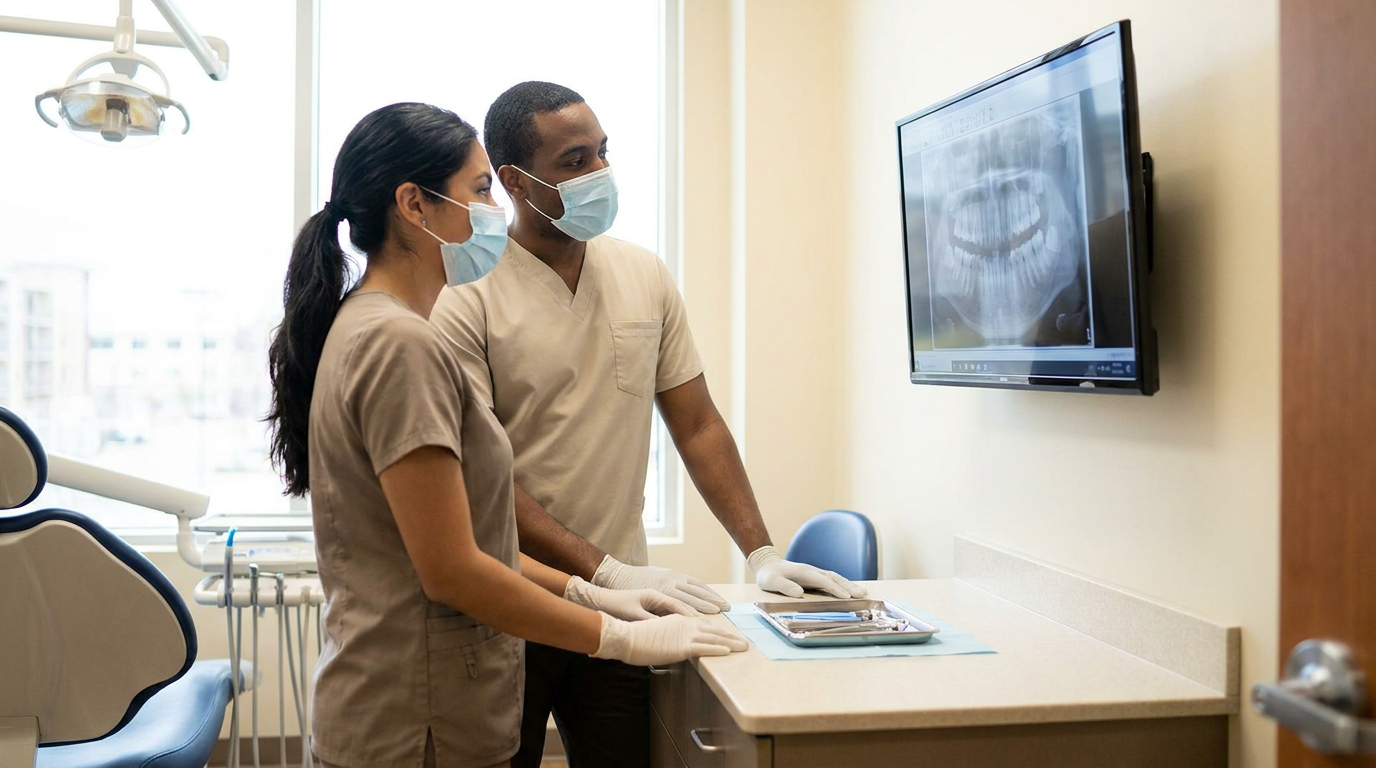









You explained the crown. You showed the X-ray. The patient nodded, then said they wanted to "think about it." Most treatment plans do not fail because the diagnosis is wrong. Rather, they fail because the patient cannot see what you see. This article covers how stronger dental patient communication builds trust, and how letting patients actually see their own pathology turns "maybe later" into "let's do it."
Why do patients say no to treatment they need?
Your patient is not being difficult. They are looking at a gray X-ray that means nothing to them. A shadow near a molar and healthy bone look identical when you have never been trained to tell them apart. When someone cannot verify a problem with their own eyes, skepticism is a reasonable response, especially when there is a bill attached.
This is the core problem in dental patient communication. You have years of training and your patient doesn't.
How does trust-building start before the treatment plan?
Trust is built across the whole visit, not just at the moment you present a plan. A few habits move the needle:
Narrate as you go. Tell patients what you are checking and why, so findings do not arrive as a surprise.
Use plain language. "The decay has reached the nerve" lands better than "irreversible pulpitis."
Show, do not just tell. Point to the specific tooth on the image, not the mouth in general.
Connect the finding to their life. Explain what waiting costs them: more pain, a bigger procedure, and a higher bill later.
These are the fundamentals of dental patient education, and they are important. But words alone hit a ceiling when the patient still cannot read the evidence you are describing.
Let patients see what you see
One change reframes the conversation: instead of asking patients to trust your reading of the X-ray, start helping them read and understand it.
That is where Overjet Vision AI comes in. Vision AI is FDA-cleared software that detects and measures conditions on the radiograph, then color-codes findings like caries and bone loss right on the image. Your patient no longer sees a gray blur. They see the cavity highlighted, the bone level measured, and the problem outlined in a color they can point to.
The effect is immediate. As one hygienist described it: "One of the hardest parts of being a hygienist is when patients don't understand that they have periodontal disease. With Overjet, you can show them exactly where there is bone loss, and the measurements and colors on the X-rays create an a-ha moment. Now they get why they need treatment, which increases case acceptance and creates loyalty."
That a-ha moment is the whole point. The patient stops feeling sold and starts feeling informed.
Does clearer visualization actually improve treatment acceptance?
Yes, and the reason is simple. When a patient sees objective evidence of a problem, saying yes becomes their decision, not a leap of faith in yours. Overjet customers describe the difference directly. "I have seen my case acceptance skyrocket since using Overjet," says Dr. Okoro at DOA Steeplechase. The same tool sharpens diagnosis, too. "It helps us pick up areas I may not have seen without using Overjet," says Dr. Soares at Advanced Dental Care of Citrus Park.
Better treatment acceptance in a dental practice is not about pressure. It is about clarity. Give patients a clear view and they agree more often, because the evidence is in front of them.
The takeaway
Strong dental patient communication is part habit and part tooling. Keep narrating, keep translating clinical terms, and keep connecting findings to consequences. Then close the last gap by letting patients see their own X-rays the way you do. When the problem is visible, the conversation gets shorter and the answer gets easier.
See how Overjet Vision AI helps your patients understand their X-rays and say yes to the care they need. Book a demo.
Frequently Asked Questions
Why do patients say no to treatment they need?
Patients often decline treatment they cannot see for themselves. A radiograph is unreadable to an untrained eye, so a spoken recommendation can feel like an opinion. When the finding is shown on the patient's own image, agreeing to treatment becomes an informed decision.
How can a dentist improve dental patient communication?
Narrate findings during the exam, use plain language, point to the specific tooth on the image, and connect each finding to what waiting will cost the patient. Showing color-coded findings on the patient's own radiograph closes the gap that words alone cannot.
Does clearer visualization actually improve treatment acceptance?
Yes. When a patient sees objective evidence of a problem, agreeing to treatment becomes their own informed decision rather than an act of faith in the dentist. Overjet customers report higher case acceptance after showing patients color-coded findings on their own radiographs.
Results based on customers' experiences. Individual results may vary.