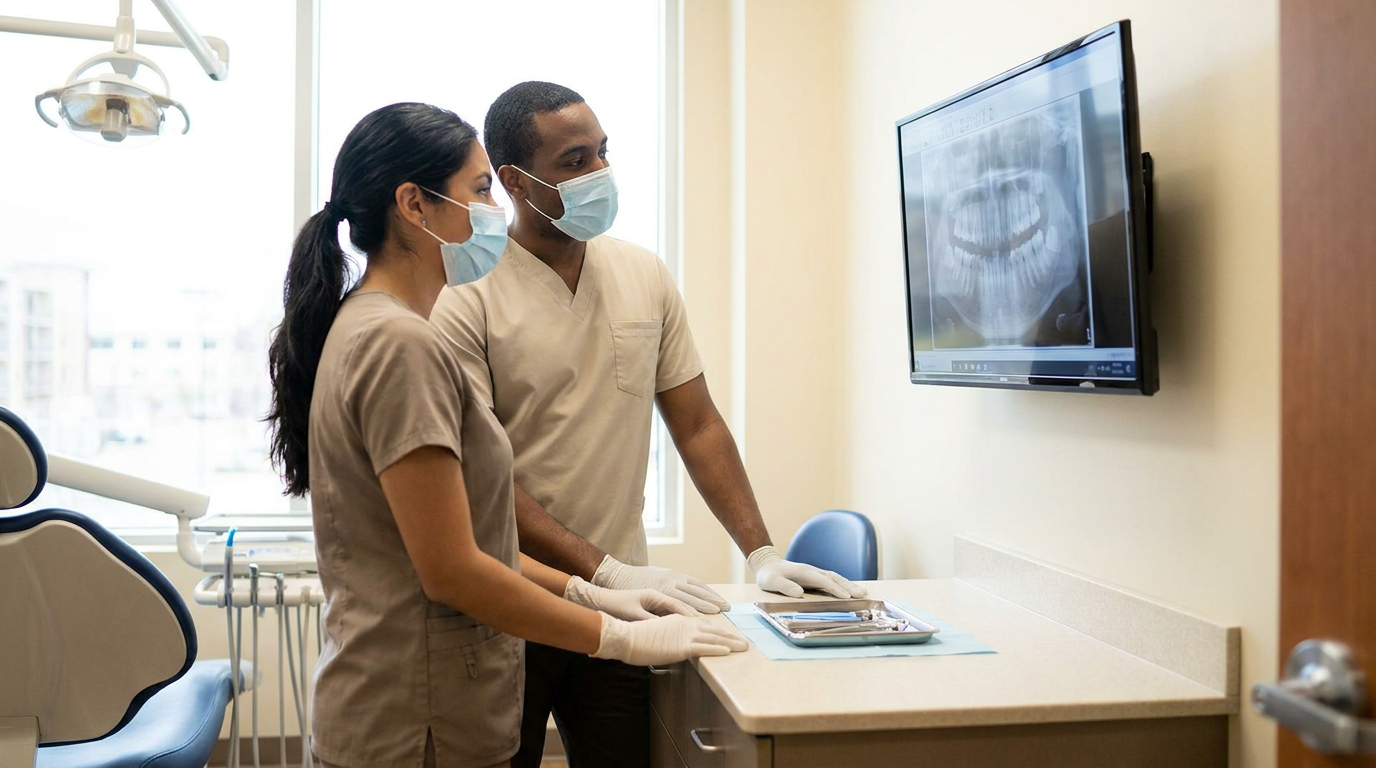





Multiple peer-reviewed studies show that AI detects approximal caries on bitewing radiographs with sensitivity that matches or exceeds a dentist reading alone. Across individual trials and pooled meta-analyses, the finding is consistent: AI works best as an objective second read that supports the dentist's diagnosis, not as a replacement for it.
TL;DR
Cantu et al. (2020) reported deep-learning accuracy of 0.80 versus 0.71 for dentists, and sensitivity of 0.75 versus 0.36 on the same bitewings.
A 2024 systematic review and meta-analysis of 21 studies found pooled AI sensitivity of 0.94 (95% CI 0.78 to 0.99) and specificity of 0.91 for approximal caries.
The same review recommends AI as a first-pass check under clinician supervision, not a replacement for the dentist.
Overjet's caries detection is FDA-cleared (510(k) K212519), and with its aid dentists detected 32% more tooth surfaces containing caries.
What does the research say about AI caries detection accuracy?
Cantu et al. (2020), published in the Journal of Dentistry (vol. 100, article 103425), trained a deep-learning model to read bitewings and compared it against dentists reading the same images. The model reached an accuracy of 0.80, compared with 0.71 for the dentists. On accuracy alone, that gap looks modest. The sensitivity gap is much larger.
How does AI compare to a dentist reading alone?
Compared to a dentist reading a radiograph alone, AI helps find more caries. In the Cantu study, the deep-learning model reached a sensitivity of 0.75 against 0.36 for the dentists reading the same bitewings, so the dentists caught only about a third of the lesions actually present. Early approximal decay hides between teeth and fades into the background of a long clinical day, which is the kind of signal an objective second read is built to catch.
Does the evidence hold up across studies?
The pattern is not limited to one study. A 2024 systematic review and meta-analysis in the Journal of Dentistry screened 2,442 studies and included 21, then pooled the results: AI reached a sensitivity of 0.94 (95% CI 0.78 to 0.99) and a specificity of 0.91 for approximal caries on bitewings. Earlier work in Scientific Reports (2021) reported similar strength on early-lesion detection, and a 2025 umbrella review with meta-analysis in PLOS One found the accuracy holds across a range of imaging modalities, not just one.
Where do the limits sit, and where does the clinician come in?
The same 2024 review found that positive predictive value swung widely from one study to the next, anywhere from 0.15 to 0.87, depending on the patient population and where each team set its detection threshold. Those swings usually trace back to how a given tool was trained and the images it was tested on. So the reviewers land where most dentists already sit: AI belongs in the workflow as a first-pass check the clinician supervises, not a stand-in for one. The software flags and outlines a suspected lesion. The dentist reads it against everything else happening in the mouth and makes the call.
How does Overjet's caries detection hold up?
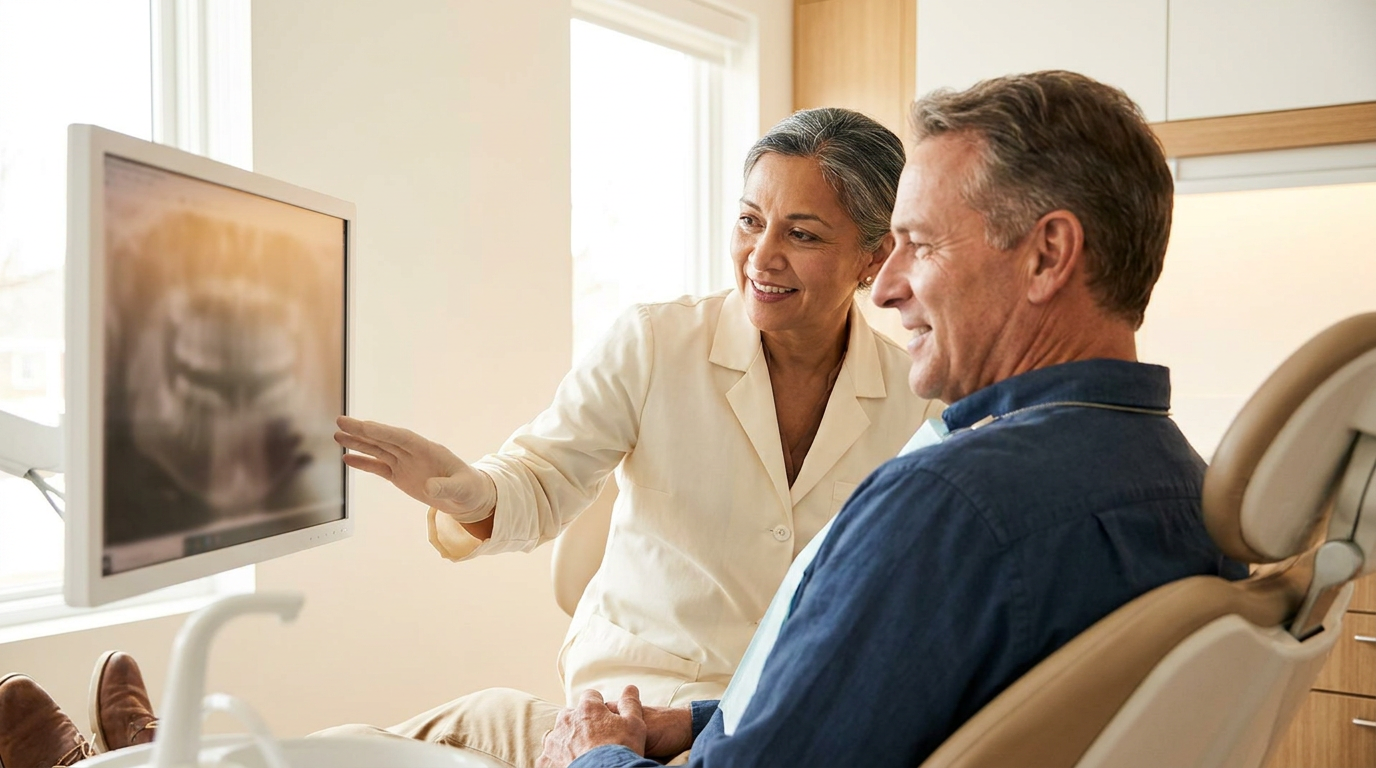
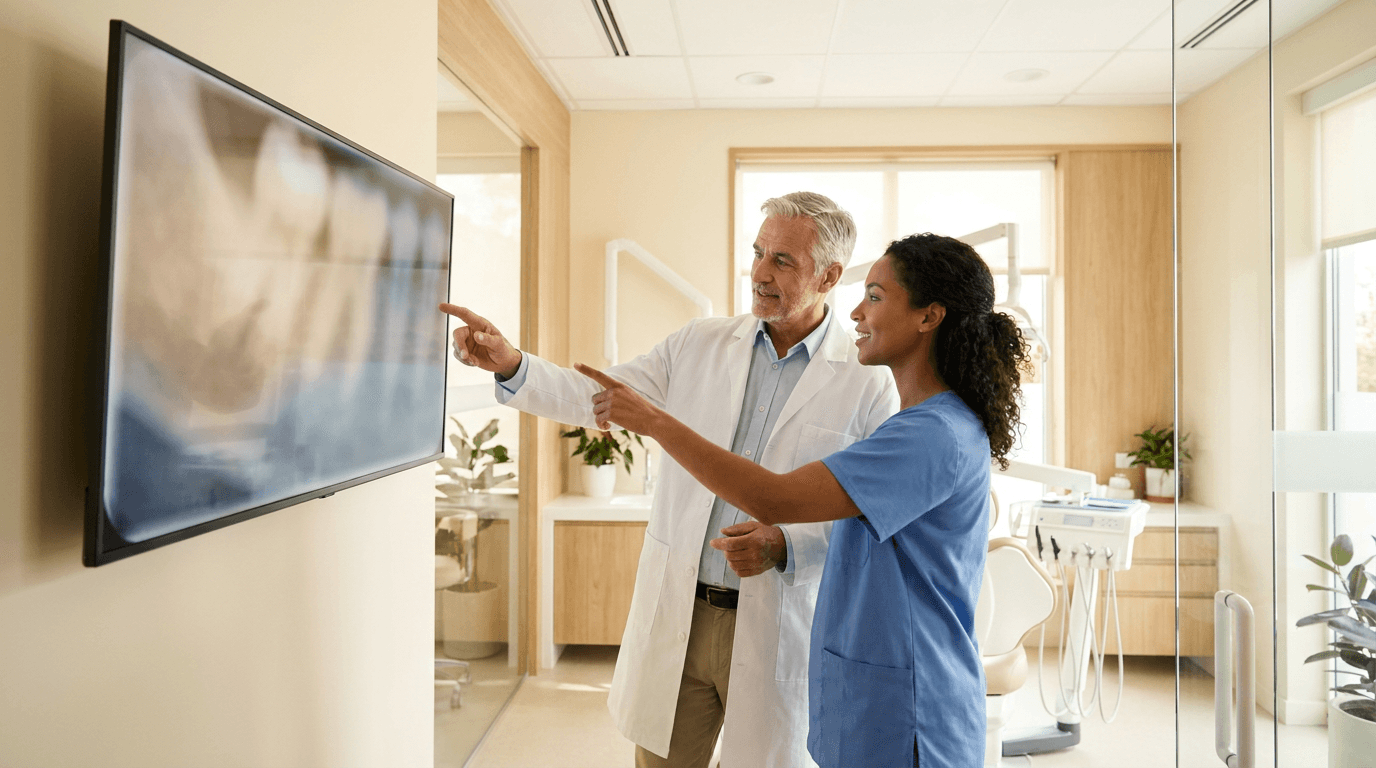
Overjet Vision AI analyzes bitewing and periapical radiographs to detect and outline caries directly on the image, so the dentist and the patient see the same objective finding. Overjet Caries Assist is FDA-cleared (510(k) K212519, cleared May 10, 2022). With the aid of Caries Assist, dentists detected 32% more tooth surfaces containing caries, according to Overjet's FDA clearance announcement. That better-than-90% figure is Overjet's own platform data, reported separately from the independent pooled results above. Overjet also reports better than 90% accuracy on its own platform data, which is the company's own figure and sits alongside the independent peer-reviewed studies above.
Caries AI FAQ
Does AI detect cavities accurately?
Yes. In Cantu et al. (2020), a deep-learning model reached a sensitivity of 0.75 for caries on bitewings, compared with 0.36 for dentists reading the same images. A 2024 meta-analysis of 21 studies reported pooled AI sensitivity of 0.94 (95% CI 0.78 to 0.99).
Can AI diagnose caries?
No. AI detects and outlines suspected caries on radiographs. The dentist reviews the finding and makes the diagnosis.
Is Overjet's caries detection FDA-cleared?
Yes. Overjet Caries Assist received FDA 510(k) clearance (K212519) on May 10, 2022.
See the evidence in your own operatory
Book a demo to see how Overjet Vision AI gives your team an objective second read on every bitewing.