







Updated: September 2026
Traditional dental practice management software handles scheduling, records, and billing. In 2025, AI-powered platforms go further: they analyze X-rays, automate insurance work, and surface performance insights. This guide covers what AI adds, the features to look for, and how to compare vendors.
Key takeaways
Traditional DPMS covers scheduling, records, billing, charting, and reporting.
AI-powered DPMS adds automatic radiograph analysis, real-time insurance checks, and clinical decision support.
When comparing vendors, prioritize FDA clearance, integration, multi-location support, and proven results.
Overjet is FDA-cleared for radiograph analysis (caries, bone level, calculus) and integrates with major systems.
Running a dental practice today is more complex than ever: more admin work, higher patient expectations, pressure on clinical outcomes, and insurance headaches. Traditional software was built for the basics like scheduling, records, and billing. In 2025, that's no longer enough.
AI-powered software helps practices:
Anticipate treatment needs and patient behavior
Identify missed revenue opportunities
Support faster, more confident diagnoses
What is dental practice management software?
Dental practice management software (DPMS) helps offices run smoothly by organizing and automating everyday tasks. Traditional systems handle:
Appointment scheduling – Manage calendars, book visits, send reminders
Patient communications – Send texts, emails, and confirmations
Billing and insurance claims – Handle payments, submit claims, track approvals
Charting and documentation – Keep digital records of diagnoses, procedures, and plans
Reporting and analytics – Track metrics like revenue, case acceptance, and retention
With AI, your practice can also:
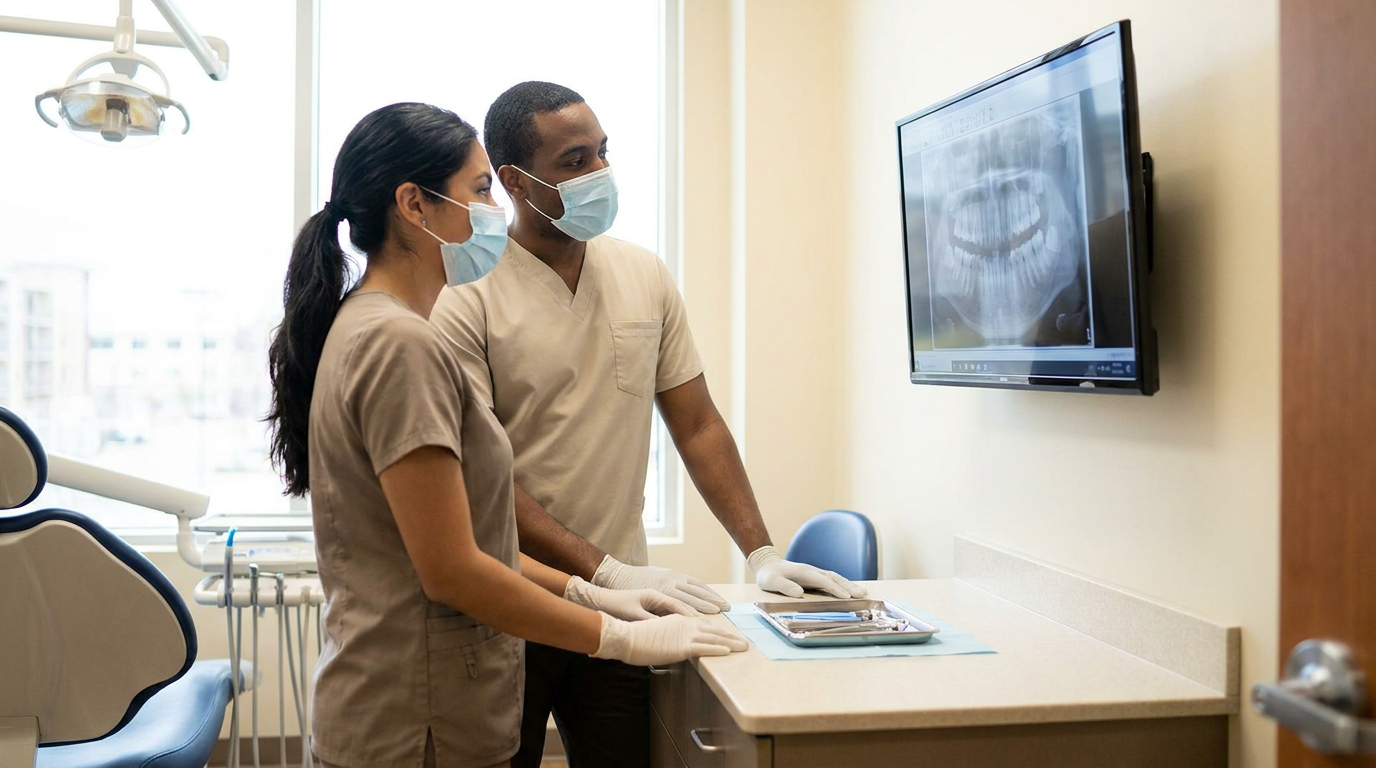
Analyze radiographs automatically for faster, more accurate diagnoses
Identify treatment needs with clinical decision support
Verify insurance eligibility in real time
Reduce claim denials through smarter coding and documentation
Gain insight into clinical performance and operational trends
Why is AI transforming dental practice management?
Better diagnostic accuracy: AI analyzes radiographs in real time to detect bone loss, caries, calculus, and more
Smarter insurance workflows: AI catches missing documentation and coding errors, which reduces denials and speeds approvals
Anticipated patient needs: AI can flag high-risk cases and guide planning before issues escalate
Personalized communication: AI tailors recall messages, reminders, and outreach to each patient
Performance insight: AI dashboards track KPIs like case acceptance, provider productivity, and treatment mix
What features should AI-powered DPMS have?
AI radiograph analysis: Automatically detect and measure caries, bone loss, calculus, and other findings
Automated insurance verification: Check eligibility and coverage before the appointment
Claim review and optimization: Catch billing issues before submission
Clinical decision support: Evidence-based recommendations during diagnosis or planning
Real-time dashboards: Up-to-date performance data to monitor KPIs
Integration with your existing systems: Works with your current EHR and PMS
Compliance and documentation support: Auto-generate clinical notes and flag missing information
Why Overjet for dental practice management?
Overjet is a trusted leader in dental AI. Its platform delivers clinical accuracy, workflow efficiency, and business insight that help teams provide better care, faster.
What makes Overjet stand out
FDA-cleared radiograph analysis: Detects decay (Caries Assist, K212519/K222746), bone level (Dental Assist, K210187), and calculus (Calculus Assist, K220928)
Real-time clinical insight: AI findings delivered during the patient visit
Insurance workflow support: Flags missing documentation and coding errors, supports faster approvals
System integration: Works with the practice management and imaging systems you already use
Scales across practice sizes: From a solo practice to a 200-location DSO
Measurable improvements practices report
Higher case acceptance
Fewer denied claims and faster reimbursements
More consistent, compliant documentation
More patient trust through clearer communication
What should you ask before choosing an AI DPMS?
Is the AI clinically validated? Look for FDA clearance.
Will it integrate with my existing systems?
Can it support multiple locations?
How easy is it to use?
What outcomes have other practices achieved?
Does it offer real-time analytics?
Why now is the time for dental AI
AI is no longer a future trend. It's a practical tool practices use today to improve care and grow efficiently.
Frequently asked questions
What is AI-powered dental practice management software?
It uses AI to enhance traditional tools like scheduling, billing, and charting, adding real-time clinical insight, radiograph analysis, and automated workflows that improve care and efficiency.
How does AI improve dental diagnostics?
AI analyzes X-rays with high precision, identifying issues like bone loss or decay instantly. That reduces variability between providers and supports more consistent recommendations.
Can AI software help with insurance claims?
Yes. AI tools like Overjet automate verification and claim processing by flagging missing documentation, catching coding errors, and improving accuracy.
Is Overjet's AI FDA-cleared?
Yes. Overjet's radiographic AI is FDA-cleared, including for caries detection (K212519/K222746), bone-level measurement (K210187), and calculus detection (K220928), and its findings are clinically validated.
Will Overjet work with my existing systems?
Overjet integrates with most major practice management and imaging systems.
How soon can I see results after implementing Overjet?
Most practices see measurable improvements, like higher case acceptance and fewer claim denials, within a few weeks of going live.
Why should I choose Overjet over other vendors?
Overjet offers FDA-cleared diagnostics, direct integrations, and tools that scale with your practice. It's trusted by DSOs, private practices, and insurers nationwide.