







Updated: September 2026
The mouth sustains life. It's vital for breathing, eating, and communicating. It's also the gateway to the rest of the body, and research shows how much overall health depends on oral health. Dentistry is crucial to our health, well-being, and quality of life.
Despite a strong preventive model that encourages seeing the dentist twice a year, patient care suffers from a lack of standardization and data-driven decision-making. It's often said that visiting 10 different dentists can produce 10 very different diagnoses.
Data collected but not utilized
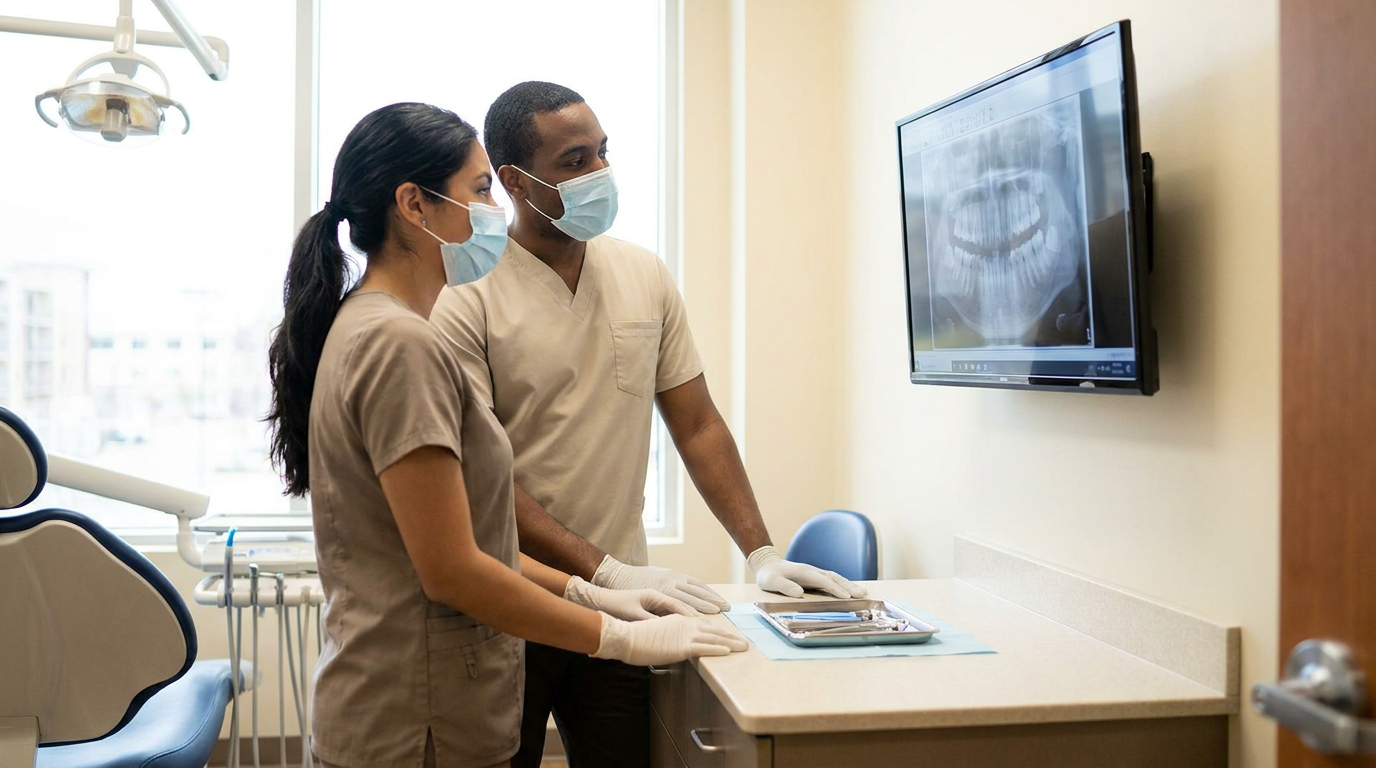
Compared with an annual physical, the twice-yearly dental visit is more quantitative, thorough, and prevention-focused. The hygienist cleans teeth, but also records quantitative information about bone loss and gum inflammation and takes X-rays to screen for disease.
Each year, thousands of patients visit a practice, generating millions of data points. That data has the potential to provide critical insight and improve care.
Until recently, though, dentists lacked the technology to automatically analyze all of it, especially unstructured data like X-rays and notes. Now is the time to use this digital information and take advantage of advances in AI and computer vision, building models and algorithms that analyze patient data automatically.
Non-standardization of dental care
Variation in diagnoses is a serious concern in dentistry. Studies show significant variation in diagnoses and treatment recommendations among dentists.
There are many reasons: inadequate training, differences in skill, variation in how thorough the exam is, and the absence of standard criteria for decision-making.
There are also fundamental differences in how dentists treat even the most common diseases, simply because standard guidelines are lacking. For example, the timing for treating cavities has evolved over recent decades thanks to a better understanding of enamel remineralization. Yet some dentists still haven't updated their treatment planning to reflect that change.
The data-driven future of dental care
With Overjet's AI platform, we're pioneering Computational Dentistry. It's a field that brings together many types of digital information, radiographs, photographs, scans, biomarkers, medical history, dental history, and more, and uses AI and mathematical modeling to support diagnosis and propose patient-specific treatments. The goal is precise, bias-free, repeatable frameworks that give clinicians better tools for decision-making.
We believe AI will transform every major part of the dental industry, including practices, payers, manufacturers, distributors, and labs.
Higher revenue for dental practices: Our software analyzes patient data and quickly identifies and charts findings for the dentist to review. That improves efficiency and reduces missed diagnoses, increasing both revenue and quality of care.
Lower cost for dental payers: Overjet's software automatically analyzes claims data and provides unbiased, repeatable results. In the short term, this improves efficiency and reduces the cost of claim reviews.
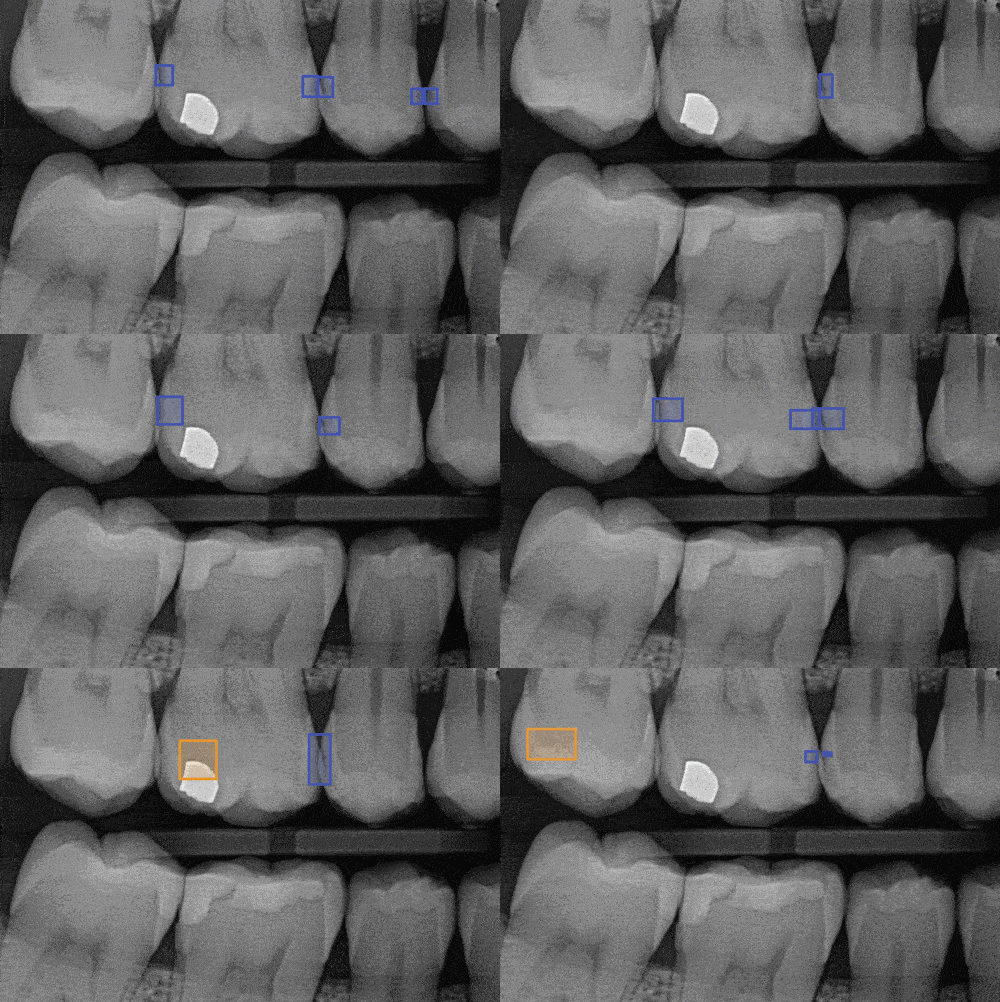
Better quality and access for patients: Overjet standardizes diagnoses and creates automatic visualizations of disease in radiographs. That helps dentists communicate more effectively and increases patient trust and acceptance of recommended treatment.
At Overjet, we're making dental care data-driven and standardized. This approach will improve the quality and accessibility of care for patients, and drive more efficiency and profitability for payers and providers.
Data collected but not utilized
Compared to an annual physical, the bi-annual visit to the dentist is more quantitative, thorough, and prevention-focused. The hygienist not only cleans teeth but also records quantitative information about bone loss and gum inflammation, and takes x-rays of the mouth to screen for diseases. Each year, thousands of patients visit a practice, with millions of data points being generated which have the potential to provide critical insights and improve care. However, until now, dentists didn’t have the technology to automatically analyze all this information, particularly unstructured data such as x-rays and notes, to help with decision-making. Only in the past decade have most dental clinics adopted digital dentistry which utilizes digital x-rays and electronic patient management systems to keep a record of patient visits. Now is the time to utilize this digital information and take advantage of advancements in AI and computer vision to build AI models and advanced algorithms that automatically analyze patient data and provide tools for better decision making. This approach will drastically change how dentistry is practiced.
Non-standardization of dental care
Variation in diagnoses has created serious concern in dentistry. Studies show that there is significant variation in diagnoses and treatment recommendations among dentists [3][4]. There are many reasons for this variation such as lack of adequate training, differences in skill levels, variation in the thoroughness of the examination and an absence of standard criteria for decision-making. There are also fundamental differences in the approach to treating even the most common diseases, simply due to a lack of standard guidelines. For example, the timing for treating cavities has evolved over the last few decades due to a better understanding of the remineralization of enamel. However, some dentists still haven’t updated their treatment planning to reflect this change. To make matters worse, treatment decisions are often based on cursory risk calculations instead of guidelines-based objective risk calculation, because manually following published guidelines, even though more accurate, can be very time-consuming.
Data-driven future of dental care
With Overjet’s AI platform, we’re pioneering Computational Dentistry — a field that incorporates multiple types of digital information (radiographs, photographs, scans, biomarkers, medical history, dental history, etc.), and uses artificial intelligence and mathematical modeling to create diagnostic inference and proposals for patient-specific treatments. This approach helps provide precise, bias-free and repeatable frameworks to provide tools for better decision-making.
We believe that AI will transform all major verticals of the $130 billion dental industry, including dental practices, payers, manufacturers, distributors, and labs. At Overjet, we are building tools for dental providers and payers to leverage our AI platform. These tools help them improve their profitability and deliver high-quality patient care.
Higher revenue for dental practices
The dental practice environment has seen a substantial change over the last decade. There has been a consolidation of solo practices resulting in a rapidly increasing number of group practices, with significant growth coming from large, multi-dentist and multisite group practices run by corporations or funded by private equity. This trend has resulted in a focus on efficiency and lower costs. However, as these groups have continued to grow, standardizing their practices to maintain high-quality care has become an issue with which they have become increasingly concerned.
This is where Overjet’s AI platform really adds value and helps practices scale easily. Our software analyzes patient data and quickly identifies and charts findings for the dentist to review. This increases efficiency and reduces missed diagnoses, increasing both revenue and quality of care. More importantly, it aggregates all practice data, in order to provide managers with insights that help them run their practices more effectively and make data-driven decisions about purchasing, staffing, and employee training. For example, the software tracks the quality of diagnoses and treatments of each provider to maintain a basic standard of care and identify areas of improvement.
Lower cost for dental payers
Dental insurance companies hire dentists to review claims which require pre-authorization or have been flagged for over-treatment. Currently, this is a manual process where dentists review each claim to determine whether the treatments performed were warranted and should be reimbursed. Due to variation of diagnoses, achieving consensus on a claim review can be challenging. Overjet’s AI software automatically analyzes claims data and provides unbiased and repeatable results. In the short term, this significantly increases efficiency and reduces the cost of claim reviews for payers. In the long run, by automatically generating diagnostic codes and quality metrics, this technology will help move dentistry towards a quality and value-based insurance system and help make dental care more accessible and affordable.
AI is making dental care data-driven and standardized.
Better quality and accessibility of dental care for patients
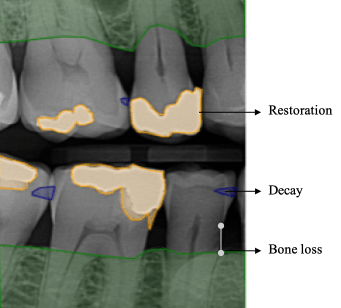
Overjet’s AI standardizes diagnoses and creates automatic visualizations of disease in radiographs, thereby helping dentists communicate more effectively to increase patient trust and acceptance of recommended treatments.
The U.S. Surgeon General has declared oral disease a “silent epidemic” as over 80 million patients lack access to dental care [5]. The integration of oral health with the overall health system is crucial to providing quality care to all patients. The current lack of integration most severely affects the low income and elderly, as out-of-pocket costs for dentistry are high and are not covered by Medicare. Technology can play a major role in integrating oral health with overall health to provide affordable access to care. This includes the use of teledentistry (powered by Artificial Intelligence) by either hygienists or nurse practitioners to reduce cost and integrating dental and medical records to effectively manage chronic diseases that are linked to oral health.
At Overjet, we are making dental care data-driven and standardized. This approach will improve the quality and accessibility of dental care for patients, and drive more efficiency and profitability for payers and providers. We are striving to build a future of dental care in which dentists are empowered by technology and supported by payers to practice high-quality patient-centric care.