






Dental practices and DSOs evaluating AI have likely encountered the same two names at the top of every shortlist: Overjet and Pearl. Both platforms are clinically validated, FDA-cleared, and used daily by thousands of dentists. They aren't interchangeable, though.
The core difference is scope. Overjet is a clinical intelligence platform that starts with imaging AI and extends into revenue cycle management, enterprise analytics, and multi-location governance. Pearl is a strong chairside detection platform built to help dentists spot pathologies and present findings in real time.
This guide compares the two across four dimensions: FDA-cleared indications, imaging infrastructure and patient-facing outputs, revenue and practice intelligence, and DSO readiness.
1. FDA-cleared indications: where Overjet vs Pearl diverge
FDA clearance dictates what an AI system is allowed to do clinically and the specific depth at which it can do it. Before comparing features, buyers should understand what each platform is cleared to detect, outline, segment, and quantify.
But first, not all FDA clearances are equal in clinical utility. Here's what each level means in practice:
Detection. The AI identifies a finding's presence (e.g., "caries detected on tooth #14".
Outlining. The AI draws boundaries around the finding, showing its location and extent.
Segmentation. The AI isolates the specific structure or pathology as a distinct region, typically as a polygon overlay.
Quantification. The AI measures severity or progression (e.g., "3.2mm of bone loss on the mesial of tooth #19").
Overjet leads the field with ten FDA-cleared modules covering caries and calculus detection for pediatric and adult patients, periapical radiolucency, automated dental charting, and image enhancement.
Pearl follows with seven FDA-cleared modules including multi-condition detection in bitewing and periapical images, periodontal bone level measurement, CBCT segmentation, and specialized modules for pediatric caries and periapical lesion contouring.
Finding | Overjet Clearance Type | Pearl Clearance Type |
|---|---|---|
Caries (adult | Detection and outlining/segmentation | Detection |
Caries (pediatric, ages 4+) | FDA-cleared for ages 4+ | Second Opinion for Kids (pediatric interface) |
Bone loss | Quantification (millimeter-level measurement) | Bone level measurement |
Periapical radiolucency | Detection and segmentation (polygon output) | Detection + contouring |
Calculus | Detection | Detection |
Restorations | Identification | Identification |
Image enhancement | FDA-cleared (AI noise reduction) | Not cleared for AI image enhancement |
CBCT / 3D | FDA-cleared (CBCT Assist — 10th clearance) | FDA-cleared (Second Opinion 3D) |
Panoramic radiographs | Supported | FDA-cleared for detection on panos |
On the Overjet side, CBCT Assist uses AI to automatically identify, label, segment, and measure anatomical and restorative structures in 3D scans. As Dr. Krystal Pham of Oceanic Dental puts it: "The choice to go with Overjet was based on its intuitive user experience, unique FDA clearances, and all-in-one platform."
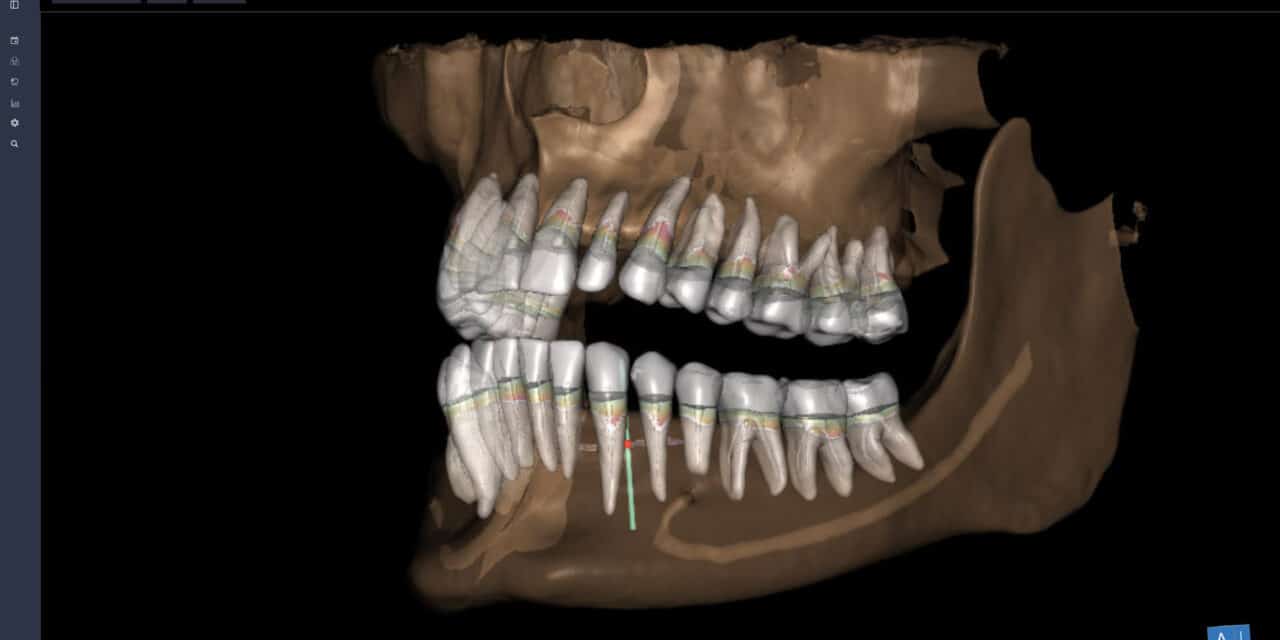
On the Pearl side, Second Opinion 3D enables automated identification of anatomical structures in CBCT scans, including the dentition, maxilla, mandible, inferior alveolar canal and mental foramen, maxillary sinus, nasal space, and airway. Dr. Kunal Rai of Meloria Dental describes his experience: "With Pearl, my patients leave confident, not confused. We're all working from the same page, and that's the foundation of trust and quality care."
Both platforms earn clinical credibility through their regulatory portfolios. The difference lies in clinical depth: Overjet's quantification of bone levels and its standalone FDA clearance for AI-powered image enhancement stand out—no other dental AI platform holds that image enhancement clearance.
2. Patient-facing outputs and imaging infrastructure
Clearances define what the AI is legally permitted to do. What matters in the operatory is what clinicians and patients actually see on screen and how the imaging layer is built behind it.
Feature | Overjet | Pearl |
|---|---|---|
Annotation style | Color-coded overlays with millimeter measurements displayed directly on radiographs | Color-coded highlights on radiographs with pathology labels |
Patient communication | Annotated visuals with precise measurements; AI findings visible in the same imaging view | Colorful AI highlights with tooth parts mapping for patient-facing explanations |
Native imaging infrastructure | IRIS: AI-native imaging software (built-in, not an overlay) | Second Opinion integrates into existing imaging/PMS via cloud-based overlay |
Image enhancement | FDA-cleared AI noise reduction for blurry X-rays | Standard imaging filters |
3D viewing | CBCT Assist with automated segmentation and measurement | Second Opinion 3D with anatomical structure identification |
Side-by-side comparison | FMX/PANO/intraoral photos across dates in a single view | Available within imaging integrations |
Tooth numbering | Automated dental charting (FDA-cleared) | Tooth parts mapping |
Sensor compatibility | Works with any sensor, IO camera, or pano machine | Integrates with dozens of imaging and PMS platforms |
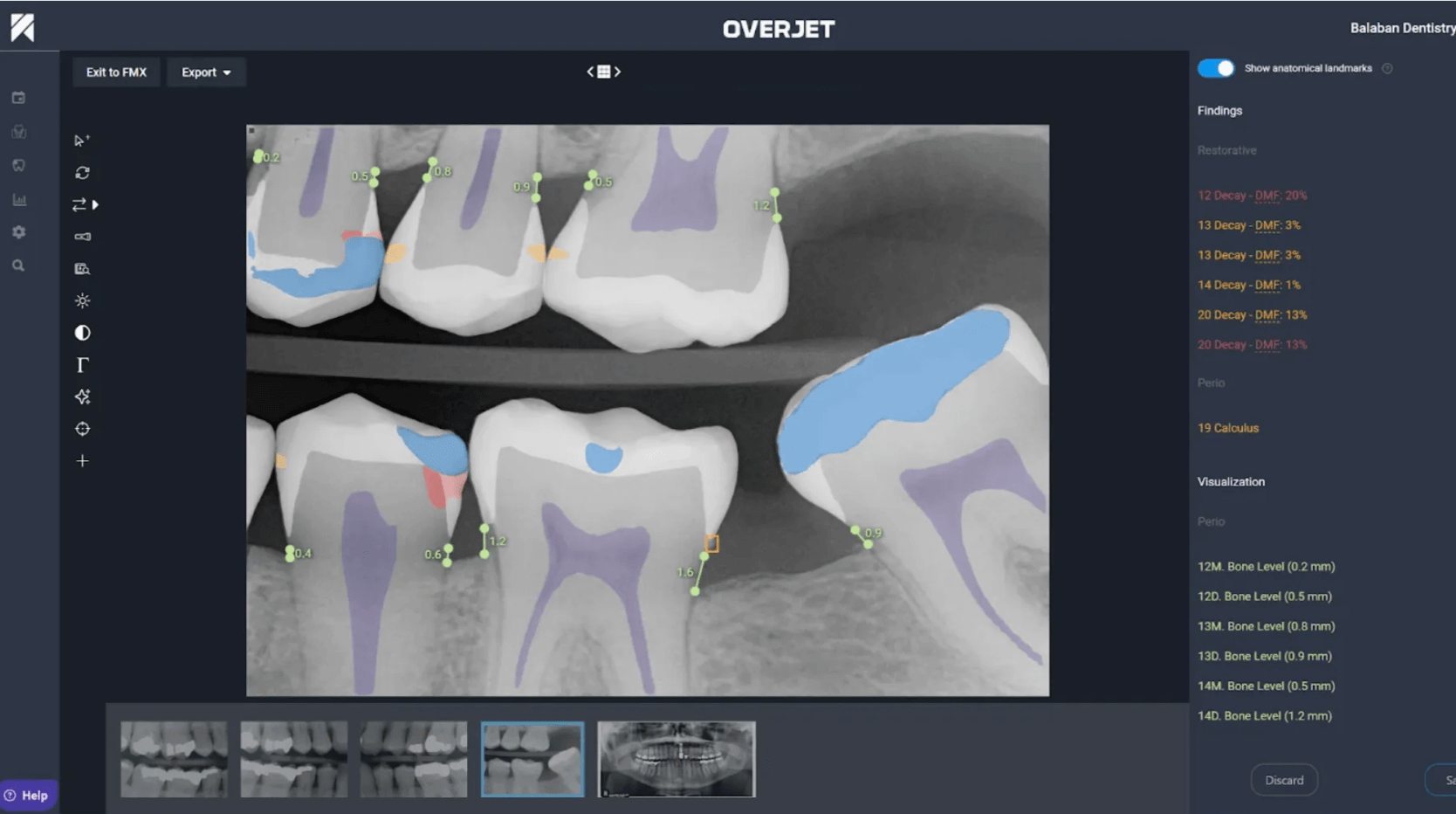
On the Overjet side, Vision AI Annotations display color-coded findings and measurements directly on the radiograph in real time. Practices using these annotated visuals report a 25% increase in case acceptance.
This is no longer just me saying that I see something. We can look at the Overjet analysis together. It's objective, and patients appreciate the clear and easy-to-understand information.
IRIS is dental imaging software with AI built in—not bolted on. It automatically enhances images, works with any sensor, stays productive offline, and elevates case presentations with AI annotations.
The image quality with IRIS is so crisp. It's amazing how clear the enhancement feature makes our images, using AI. It's really important to have high-resolution pictures when we diagnose patients, and that's what IRIS gives us.
On the Pearl side, Second Opinion is a browser-based platform that integrates with your imaging software or PMS to automatically upload and analyze 2D radiographs. It's a capable overlay that works well within existing workflows. Dr. Bassey-Duke of Clyde Munro Dentistry explains that AI-enhanced appointments add "a layer of transparency. You saw what I saw, and we agreed on this together."
The architectural difference matters: when AI findings live inside the same imaging environment a clinician already uses, they flow naturally into documentation and patient conversations with nothing extra to open or toggle.
3. Revenue and practice intelligence beyond the radiograph
This is where the comparison widens most. Pearl is primarily a diagnostic imaging AI with a growing Practice Intelligence layer. Overjet extends well beyond the radiograph into revenue cycle management, operational intelligence, and documentation support.
Capability | Overjet | Pearl |
|---|---|---|
Historical radiograph analysis | 12-month chart audit analyzing past patient images to surface missed treatment | Automated chart auditing with treatment gap identification |
Missed treatment identification | AI-flagged care opportunities with dollar-denominated value per clinic | Flags untreated conditions and prioritizes patients by treatment need |
Insurance workflow automation | Insurance Verification and ReviewPASS for coverage clarity and coding review | Instant insurance verification and benefits breakdowns |
Documentation & coding support | Identifies coding errors; supports clean claims before submission | Supports cleaner claim submissions |
Reported financial impact | $44K/month in additional care opportunities per clinic; 10x ROI | $30K/month in boosted production per practice; 20+ hours/week saved |
Case acceptance impact | 25% increase in case acceptance | 30% more treatment acceptance |
On the Overjet side, Chart Audit works retrospectively—analyzing 12 months of historical images to surface treatment that was never scheduled or never identified.
Before, a procedure had to actually take place for us to have data. We had no way to identify issues that weren't already treatment planned, which meant we didn't know the gap between what the provider diagnosed, versus what could have been.
Overjet's Insurance Verification and ReviewPASS further reduce revenue leakage by automating coverage checks and flagging coding errors before claims go out.
On the Pearl side, users see similar downstream effects. Dr. Elliot Rand of Rand Center for Dentistry notes: "It shifted the conversation from, 'We'll watch this,' to 'Here's what we're seeing, let's take care of it now.'"
A diagnostic AI that detects more disease is valuable. A platform that also shows you exactly how much production you're leaving on the table—then helps you capture it with cleaner documentation and faster insurance processing—is a different category of tool entirely.
4. DSO and enterprise readiness compared
For multi-location groups, the comparison shifts from chairside features to infrastructure, governance, and network-wide analytics. Here's what that looks like for Overjet and Pearl:
Capability | Overjet | Pearl |
|---|---|---|
Diagnostic standardization | Uniform AI analysis across all locations, sensors, and providers; consistent baseline for every clinician | AI applies universal detection criteria to every image; supports consistent diagnoses |
Multi-level analytics | Org, region, clinic, provider, patient visibility with benchmarking | Practice Intelligence with clinical quality and production tracking by provider |
Governance & security | HITRUST-certified; HIPAA-compliant; audit-defensible documentation | HIPAA-compliant; GDPR-compliant; ISO 13485 certified |
DSO onboarding scale | 240+ practices (NADG), 147 practices (Mortenson), Affinity, and others | Batch onboarding supports up to 50 locations per month; integrates with Dentrix, Eaglesoft, and others |
Reported financial impact | $44K/month in additional care opportunities per clinic | $30K/month production increase per practice |
Provider coaching tools | Provider benchmarking to identify coaching opportunities and track case acceptance by provider | AI-guided clinical training; supports new clinicians with consistent detection |
On the Overjet side, the platform applies standardized AI analysis uniformly across all locations, creating a shared diagnostic baseline—a hygienist in Phoenix and a general dentist in Philadelphia see the same objective findings. DSO Analytics provides visibility at the organization, region, clinic, provider, and patient level, with benchmarking that surfaces $44K per month in additional care opportunities per clinic.
I oversee a vast team of dentists and hygienists across 45 locations, making it impractical for me to be present with each of them simultaneously. With Overjet, I can now effectively monitor the activities throughout our entire organization—down to individual dentists and their patient appointments.
The HITRUST CSF Certification also recognizes that Overjet adheres to the highest standards for healthcare data security. For DSOs navigating payer audits, HITRUST certification means defensibility beyond standard HIPAA compliance.
On the Pearl side, the platform is HIPAA, GDPR, and ISO 13485 certified with configurable US/EU data storage—solid enterprise foundations, particularly for organizations with international operations. Pearl supports native integration with Open Dental, Dentrix, Eaglesoft, Carestack, Oryx, Curve, Denticon, and Software of Excellence's EXACT.
Pearl helps us deliver consistency, coaching, and clarity across every office. It helps young doctors become confident providers. It helps seasoned clinicians work more safely. It helps patients say yes to treatment.
How to choose between Overjet and Pearl AI for your practice
The right choice depends on the scope of what you need AI to do. Both platforms are legitimate, clinically used tools—they're not built to the same blueprint, though.
Your primary need is chairside detection support. You want a second set of eyes on radiographs to catch more disease and show patients what you see. Both platforms address this well, with strong detection accuracy and an intuitive patient-facing interface.
You need detection plus quantification plus revenue intelligence plus documentation support. You want AI that finds and measures pathologies, audits historical charts, verifies insurance, and flags coding errors before claims go out. Overjet addresses this scope, connecting imaging AI directly to production and revenue workflows.
You're operating multi-site or actively scaling. You need cross-provider standardization, org-level analytics, and enterprise-grade security like HITRUST. Overjet's enterprise analytics, governance layer, and DSO-scale adoption (240+ practices at NADG, 147 at Mortenson) make it purpose-built for this scenario.
Neither platform is wrong. But one is built as a chairside diagnostic aid, and the other is built as clinical intelligence infrastructure. The question isn't which is "better"—it's which matches the scope of what you're trying to solve.
Ready to see how Overjet fits your practice or DSO? Book a personalized demo to see how the platform applies to your specific clinical and operational goals.
Overjet vs Pearl FAQs
Overjet vs Pearl FAQs
How does Overjet and Pearl pricing compare?
Pearl's Second Opinion is listed at $349/month by a third-party partner with no contract required, though volume-based pricing is available for larger organizations. Overjet pricing is customized based on practice size, location count, and selected modules, however practices report 10x ROI from increased production on average. Request a demo from each vendor for a tailored quote.
What FDA clearances does Overjet hold that Pearl does not?
Overjet is the first and only dental AI platform FDA-cleared to enhance images—automatically improving blurry or noisy X-rays without losing clinical details. It also holds distinct clearances for bone-level quantification (millimeter-precision measurement) and age-specific caries detection for patients as young as four. CBCT Assist represents Overjet's 10th FDA clearance.
Which dental AI platform is better for DSOs?
Overjet is the stronger fit for DSOs needing enterprise analytics, cross-location standardization, provider benchmarking, and HITRUST-certified security. Overjet announced a full-scale rollout of IRIS across all 147 Mortenson Dental Partners locations, spanning nine states and serving nearly one million patients annually. Pearl offers solid DSO onboarding and Practice Intelligence dashboards, but its core strength remains chairside detection.
How does Overjet's Chart Audit identify missed treatment opportunities?
Overjet's Chart Audit analyzes 12 months of historical patient radiographs using its FDA-cleared AI. It flags conditions that were either identified but never scheduled or not identified at all—producing a dollar-denominated view of unmet treatment needs that helps practices prioritize same-day and recall-based opportunities.
How does Overjet integrate with my practice management system?
Overjet seamlessly connects IRIS with your existing sensors and PMS—no disruption to your workflow. Integration is handled by Overjet's onboarding team, typically completed within days.
What ROI can a single-location practice expect from Overjet?
Overjet reports a 10x ROI from increased production on average, driven by higher case acceptance (25% increase), surfaced missed treatment, and reduced insurance friction. Individual results depend on practice size, patient volume, and how fully the team adopts the platform's revenue and Chart Audit tools.