







A chief clinical officer at a 40-location DSO is accountable for the quality of care in every operatory. The main tool for checking that work is the monthly chart audit. It samples a percentage of charts per location, lands weeks after the treatment decision was already made, and depends on whoever is reviewing to apply the criteria from memory. A provider whose patterns are drifting can go several review cycles without a single chart in the sample.
The visibility gap behind clinical variation
A CCO signs off on consistency across the whole organization. Day to day, consistency is exactly what's missing. Treatment plans vary by provider. Radiographic interpretation varies by who's reading. Perio findings depend on the operator. None of that is visible from a central seat until it surfaces somewhere costly: a patient complaint, a denied claim, a state board inquiry.
Manual chart review can't close that gap. It samples a thin slice of cases, runs after the fact, and treats every reviewer's judgment as the standard. Two auditors looking at the same chart can reach different conclusions. By the time a pattern is clear, those treatment decisions have already been delivered to patients. Oversight built that way stays reactive. The fix is to move from periodic sampling to continuous visibility, where every case is measured against the same criteria.
Standardized analysis makes outliers visible
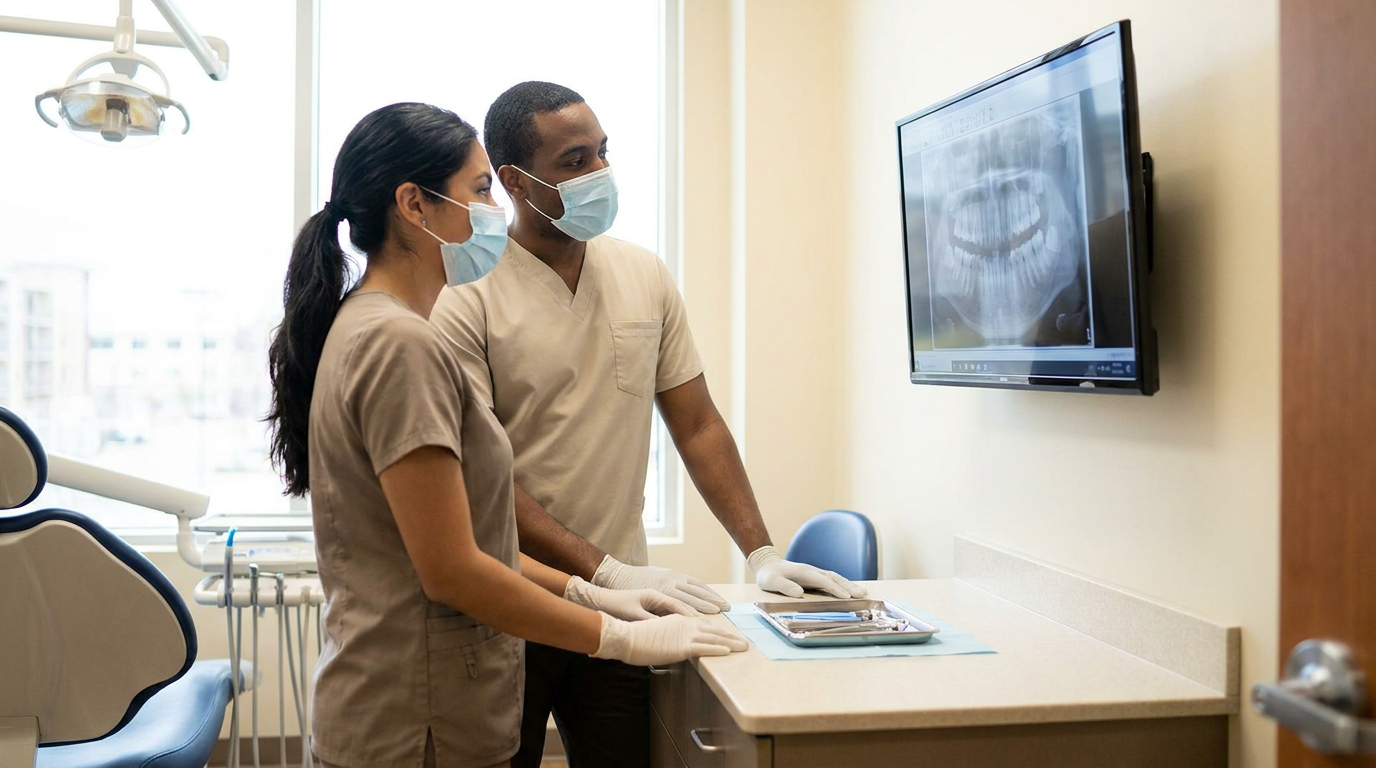
Vision AI applies the same FDA-cleared detection and measurement to every radiograph in the organization, no matter which provider or office captured it. A bitewing read in Phoenix gets the same analysis as one read in Tampa. Because every case is measured against consistent criteria, treatment decisions that fall outside the norm surface on their own. The CCO doesn't have to go hunting for them.
That gives a clinical leader a centralized view of radiographs, perio metrics, and treatment plans, with case flags raised against standardized criteria instead of reviewer memory. Vision AI's detection and measurement carry 12 FDA clearances, so the criteria a CCO standardizes on are clinically validated rather than house rules. The time savings are concrete. A CCO reviews the cases that fall outside the norm instead of working through every chart to find them. Consistent radiographic analysis also strengthens the documentation behind each treatment decision, which matters when a claim or a complaint puts that record under review.
Turning flags into measurable coaching
Finding the outlier cases is half the job. The harder half is doing something with them. Traditional audits rarely get that far, because the time goes into the review itself and there's little left for coaching.
Quick peer-review workflows change the math. A CCO can move from a flagged case to a documented review in minutes, then route it to the right provider with specific notes. Voice AI's Coaching module and practice performance insights make the follow-up measurable, so a clinical leader can see whether a provider's patterns actually shift over the next quarter. That turns coaching from an annual review into something a CCO manages continuously.
This is also where the surveillance worry comes up, and it's worth answering plainly. Standardized criteria apply to every case and every provider equally. No one is singled out for monitoring. Providers see the same flags their CCO sees, which keeps the conversation collegial and focused on calibration. Consistent review and documentation also lower the organization's compliance and quality exposure, without a separate audit program to staff.
Oversight that holds as you grow
Clinical oversight doesn't have to scale by hiring more reviewers. Standardized case flagging plus fast peer review lets a CCO reduce variation and clinical risk across every location with the team already in place. And the model holds as the organization grows. The fortieth location gets the same criteria as the first, on day one.
Book a Demo to see how Overjet supports clinical oversight across a DSO.
FAQs
What do clinical oversight tools do for a DSO chief clinical officer?
They give a clinical leader a centralized view of clinical data across every location: radiographs, perio metrics, and treatment plans, all analyzed against the same criteria. Instead of sampling charts after the fact, a CCO can see which cases fall outside the norm as they happen, run targeted peer reviews, and coach providers based on patterns rather than one-off findings.
How is automated case flagging different from a manual chart audit?
A manual audit reviews a sample of charts, usually weeks after treatment, and relies on each reviewer to apply criteria from memory. Automated case flagging applies the same standardized, AI-assisted criteria to every case, so outlier decisions surface on their own. The CCO spends time reviewing the cases that matter instead of searching for them.
Does Overjet's AI replace a clinician's judgment?
No. Overjet detects and measures findings on radiographs. The clinician makes the diagnosis and the treatment decision. For a CCO, the value is consistency: every provider works from the same AI-assisted analysis, which makes variation easier to spot and discuss.
Will providers see case flagging as surveillance?
Standardized criteria apply to every case and every provider equally, so no one is singled out. Providers see the same flags their CCO sees. Used this way, flagging supports calibration and coaching rather than monitoring, and keeps peer review collegial.