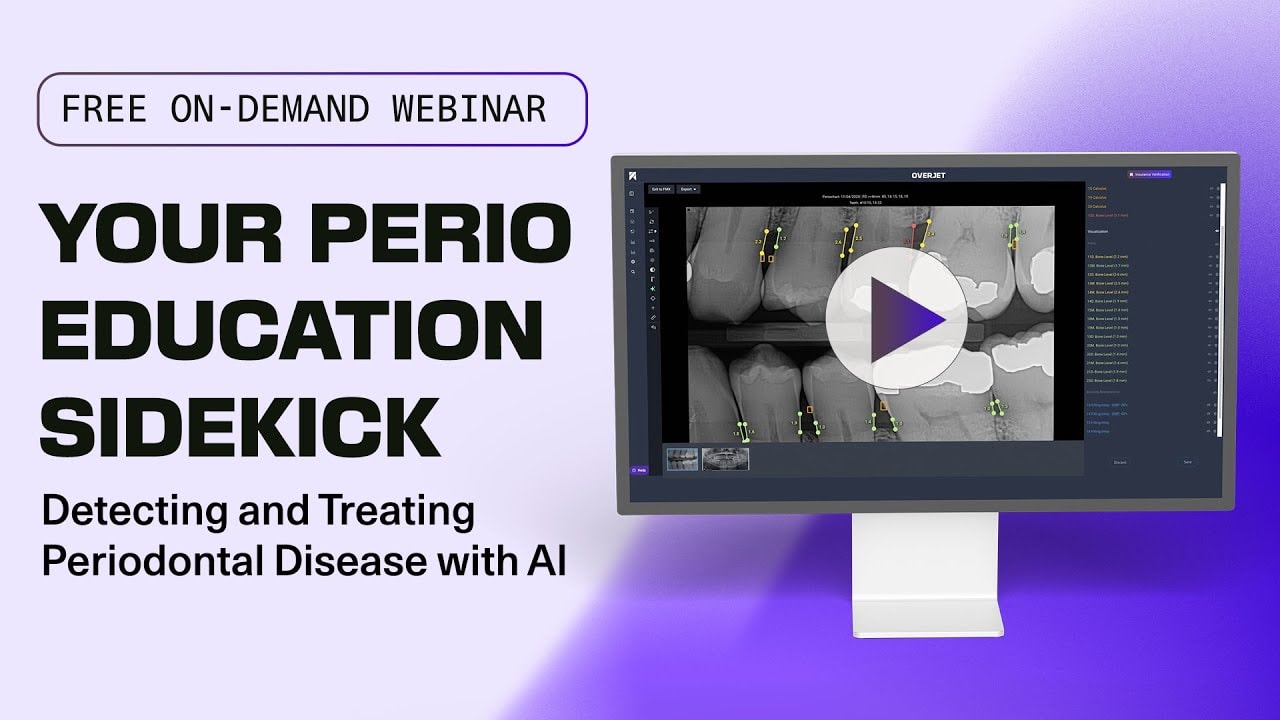
Your Perio Education Sidekick: Detecting and Treating Periodontal Disease With AI
At a glance
AI helps by making periodontal disease visible. It overlays color-coded findings and bone-level measurements on the x-ray, so a condition that’s usually asymptomatic becomes something the patient can see — a red area, a number, a percentage of bone loss. That visual opens a conversation clinicians often avoid and helps patients understand and accept treatment. The clinician still makes the diagnosis; the AI confirms and quantifies.
Core topic: Periodontal disease goes undiagnosed and AI-annotated radiographs change that. The conversation returns to three threads: perio as a “silent assassin” that’s asymptomatic and easily dismissed by patients and clinicians alike, the power of visual color and measurement overlays to educate patients regardless of language, shyness, or end-of-day fatigue, and the team workflow — hygienist-led data gathering, dentist co-diagnosis, and steady calibration — that turns AI from a novelty into muscle memory. Throughout, the clinician stays the decision-maker.Key Takeaways
- Perio is the “silent assassin,” and visuals finally make it discussable. Because periodontal disease usually doesn’t hurt, patients dismiss it and clinicians hesitate to raise it — Dr. Block noted many new patients say no one had ever probed or told them. With more than 60% of periodontitis going undiagnosed, showing bone loss as a red-yellow-green “traffic light” with millimeter and percentage measurements turns an uncomfortable, abstract warning into something patients grasp immediately.
- Visuals transcend language, shyness, and fatigue. Dr. Block’s point: the AI doesn’t get tired and “speaks every language.” After 20 patients, a clinician won’t explain perio as well at 5 p.m. as at 8 a.m., but the annotated image is consistent. He sits patients up, turns the overlay on and off, and lets them point to the red spot and ask “do I have a problem there?” — which shifts the conversation onto the finding and drives SRP and maintenance acceptance.
- AI is co-validation, delivered through team calibration. In his practice the hygienist gathers all data and reviews findings with the patient first; the dentist pops in to confirm, making it a co-diagnosis. Toggling the AI on and off builds the team’s trust in the output, and reinforcement at the morning huddle made it habitual in about one to two months.
In this webinar
Q: Who reviews the AI first in your practice?
The hygienist. Dr. Block runs on documented SOPs: the hygienist takes x-rays, charts, captures photos, does diagnostic scans for new patients, reviews the findings with the patient, and flags concerns before pinging him. He enters for a few minutes to confirm — a co-diagnosis that reinforces what the patient already saw.
Q: How long did team calibration and “muscle memory” take?
About a month or two. He treats the morning huddle like a daily team meeting and kept “planting the seed” to use the AI. The dentist can’t be the only one excited about it — the whole team has to be on board.
Q: Have you seen changes in SRP or maintenance acceptance?
Yes, though he frames the AI as one tool among photos and videos in the education process. It’s easy to treatment plan a painful broken tooth; perio is harder because nothing hurts. He keeps scaling and root planning on the plan and revisits it every recall rather than removing it, and pairs it with a strong three-month recall.
Q: How do you treatment plan when the AI shows red, but probing is 3 mm with 3 mm of recession?
The host emphasized differentiating clinical attachment loss from soft-tissue measurements: a patient can have a reduced but stable periodontium with no inflammation or bleeding. Probing depths don’t always match bone-level measurements, so the whole team needs that calibration to communicate it accurately to the patient.
Q: How accurate is the AI, and can it detect a bad x-ray angle?
Many models run on each image — caries, calculus, bone-level measurements — each with its own sensitivity and specificity, all publicly documented at fda.gov. Yes, the AI can detect poor angulation, and AI-based grading of x-ray exposure quality is coming.
| Figure | Detail |
|---|---|
| 60%+ of periodontitis goes undiagnosed | |
| Red / yellow / green | the AI traffic-light overlay (red = severe, yellow = caution, green = healthy) |
| 0.4–1.9 mm | healthy CEJ-to-bone-crest range on a bitewing |
| T1 / T2 / T3 | longitudinal comparisons that show a patient’s periodontal change over time |
| 1–2 months | time it took Dr. Block’s team to make AI use habitual |
| 3 months | recall interval for periodontal patients |
Speakers

Dr. Eric Block
Dentist
Dr. Eric Block is a full-time practicing dentist, author, speaker, and mental health advocate based in Acton, Massachusetts. He practices at Acton Dental Associates and is widely known for his work helping dental professionals reduce workplace stress and burnout.
The Stree-Free DentistFrequently Asked Questions
Q: Why is periodontal disease so often undiagnosed?
Because it’s usually painless. Patients don’t feel it, so they dismiss it, and clinicians can be hesitant to raise a problem the patient can’t sense — which is why more than 60% of periodontitis goes undiagnosed. Making it visible is the key to addressing it.
Q: How does AI help explain periodontal disease to patients?
It converts an abstract warning into a picture. A red-yellow-green overlay with bone-level measurements and percentages lets patients see the disease for themselves and often point to it and ask about it, which makes the education far more effective than words alone.
Q: Does AI diagnose periodontal disease?
No. Dr. Block is explicit that the clinician makes the diagnosis and the treatment plan. He toggles the AI on and off to confirm findings, and treats it as objective confirmation.
Q: Why don’t probing depths always match the AI’s bone-level measurements?
Because clinical attachment loss and soft-tissue probing depths measure different things. A patient can have a reduced but stable, healthy periodontium, so probing depths and bone levels won’t always align — which is why team calibration matters before communicating with the patient.
Q: How long does it take a team to adopt periodontal AI?
In Dr. Block’s practice, about one to two months to become habitual. Daily reinforcement at the morning huddle and getting the whole team invested were what made it stick.
Full transcript
Dr. Eric Block: I wanted to talk about perio today because I feel like it's such an often overlooked issue. And if there's anything that that can help the dental office, the the hygienist, the dentist, bring up that conversation about perio, I think it's it's a huge factor and it's a huge win for for the dental office.
Interviewer: Yeah, I I couldn't agree more. So I guess as we kick this thing off, let let's if you will expose this 800 pound gorilla that is in the room and has been in the room forever. We do know that you know wi with data about you know 60% or more of perodontitis actually goes undiagnosed and you know you can see these numbers on the slides. It's so prevalent. It's a real problem for society and and I think that um the way I view this is um it's oftentimes a hidden problem since it's asymptomatic, right? And patients don't really know the severity of their condition. Um they often times dismiss it and I think unfortunately we in the profession do some similar stuff. So I think it's a problem that's definitely worth tackling. uh there there certainly is a lot of value in getting this right for society um and can technology help us do that right you know when we couple um these statistics with um this statistic I'm going to show here which is around case acceptance right and and patients turning down more dentistry than we would want them to turn down that really to me Eric highlights the depth and the breadth of this problem it isn't something small that we can make incremental gains on. It's something that affects so much of society that I believe that we really we need to dedicate a lot of energy to this. How do you feel about you know kind of that that concept?
Dr. Eric Block: Yeah. Well, this this presentation you you titled the silent assassin and it's because why? Because it doesn't hurt. Usually patients come in with with perodonal issues and it it doesn't hurt. Um, and I I hear this a lot from new patients. They'll say, you know, no one ever told me that or no one ever probed um around my gums like like you have. Um, so I and I don't know why that is, why we're so comfortable telling patients about carries or or needing a crown, but why dental officers so hesitant to talk about pario because it's it's such a problem. And if patients uh first of all, if they're not told about it, second of all, if they don't understand what you're telling them, uh if they're not properly educated, they're not going to move forward. They're not going to just come in and say, "Hey, I want to get some scaling root planning done." They have to be properly informed and educated.
Interviewer: Yeah. And and it's interesting you mentioned about uh probing. you know, so many practices struggle with the being consistent with probing and taking paradonal measurements and taking uh documentation around that. Um, how did AI specifically help you, you know, in your practice setting close some of those gaps? Can you talk to that a little bit?
Dr. Eric Block: Yeah, we always had, you know, part of our our hygiene protocol and workflows and part of our our systems to to probe, but you know, when you're probing and you're you're mentioning these numbers to patients, you know, sometimes it just doesn't click on what you're what you're trying to tell them. Um, so, you know, I really try to talk to patients in lay terms um so they understand what we're talking about. I, you know, instead of saying the word probe, I'll say, you know, we're using this, it's kind of like a ruler and we're measuring how deep um the ruler goes in your gums and the the higher the number, the more bone loss you have and the more inflammation you have. I try to speak to them in, you know, in lay terms so that they understand. But when you open up the the AI and you show patients the, you know, the measurements, it just opens up that conversation that a lot of dentists and hygienists just don't want to have. We don't want to be the bearer of bad news uh and try to explain to a patient that they have a problem and it doesn't hurt, they don't feel it, they didn't know about it. So that's where I really feel like where AI really came in uh to help me in my practice.
Interviewer: Yeah. And you know, I'm thinking about sort of the main features and and uh value prop that brings to the dental chair. What are the main features that you actually use? we talking about bone level measurements? Um the the overlay itself with the colors and the quantification or maybe longitudinal comparisons between a T1 and a T2 and a T3, you know, for a patient over time.
Dr. Eric Block: Yeah. The measurements and the colors. I mean, it it is I tell patients it's like a traffic light. There's and there you can see there's red, yellow, green like a traffic light and you know, red is stop and it's bad. Uh it it's when you show a patient these X-rays and you show them the measurements, you know, they're going to understand more uh of what you're trying to tell them and and the problem that they're having and the the the chances are higher that they're going to move forward with treatment because they understand it. And it the the colors and the the measurements and I know with the PAS, it'll actually show percentages of of bone loss. That transcends language. It transcends uh you know, case presentation. And it transcends if you're shy, if you're tired. The AI doesn't get tired. The AI speaks every language. You know, patients will understand these visuals more than and more than trying to explain. Explaining dentistry is hard. Trying to explain to someone about about perodonal disease. That is hard and exhausting. And if it's at the end of the day and you've seen 20 patients and you're tired, you're not going to explain it as well as if you're fresh at 8 a.m. So, the AI just helps.
Interviewer: Yeah. And you know what I've heard recently from a number of folks out there is that they are in sort of this mode when they're using AI and the visuals where they're they're pausing their conversation to allow the patient to interact visually with the imaging and then have the patient come to them. And I'm hearing reports of things like the patients pointing out a red spot or or a marking or a number on an X-ray and saying, "Do I have a problem there?" or I have a problem there, don't I? Have you experienced that type of thing with your patients?
Dr. Eric Block: Yeah. They'll say, "What's that red spot?" You know, it's boom. It's it it turns the conversation into focusing on uh on a problem that they they probably have. Sometimes, you know, I tell them there's, you know, maybe this is a, you know, radiographic burnout, which I'll explain to them what that is, or there's maybe a a radolucent liner um under their filling that's showing up um red. And again, I talk to them like I'm talking to my 10-year-old son. I talk in lay terms. I don't talk dental jargon because they're not going to understand. But um I always sit them up. Um I make sure they take their We give every patient, you know, sunglasses, eye protection. I make sure they take their their glasses off. I sit them up um so they can see and I move my large body out of the way so they can see the screen and we just go over their X-rays together and we start um pointing out red areas. I personally like to turn the AI on and off. Um I'll hit the space bar and I'll show them this is what a traditional digital X-ray looks like and then I'll turn the AI back on. I'll say now here are the AI annotations. And uh most patients are impressed. You know, they think it's, you know, it's it's great technology. And I always say, this is a company out of MIT cuz I'm close to Boston and that, you know, the the the local patients here love that, too. Um, but they'll just point out areas. I mean, the red areas are uh an obvious issue that's going on, and we'll just review the X-rays together and and point out problems. So, it really helps in that in that um patient uh education process.
Interviewer: Sure. you know, um I hear a lot about workflows, right? There's this conversation around uh changing of workflows and is that harder or or easier and where are we going to land with that? Talk to me a little bit about um who re reviews the AI first in your practice because obviously there's a a role for the doctor, there's a role for the hygienist, there's a role for the treatment coordinator, the front office, specifically to the clinical piece who is actually looking at the AI annotations first with the patient in your in your setting.
Dr. Eric Block: That that's an amazing question because I'm very big on workflows and uh SOPs or standard operating procedures and having protocols in place. Um and it's just made my life so much easier. So I have a whole protocol for this workflow and I have my hygienists do all the data gathering first um before they um they message me. We have an intraoffice communication system so they'll ping me when they're ready for their exam. and I I have five hygienists to see. Um, so, you know, sometimes I'm I'm running around and the last thing I want to do is get in there too early and I don't want to get in there too late where people run behind. So, the hygienist will do all the data gathering first before they start the cleaning, the mechanical cleaning. They'll take the X-rays, they'll do the charting, they'll they'll take any photos. If it's a new patient, we'll do diagnostic scans. uh they'll take all of that and then they'll tell me they're ready for an exam and at that point I know I can pop in at any time. Um so they the hygienist has already reviewed the x-rays with the patient. They've they've jotted down um any areas of concern that they want me to look at and then they'll start their cleaning and that's when I you know usually I pop in because I don't want anyone to run behind. I don't want to pop in too late um or too early where there have they haven't been um properly uh charted. So when I come in, we just review them again. So it's it's a second time the patient is seeing the AI and the X-rays. Uh so it just reinforces any um potential issues that were brought up with the hygienist. It's it's a co-dagnosis with the hygienist. They're bringing up an issue with the patient and I'm um uh agreeing or disagreeing. Usually I'm agreeing because they've been with the patient for the past 30 or 40 minutes. I'm just popping in for three minutes. um and you know they were um with that patient and you know cleaning their teeth and seeing what was going on and probing um and then I pop in and u we create a treatment plan from there.
Interviewer: And so you're validating what the the hygienist findings are and and I guess in another manner of speaking validating what the AI outputs are. Um putting that that human stamp on the information that the technology is actually delivering at the chair right and I think that's important um from my perspective that you know this is not really about the technology overriding something that we're doing. In fact I think it's just the opposite of that. I think that the technology actually is augmenting what we already do really well but you know maybe helping us do it more efficiently and then delivering some uh some sense of if you will co-validation because it can work the other way too right the computer can validate your assessment of the patient as well to ultimately drive the understanding that the patient um oftent times at least historically hasn't had. Uh so you know you think about training and calibration because you mentioned systems in the practice. What kind of things did you guys have to do in your office when you first put this in to be able to have everybody let's use the term trust the AI output as an example because it is new right this is a new thing for for all of us in dentistry.
Dr. Eric Block: I I think that's the key word there is is trusting it. And and I still like I like I mentioned earlier I turn it off. I turn it on. We're we're the clinicians. We're the ones making the diagnosis. Uh if there's carries, I'm the one drilling into that tooth. I want to make sure that the that the AI is right. Um and I'll turn it off, I'll turn it on, and I tell the patient, you know, this is like a great second opinion. I totally agree with the AI. Um it's showing that you have bone loss. Um, and the hygienist has already mentioned about the bone loss, about the the need of scaling and root planning. So, I'm like the second opinion and then the AI is like the third opinion. Uh, and we'll just tell the patient, yeah, we totally agree with what it's what it's saying. It's it's it's great, you know, it's a great backup. Um, now, when I first started out as a young dentist, looking at an FMX in front of especially in front of a new patient was one of the most intimidating things that I experienced. And I wish I had this 20 years ago when I first started out because it's like a second opinion. It's it's like other, you know, hundreds or thousands of dentists have looked at these X-rays and are giving you their opinion. Um, but it's um there is a trust factor and when you're starting out, it's you got to just constantly get it into your workflow, remind everyone to use it. I I'll bring it up at the morning huddle and I'll say everyone, you know, make sure you use your AI. Um it's just that reminder and eventually it just becomes part of your day. It becomes part of your workflow. It's just like you know doing anything else. You get you get used to it. So it's just a matter of just keep going over it, reviewing it. Um because as dentists, you can't be the only one that's excited about this. You have to get the whole team on board. And it some doesn't happen overnight. You got to just keep reminding people and going over and over and over that this is there uh to help us and it's a great technology and it's super impressive to patients.
Interviewer: Eric, how how long do you think that that process of team calibration and then sort of if you will muscle memory took for your team?
Dr. Eric Block: Yeah, you know, we have the morning huddle. So, I would mention it. I use the morning huddle like a little team meeting every morning. uh we review uh you know who's overdue for treatment, you know, where to put emergencies, you know, really important things. But I'll review topics for the day and I always in the beginning remind people of a new technology or new treatment. And um there there's still times where, you know, I'll walk into the hygiene room and it's not up and we'll have to remind um you know, the staff to to turn it on. So, it still happens, but it it probably took, you know, a month or two to really get um people into the swing of using it. But it's like you just plant seeds. You know, every day I just kept planting that seed that we got to keep using it.
Interviewer: Sure. Sure. Um let's talk about case acceptance for just a second. um in your practice, have you noticed um any changes in SRP or maintenance um acceptance around uh you know the AI visuals and for the patient being able to understand what the importance is of a disease that oftent times is again the silent assassin you know unheard it doesn't hurt yeah you know when I floss my gums they bleed a little bit doc but I don't have a problem kind of thing have you noticed changes in in the acceptance levels
Dr. Eric Block: Yeah. And the AI is it's just another tool in your tool belt that you can use to help educate the patient because again, if if it's not hurting, I mean, the easiest thing to to treatment plan is when a patient walks in with a broken tooth or it hurts.
Interviewer: Yeah.
Dr. Eric Block: It's easy to treatment plan and and get case acceptance. But especially a new patient, if they're coming in and nothing hurts and they're not having bleeding or they're not complaining of any of any symptoms, then the AI is another tool. But you've got to, you know, really educate the patient. We take good photos. Uh we have videos that we show patients. Um it's just all part of the the education process. And you know, usually we get patients to move forward. If they don't, then we keep bringing it up. We just keep at them. You know, there's bleeding here. Uh your gums are not healthy. Um you're getting bone loss. We don't want to lose the We don't want to lose these teeth. Um and just keep at it. And and eventually they do come around. Maybe not, you know, right after the first appointment, but we don't take the scale and root planning off the treatment plan and archive it. We always keep it on there and just keep bringing it up. Um, and uh, usually also after we have pretty good success with keeping the patients on a three-month recall after.
Interviewer: Yeah. And that that brings up the concept that I mentioned earlier before, which I think is one of the most important ones around this particular type of technology is the ability to look at it through time. You and I both know and and I'm sure the audience knows that a snapshot of a dental condition oftentimes doesn't tell the full story. In fact, it never does tell the full story. It's oftentimes what is happening over time. And I think in the the realm of pererryio especially because the patient can feel the same on day one in year 50, right? They they can feel the same exact way in their mouth and yet their mouth can be completely different over time. Um to the point of now my teeth are at jeopardy for being lost completely and I never even knew about that. So talk to me a little bit about that and how that concept is translating to um maybe you use the term I don't want to use the term deferred but a later case acceptance than on day one because it's still important isn't it?
Dr. Eric Block: Yeah. And sometimes it happens, you know, new patients maybe they, you know, we we educated them, uh, we told them about the perodonal problems, uh, and they didn't move forward with with scaling and root planning, um, but we'll hit them up the next time, uh, and just keep reinforcing it. We also have written and documented, uh, protocols for patients with perodonal issues. We, as a, as a team with the hygienist, we got together with our periodonist. And if you don't have a periodonist, then I I recommend getting together with your local periodonist that you refer to and come up with a game plan. Come up with a recipe, a workflow. Uh what if a patient has u really deep pockets? What if they didn't respond after scaling and root planning? What do you do? When do you use a restin? Um when do you refer to the periodonist? Uh if there's recession, uh when do you recommend gumrass? we've come up with all of these uh potential issues and protocols. So, we have kind of a like a workflow that that we use. Um but yeah, it does happen where patients they they didn't move forward whether it was because of money or because they didn't totally understand what was going on or they just felt like they could just wait. It wasn't a problem that was um an urgent problem. Maybe they had other restorative issues they had to take care of. But, you know, we'll just keep at them at at recalls and and, you know, ultimately we'll we'll get them on the schedule to to get them, you know, headed in the right direction and taken care of.
Interviewer: Yeah, absolutely. You know, um, thinking about clinically, right, one of one of the challenges with perio is determining whether a problem is soft tissue is hard tissue. And that that's really really important because the therapies are different, you know, and um, this is a sort of a common appearance, right? Maybe this is a a teen or a young adult or something like that. And you can look at these real beefy red gums and sort of they're they're flaming at you, right? They're screaming. And you know, I I know when I practiced, I heard oftent times, you know, you're looking at this this visually, and this is a pererryo patient, a quote unquote pero patient. But, you know, the ability to look at the bone level measurements, as you can see on the X-ray, really really deciphers that for you. It gives you the ability to know that rather than just kind of guessing at it. You know whether there's bone loss. You know how much there is. You can quantify it and then really that comes into making a much more specific diagnosis, doesn't it?
Dr. Eric Block: Oh yeah, absolutely. And you know, I always talk to the hygienists and and we we always talk about, you know, using your best clinical judgment. Um, and you know, what's best for the patient and their situation and, uh, if you don't have the proper x-rays or the proper PAS, um, you're not going to get all the information. And so this would be a case that looked like they had, you know, major periodonal problems, but when you look at the the X-rays and the AI shows not much bone loss, um then maybe you create a different different treatment plan. Um so yeah, I mean it's it you've got to have the necessary X-rays and um um you know, get get your team together, get them all on board, get them all on the same page.
Interviewer: Yeah, we need to speak the same language, right? Certainly the the teams do. kind of another clinical example I guess for the the audience here. You know again blunted pillas you can imagine this is bleeding every time you look at it and and it can really really look like a periodontitis situation visually but as you can see no evidence of any bone loss. you know, I I did a um uh literature review last year uh on some NIH data uh and talking about um you know, what the actual levels of uh CEJ to bone crest measurement should be in the normal situation and um you know, I I'd practiced a long time and kind of forgot that it went out the window for me, right? Um but in looking at the literature you know that's like 04 to 1.9 millimeters from CEJ to crest to bone when we look at it on a bitewing in a healthy paradonal situation right um so the ability to look at a visual here maybe on the left side and then tie that to some information on an X-ray and maybe you think about the concept of staging and grading as one example. Um, this just allows us, uh, you know, in my view, to be able to be much more precise than we've ever been in the past. In the old days, it was, well, I think you have some bone loss here. Um, maybe it's generalized, moderate bone loss. Now, we could point out the surface on the tooth, measure specifically to the tenth of a millimeter, and really have a definitive kind of idea of what's going on with the patient. Right.
Dr. Eric Block: Yeah. And I I actually started out in my career with regular paper film X-rays and we we had dip tanks for when I was doing implants to to get a quick X-ray and then we went to that next step where we added digital X-rays and that was like a major game changer. Now when you add AI it's like the next level up where it it helps you as the provider. It makes your life easier. um it makes you better and it makes uh educating patients uh easier. So, you know, to me it's like that you're just going to that next level.
Interviewer: Yeah. So, you know, before we jump into the Q&A because we are moving toward the bottom of the hour, um for folks who are in the audience, Eric, that are listening and might might think about, you know, jumping into the AI uh pool as it were, maybe starting on Monday morning. So what what does the first let's say month or 30 days playbook look like for for that that persona who might want be thinking about jumping in and adding this to their practice?
Dr. Eric Block: Yeah, I would say that you know the most important thing is if you have the AI to use it you know make sure everyone is using it and it's just part of your you know part of your your workflow. you take the X-rays, you sit the patient up and you review the X-rays with them, and there's a big, you know, juicy class 2 uh area of decay there. Um, it is so so much easier to point to that big red area and tell the patient, "This is bad. This is a this is a big cavity. We need to get you back in and fix this." And then you can point to the yellow areas. That's like caution. you know, I would probably do that, you know, that mod because I'm already in there doing number three MO. So, I'd probably do number four mod and I'd have that conversation with the patient. Um, but then it it's picking up all the tartar, uh, all the calculus, uh, and it's picking up bone loss. So, there's a lot going on with this one bitewing and it just jumps right out at you. And uh to me, you know, when I like I mentioned, when I first started out, I'd be looking at this X-ray for like, you know, 5 minutes trying to, you know, figure everything out and and explain to the patient. Now, it it's so uh quick and easy to show a patient with these color differences and the and these measurements.
Interviewer: Yep. Got it. I I love that for sure. Um as we're coming into the bottom here, let's bring it home with a couple of questions. I do see a couple in the chat. Um first one is, how do you treatment plan when you see red on overjet? But the probing you get 3 millimeters and recession of 3 millimeters with total clinical attachment loss of six. I think this is a really really important question that um goes back to our roots and and Eric you and I both know that and we talked about this that differentiating uh clinical attachment loss from soft tissue measurements is really important. Right? You can have a reduced periodonum and the patient can be healthy. In other words, stable. There's no inflammation there. There's no bleeding there. So I think from the the the RDH team perspective, the hygiene perspective, um understanding that probing depths don't always match bone level measurements, nor should they, you know, right, all the time. And understanding that calibration piece is critically important because knowing that for the entire team allows us to communicate it properly from team member to team member and then from team member to the patient which is the most important part of it all. Right.
Dr. Eric Block: There's there's so many factors the the patients you know what's their medical history medications. um if there's no you know bleeding or inflammation um with probing it's you know it it totally changes the the treatment plan. Um are they you know being if they haven't seen a dentist in 5 years are they you know being treated regularly is so many factors it's it's so multiffactorial.
Interviewer: Yeah. Yeah. Next question is um around accuracy. How accurate is the AI? Is it able to detect if the X-ray is taken in a wrong angulation? That's really an interesting question isn't it? And I think it's a really good one. it goes to sort of the use of of the tool. U it's very accurate now all of the the models and there a lot of different models that are running on these images you know things like cavities calculus detection we're talking about pero bone level measurements but they're all a little bit different they all have their uh unique characteristics in terms of how sensitive or uh how much specificity they have you can dig into that at fda.gov gov for sure. All of that is publicly accessible uh is very readily e easily readily uh accessible for you uh at the FDA. Um and then the second question around if the X-ray is taken in the wrong angulation, can the AI detect it? The the answer is yes, it definitely can detect it. And um just to give you a little sneak peek of what may be coming down the pike is uh utilization of AI to grade X-ray exposure quality will be coming in the future. So uh really cool things are coming uh that are being facilitated with artificial intelligence and automation and um you know you should you should um I think for the audience take advantage of understanding the technology and learning about it because it's something that will certainly be affecting all of us in our practice careers.
Dr. Eric Block: I just wanted to follow up with just reminding everyone that you're the clinician, you're the one making the diagnosis. You're the one making the treatment plan. I turn the the AI off. I turn it on. Uh I make sure that it's, you know, if if I'm treatment planning a cavity, a carries, I'm making sure that it that it's accurate. It's it usually is, but occasionally there'll be some radiographic burnout that it picks up and I'll turn the AI off and I'll tell the patient, "This is just the curvature of the of the tooth on the X-ray. We don't have to worry about it. We'll just follow it." So, always use your your your clinical judgment.
Interviewer: Yeah, 100%. That that's really a great call out. probably the biggest bullet point for today. Right. Well, listen uh Eric, this has been fantastic. It's always great uh talking shop with you. I I always enjoy doing this and um thank you very very much for donating this time to to the cause today. Uh for you folks in the audience um uh you know should you have further interest uh in this topic or any of them around artificial intelligence, you can reach out to us here at Overjet. I am connected with Dr. block real closely. Uh, and we both I I'll speak for for you, Blocky, uh, are happy to talk to anybody that wants to ask questions about this stuff at any time. So, thank you all for attending and hope you have a wonderful rest of your day wherever you're uh practicing dentistry