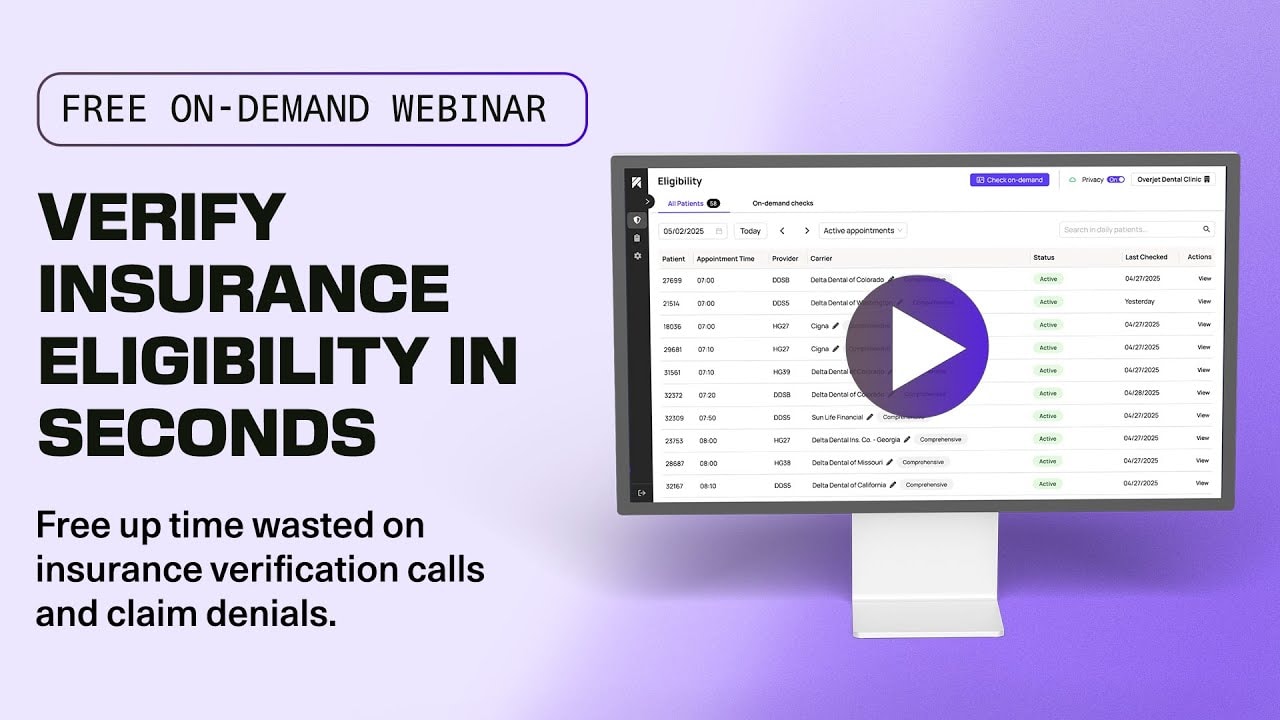
Launch & Learn: AI-Powered Insurance Verification
At a glance
AI can automate insurance verification by reading a practice's schedule and checking eligibility and benefits for every patient before they arrive. Rather than staff calling payers, logging into portals, and rekeying data, the system pulls from the richest source available — payer data feeds first, authorized payer-portal bots next, and legacy data only as a fallback — and returns standardized, code-level coverage, treatment history, and plan limitations automatically.
Core topic: The launch of Overjet's AI-powered insurance verification, aimed at the front office rather than the operatory. The session returns to three threads: why verification is so painful today (fragmented, low-quality data across portals, phone calls, and legacy feeds), how a data-source hierarchy delivers richer and more accurate results, and a live demo of the product — followed by pricing, supported practice management systems, and a preview of Review Pass, a real-time clinical pre-check with payers.Key Takeaways
- Verification is broken because the data is fragmented and low-quality. Ryan Kennedy framed the pain points practices report: too many phone calls and payer portals, lost passwords and two-factor prompts, and incomplete or inaccurate vendor data. Legacy EDI feeds — what many practice management systems and existing products rely on — verify only about 70% of patients, lack code-level detail, and can differ from the payer portal by a 3–5% error rate.
- A data-source hierarchy is what makes the results rich and accurate. The product's edge is preferring the best source: direct payer data feeds first, then authorized bots that log into payer portals and standardize what they scrape, and only falling back to legacy EDI when nothing better exists. Across clinics using it, roughly 90–95% of checks come from those richer 'comprehensive' sources, returning code-level coverage, full treatment history, downgrades, and missing-tooth clauses.
- It runs off the schedule and folds into the front-office workflow. Integrated with the practice management system, it verifies every scheduled patient from same-day up to 10 days ahead, color-codes results (green for active, red for ineligible, yellow with next-step guidance), supports on-demand walk-in checks by name or SSN, and lets a practice add custom codes. Clinics report spending about 60% less time on verification. A preview of Review Pass extended the theme to clinical pre-checks.
In this webinar
Do you also provide treatment history?
Yes. The service history comes from the payer, so it can include care a patient received at a different clinic, shown as richly as the payer provides — by tooth, surface, quadrant, arch, and date. Overjet also approaches payers to request deeper data where it isn't already available.
Can we search without the patient's subscriber ID?
Yes. On an on-demand check you can search by Social Security number, and if the patient is already in your practice management system you can pull them up by name — useful for walk-ins who don't have their card.
Is there an extra cost for custom codes?
No. You can add custom codes yourself, and if the bot can see them in the payer portal it will generally return them in the same format. If a code you added doesn't appear, the team can usually resolve it within a week or two.
Is this 100% AI?
No — it's a mix by design. The aim is to pull from the richest sources (payer portals and payer data feeds) for roughly 90–95% of appointments, falling back to legacy EDI only for the remaining 5–10%, which depends on a practice's patient and payer mix.
How is Review Pass different from verification?
Review Pass is a real-time clinical pre-check: with the patient's information and radiographs, it asks the payer whether a proposed procedure meets that payer's clinical requirements, returning an answer in about one to two minutes. It never denies — it either confirms the clinical requirements are met (so the claim can bypass a dental consultant) or flags that the case is likely to go to manual review, prompting stronger documentation. It was in private beta at the time of the session, and Overjet notes its AI is never used to deny claims.
| Figure | Detail |
|---|---|
| ~60% | Less time clinics report spending on insurance verification with the product |
| 61,000 | Active clinical users on the Overjet platform (as stated) |
| 116 million | Insured Americans touched by payers Overjet works with (about half) |
| ~20% | Share of US dental schools that have integrated Overjet (as stated) |
| 300+ | Payers supported for verification |
| ~70% | Patients that legacy EDI data alone can verify (with a 3–5% error rate vs. portals) |
| 90–95% | Checks drawn from richer 'comprehensive' sources (payer feeds and portals) |
| up to 25% | High-cost complex procedures that can be denied or downcoded, per Overjet |
| $329 / $479 / custom | Monthly price up to 500 visits / 500–750 visits / larger practices (as stated) |
| 30 days | Length of the paid trial offered |
| 1–2 min | Review Pass response time |
Frequently Asked Questions
Why is dental insurance verification so difficult?
Because the data is fragmented and inconsistent. Staff juggle phone calls, multiple payer portals, lost passwords, and two-factor prompts, and legacy data feeds verify only about 70% of patients without the code-level detail practices actually need.
How does AI-powered insurance verification work?
It reads the practice schedule and automatically checks eligibility and benefits for each patient, pulling from the richest source available — payer data feeds, then authorized payer-portal bots, then legacy EDI as a fallback — and returns the results in one standardized format.
How much time can it save?
Clinics in the session reported spending about 60% less time on verification, largely by removing manual portal logins, phone calls, and rekeying, and by handling two-factor authentication through an authorized credential rather than bothering staff for each token.
Does it work with my practice management software?
At launch it supported Open Dental, Dentrix, Dentrix Enterprise, and Eaglesoft, with Denticon, Care Stack, and Dentrix Ascend described as coming soon. Confirm the current list with Overjet, since support expands over time.
What is Review Pass, and how is it different from verification?
Review Pass is a separate, real-time clinical pre-check: it asks a payer whether a proposed procedure meets that payer's clinical requirements and responds in about one to two minutes. It never denies — it confirms the requirements are met or flags a likely manual review. It was in private beta at the time of the session.
Full transcript
Abby: Hi everyone, welcome to Overjet's launch and learn. We're excited to show you our new AI powered insurance verification solution. Before I pass it over to Ryan, if you have any questions throughout the session, please put them in the Q&A box at the bottom of your screen and we'll answer them at the end of the broadcast. Now, I'll pass it over to Ryan Kennedy, Overjet's Chief Strategy Officer to get started.
Ryan Kennedy: Let's jump into it. Um, so what we're going to do today is going to give you a quick uh intro to Overjet. There's a mix of folks who are existing customers and then also uh folks who are new to Overjet. So, two minutes on just who we are and what we're up to. Next, I want to talk a lot about our new insurance verification uh product that's designed to help save your team almost 60% of the time that they spend uh doing insurance verifications. And then we'll open it up. We'll do a demo uh and then we'll take some questions at the end. So, let's jump into it. Um so on overjet you know just our company is focused on improving oral healthcare for all. Uh and the way we're doing that is we're using AI to enhance care uh and reduce friction all across the whole uh dental ecosystem. We work with insurers. We work with dentists. We work with educators. We work with major DSOs and we're partnering deeper and more closely with a lot of the front office staff and office managers solving problems that they encounter every day with their patients all for the purpose of making sure that we can improve oral health. That is our northstar as a company. It's why I joined the company. That's why I've been here for four and a half years is we have a huge opportunity to use AI and better software to improve health for patients. Um uh for those of you who don't and aren't using Overjet uh in the operatory uh what I was just mentioning is that that's where we got our start. That was uh the place that many people know us by. And you know what we can deliver is that ability for your patients to really see what your dentists are seeing. And what that ensures happens every day is ideally we're helping you improve case acceptance. We're helping patients really understand why they need the care that your clinical teams are diagnosing. And then a lot of these measurements that we're doing today with AI also make sure that your clinical team is giving them the most comprehensive uh diagnosis and treatment plan that they can get that nothing's missed and that they're using kind of uh the best measurements and the best detection possible in the industry today. That technology that many of you on this call are already using today in your operatory has propelled Overjet to be the leader in dental AI. We're thrilled to work with over 61,000 active clinical users who are on our platform. Uh we also work with insurers that touch almost half of insured Americans today. Uh so 116 million Americans. And on the insurance side, that same AI technology, what it's doing is it's helping speed along approvals and the consistency of decision-m that's happening at insurance. And we often hear concerns that it's being used to deny claims. I can tell you that Overjet's AI technology is never used to deny uh claims. And then lastly, we work with US dental schools. Almost uh we're approaching almost 20% of dental schools have integrated overjet technology both directly into their curriculum and then into their clinics. Um so we are, you know, thrilled to be named things like, you know, Time's best invention of 2024. Um but Overjet's come beyond just what I just showed you and we've really branched out to other parts to solve problems all across the operatory. We are an intelligent platform designed for the entire dental office. And so I showed you dental AI assistant before. We also have analytics. So if you have multiple sites and you're trying to help understand what's happening and the level of care and the care opportunities, we also have Iris imaging. If you're interested in getting rid of, you know, clunkier or legacy um imaging uh that is on the desktop. We have cloud-based solutions that allow you to use AI natively and capture all your X-rays to the cloud automatically backed up uh with unlimited storage. If you're struggling with credentiing and you want to find a more modern way to submit those applications and save time and take out the hassle and headache of doing that, we also offer credentiing. What we're going to focus on though today in today's session will be insurance verification. Uh, and what we offer here is, you know, the ability to make sure that all of the eligibility and benefits checks that you want to make sure are done before the patient walks in the door are automatically done with the most comprehensive data possible. And the pain points that we have heard over the years of working with some of the largest dental organizations and some of just you know a small single clinic is what we consistently hear is there's just too much work when it comes to verifying insurance. It is phone calls. It is going to payer portals. It is someone reset the password and we don't know what it is. Um or someone who used to work here set it up and now we can't get in. Uh it's also incomplete and inaccurate data from a lot of the vendors that you do go out to and who offer a solution already in the area. Um and then lastly, it's a lack of rich data sources. What you really want when you get that treatment plan and you want to help the patient understand how much it's going to cost for them is you want that code level coverage about what percent is insurance going to cover? Are they going to have anything on frequency limitations? uh you want to know the patient's treatment history. All of that rich data or downgrades. If you can't find it either through the existing source that comes through through your practice management, you know, you may have to go to a payer portal, you may also have to pick up the phone to get that information. And we want to think about can that just be done automatically with AI for you. I'm going to take two seconds to just answer a question that I've been learning a lot about over the last two to three years about like why is insurance verification just so bad today? Um, and any vendor that you talk to, it's it's helpful to get under the hood of like how do they how would you get the edge? Like why why will you give me a different experience than everybody else we've tried before? Um, and what I would say on the bottom here is I I listed out kind of the four big places you can get data in the industry today. Uh, first is, you know, the legacy EDI data. Um, you know, a lot of products that you can buy today or maybe offered right out of your practice management software use this data and it had its time and place, but it's really a legacy standard that hasn't evolved and kept up with the complexity of insurance uh plans and you know the ways that they want to uh structure plans today. And that standard hasn't kept up. And so what we consistently hear from customers is that they often find that they'll get about 70% of the patients uh they can verify through these kind of legacy EDI data. However, their frustration is both they won't get the rich level of data, code level coverage, all their treatment history. They won't get things like down codes, missing tooth clauses. They also report high levels of errors and that sometimes when they compare that data versus what they can see in the payer portal, there may be a difference of 3 to 5% uh error rate between the two sources. Um so what the other places you can get data or payer portal. So you're going to these today and that that in and of itself can be a headache if you need to do that across 15 different um insurance companies. Uh and you may also have staff that changes over time. So you're kind of constantly retraining them. Here's where you go. You co-click here. Oh, you don't have the two-factor authentication. Oh, the password changed today. Like all of that can be a headache. And then you still when you get all that data, you may either have them put it into a form where you kind of standardize it for your clinic. Um that that just takes effort and time and this is hours that you're not spending uh helping patients in other ways that are helping the practice move forward. Um the other place you can get data is many payers are starting to make it uh data feeds available to companies like Overjet and others. Those are like called APIs. Those data feeds are often quite rich and wherever they are available, we have built our product to absorb those because that's often you're going straight to the source. And then last is obviously you can call payers, but no one wants to wait on the phone for 15 minutes or sometimes even an hour just to ask simple questions for a patient. So what I would say is the edge that you're going to see with the overjet product if you were using us is that we are natively built kind of in the richest sources of data where it's if we can get the data directly from the payer we will provide that as a backup. Our next best source is payer portal. So we'll ask you to enter your credentials for the payer portal. We'll send out a bot on your behalf that will log in, find the patient, scrape all that information, standardize it back into a single format that your team understands how to read and how to use. And only when that rich source of data is not available, will we fall back to what you may be able to buy from other vendors, which is this EDI data. Um, so the promise that you can get from AI powered insurance verification is can we help you when we're integrated with your practice management software? We see the full schedule. We'll verify all of your patients for the day. You can set it for anywhere between the same day or up to 10 days in advance. We'll go gather all of that information. You'll get this comprehensive level of data, and I'll show you examples of this in just a second so you get a look and feel for what this would feel like for your team. And then we're getting that data already from your practice management. So you're not needing to go in and enter anything special or jump between uh the systems to tell us who the patient is. And you're getting it for over 300 plus uh payers. And what we find with uh clinics that we work with is that they report spending about 60% uh less time doing this and a lot happier staff about just having a product that does it right out of the box. Um so let's jump into the portal which I think is the most exciting part of any of these presentations. Um so this is our overjet sales portal. So all the data you see here is um you know anonymized. Uh this these are all fake names. Um but what you would land your team would log in today. They'd see all of your patients. They'd see the appointment times that they're coming in for. They'd see the provider they're going to see and then their carrier. Um, and then either same day or up to 10 days in advance, which you can control and set this in your settings, you'll send out uh the overjet bots or the overjet like um uh job that will run and we'll go grab all of this information. Everything that's green means that we are good to go. Active coverage um no issues. Someone will appear in red here if they have inactive or ineligible uh information. So that's helpful for you to know that you need to reach out to that patient um and update their information. Also, if there's something wrong, so let's say we know that the date of birth is wrong and we weren't able to find them because of that. We'll give you kind of rich feedback in the status. You'll see a little yellow and that yellow will often have a little click and it'll it'll give your team instructions like we weren't able to get it, but here's what we would recommend as the next step. So, um that we can help you in any way that we can. Let me drive into what these uh results, you know, can look like here. Um you're going to get, you know, remaining benefits, uh deductibles, when it was checked, all sorts of information about the the plan itself, including important information like uh missing tooth clauses, the benefits uh period. We also, where possible, where it is provided on the payer portal, all sorts of information that you're constantly needing to go find and fill in on your forms. So this can be things like um you know coordination of benefits uh how you know orthodontics how the payment schedule may work on that um it can also be um you know downgrades um so really rich information if it's available out in the world we have found a way to get it and provide it to you. You know just bare warning we continue to add as many places where we can find downgrades as possible but some payers just don't put it out there even today and you still have to call. We are working on solutions for that. Uh but for now, if it's out there in the world, there's a and you can you can tell us, you know, hey, I was able to find it here. Let us know and we can often add it in if if somehow you found it, but we didn't. But we've done a great job of trying to scour all sources of data uh possible to uh provide this information. If you keep scrolling down, what you'll see is, you know, maximums uh for individuals and families, deductibles, what those categories apply to, and then we start to get into the rich code level data. And this is really where you start to see that lift from legacy sources of data who may only give you at like the diagnostics will cover 50% or uh you know this care category will give you at this level. What what you really want is you want confidence in the code level um that there you know is uh coverage how you know co-pays and deductibles work any limitations age and then also you want to be able to pair that with prior treatment history. So the nice thing is for any of these procedures you can see the service history and you know one of the limitations I've often heard and frustrations from customers is on legacy EDI data sometimes you [clears throat] can get a little service history but you might almost only get like the very last um treatment and what you often need to deter determine sometimes these frequency limitations is every time that it's occurred and we give you all of that and you can see it. We'll also give you things like what tooth was it on, surface, quadrant, where that's appropriate uh for the procedure. If there's also special disclaimers that the payer wants to know that they'll have put on their website, we'll list those here. Um so those will be like relevant about it could be a downgrade or it could be other documentation requirements that they have put on their website and they want you to know about. We'll display those. If you keep scrolling down the page, what you see is lots of codes. What we've done is we've picked the ones uh talking to our customers and analyzing data with them that are the most frequently requested, but the good news is we know every clinic uh you know focuses on different types of care and and dentists focus on different things. So we give you the ability to set your own codes and so you can say you know these are the codes that are really important given the type of practice that we have. Um, and what'll happen is the bot will receive those and if it can find those on the page, it will also return them in the exact same format that you're seeing here. Um, so that you can really customize this to fit your office and your needs. Um, we'll also give you information about uh coordination of benefits, uh, any waiting periods and then that rich level of service history um, you know, by tooth, surface, quadrant, arch, um, and date. Um so if you uh one of the other things we also hear that's been popular is being able to check on demand very rapidly. Um I was talking to a clinic yesterday telling us how this has really helped them on same day care where they get a lot of walk-ins. And so you know if someone walks in the door you can enter their information. You can also enter their social security just in case they don't have their card with them. and both of them will go out and um and check and return this ondemand response and we'll get that same level of rich uh data that you just saw. Um so the other thing is uh I mentioned before we use uh payer portals to do this. A question we commonly get is well I use a lot of portals that have two-factor authentication. Is is that going to create a problem here? The good news is no. Um so what we have done is we've solved that in a very smart way too. And I think if you're talking to other vendors, this is one I'd encourage you to ask about is what we will give you is we'll give you an email and we'll give you a phone number and we'll set those up with your team in a quick session. We'll gather together for about 30 minutes. We'll uh go to the portal with you. We'll enter that one time and we basically create our own two-factor authentication credential that you've authorized overjet to be able to get into the portal. And the good thing about that is that means we don't need to bother your team for that little token that will come in by SMS or email. Um, and that took a lot of extra work on our side to make seamless. But what we wanted to say is once you launch with Overjet, like we you shouldn't have to do a lot of maintenance on how it feels to use our product. If we need to reset the password behind the scenes for that two-factor authentication, we'll do that automatically uh with a script uh to do that. So your staff doesn't have to worry about that. Um, so, um, I mentioned before just quickly, you know, on the settings, you know, you're you're able to edit and change anything on your password. So, there's a single place that your team knows. So, you don't necessarily have to have a random spreadsheet or a piece of paper in the office that's got all of these. So, your team has a single place to find things. You can also change how far in advance you'd like these to run. Um, so anywhere between uh same day and 10 days in advance. And then again, you can add custom codes that you would like uh for the product uh to check. Um so I'm going to run back to uh a couple other items and then we'll jump into Q&A. But um one of the key questions we often get is, you know, how do I start using it? How much is this going to cost me? So uh we do price uh by the size of your office. And so for up to 500 monthly patient visits, it is $329 per month. Uh for a larger practice, between 500 and 750 monthly patient visits, it's $479 uh per month. And if you have even larger uh practices, we can give you custom pricing based on the amount of uh patients that you see on average. Uh for everyone on the webinar, we're excited to be able to offer a 30-day paid trial, and Abby will also post that up uh in the chat uh link here. So, you can just add your name and say, "Hey, let's let's give it a try." Also, if you still have really much more detailed questions that you, you know, you'd like to talk to someone in our sales team to get information, you can put that there and our sales team is happy to reach out to you and answer any more detailed questions um about using the product. Couple other things I'll mention um on the product. Um there is a way on that I know a lot of practices are really interested in having a record in their practice management software. Um and so we give you the ability to download all of these. So if you go to one of the pairs, you can just click uh download PDF and then you can uh place that in your document center. Good news is we're also working the engineers are actively working on just having that be automatic for you. So that PDF will just get written back to your practice management software and we expect that to come out uh likely in the next one to two months for some of the major practice management softwares. So um and on the practice management softwares uh I just wanted to mention kind of upfront the practice management softwares we do support um so this is available today on Open Dental on uh Dentrix, Dentric Enterprise um and Eaglesoft. Uh we anticipate also launching shortly with uh Dentacon and um and uh Care Stack uh shortly. So uh and then also actually uh Dentric Ascend. Uh so so many to remember but they are uh coming shortly. So if you have any of those happy to put you in the queue and also let you know as soon as those are available so you can get hands- on with it. Abby, I saw a couple questions I think coming in in the chat. So love to send it over to you for questions.
Abby: Yes. Yeah, we have lots of questions here in the chat. Um, will you also provide treatment history?
Ryan Kennedy: We do. So, yeah, on this uh you can see service history and this is coming again from the payer. So, if they've gone to a different dental clinic in the town, um you'll see it here. We're not we're not necessarily pulling this from your system. So, and as you can see here in the service history kind of as rich as possible will give you um this and one one other thing I'll just mention is you know overjet yeah we're constantly looking for new source of data. There are payers who will give service history but they may not give the richness of the data that you're seeing here. Um we do our best to get it to you. We do also go approach payers and ask them for more data uh if they can provide it but yes we do. Yeah.
Abby: Are we able to search without having the patient subscriber ID? Sometimes patients don't give us our sub subscriber ID.
Ryan Kennedy: You can. Yeah. So, you can search up here uh by uh patient name. So, if they're in your Sorry, actually, let me make sure I say that question one more time because there's two different ways I can interpret it. Say it one more time.
Abby: Are we able to search without having the patient's subscriber ID?
Ryan Kennedy: Yes. Uh yes. So, on the on demand check, you can search by social security number. So they need they need one of those right now. Yes. And then also um if they are already in your practice management because they're your uh patient, you can also pull them up. So like if they just walked in, you can just type in their name at the top and find them in your practice management.
Abby: Um one question, Ryan, was just to put the pricing slide back up if we want to pop back over there.
Ryan Kennedy: Sure. [clears throat]
Abby: Um is there an additional cost for custom codes?
Ryan Kennedy: No. Um and you can add those yourself. So you can you can add those in. And again, what what I would say again is if it's available, if you can see it in the payer portal and you enter it, our bot generally has pretty high ability to grab it. Also, if you if you if for some reason you put it in, you don't start seeing it appear, just let us know. Those are types of things where we can usually resolve it in a week or two. It's not like a major um effort to if if you can see it in the portal, we can generally get it for you. So,
Abby: okay. Um is this 100% AI?
Ryan Kennedy: Uh, no. So what what what I would say is if we jump back to um if you jump back to this slide the the way to think about it is and this is also it's really important under the hood because what you're seeing is the most vendors are starting to say are entering doing payer portal but what you want is you want a product where it's natively like the way we started was we're going to as much as possible go to the richest data and build from there and only when we can't provide a great experience are we going fall back to legacy ways of providing data. So what you should expect um here is and we look across all of our clinics who are using this today will be a mix of uh up somewhere in the kind of 90 to 95% will be what we call comprehensive and when I say comprehensive I mean these two sources so payer portals payer data feeds and only when that's not available will we fall back to the EDI data. So ideally you're only seeing it 5% maybe 10% of your appointments. It's EDI. And where that comes up is it's it's all about your patient mix and what insurance they have today. Could be higher. Ideally, it's as low as possible because the best data you want is either straight from the payers or from their portals.
Abby: Awesome. Thanks, Ryan. There are a couple questions in here actually about review pass and how this process is different. Do you want to walk a little bit through our review pass solution as well?
Ryan Kennedy: Sure. Sure. Um, happy to cover that. So, um, uh, sounds like maybe some folks who've been following, uh, our announcements on that. So, um, for those of you that don't know, uh, Review Pass is, um, I mentioned before on the webinar that Overjet works with payers that touch almost half of Americans today. And what we're doing on that side with insurers is we, you know, if we're provided, you know, the claim and the radioraph, we're able to say almost instantly using AI, you know, is it going to meet the requirements that are set by the clinicians at a payer. Um, and so that's how payers will use that today. They will say, "Hey, a claim just came in. It's for a crown. Like, can you look at it with AI? We're going to write some rules about how much decay or other things that we're going to expect to be present in that radioraph. If it has all those, can you just let us know and we'll have it bypass going to a dental consultant who the dental consultant at the payer is ultimately the one who will deny or downcode something. So what we what we realized with uh for overjet is we said you know that you you know that almost instantly like dentists and you know treatment coordinators would love this information up front to know that the care that's being proposed they want to know will it meet the clinical requirements um that you've set and so that's what has become review pass uh and this is a product that we announced um two or three months ago that we had started doing private uh beta testing for it. I can uh tell you show you that actually a little bit more here actually in the portal. So in review pass so if you were um you know purchasing our insurance eligibility um we don't we don't offer it as default right now for access to review pass but what instead we do is folks who are using our eligibility solution. We are looking at do they have high coverage of a lot of the payers who are available on review pass and we'll reach out to individual clinics and ask them if they'd like to be part of the beta trial as we iterate on that product with some of the largest payers in the country. But what review pass allows you to do and I'll just pull up an example here is let's say that you know a patient has come in uh and they've been treatment planned for something. So in this example, they've been treatment planned for a crown. Um, and what you're very curious about, ideally while the patient is still there, is you want to get a sense of will this meet all the clinical requirements that, you know, in this example, MetLife has for this patient. Uh, what you're able to do is basically just hit submit. Uh, and it will, uh, grab all of the X-rays, the patient information, insurance information, uh, and, uh, clinical notes, and it will pass that over to MetLife in real time. So it's not it's not making a guess. It's not like probabilistically AI thinks this is this is like literally your information is leaving with your permission from your clinic. You're sending it over to Metife. At Metife it's arriving overjet's also at Metife. It arrives. It goes into the overjet system at MetLife and it responds back in about one to two minutes if it will meet the clinical requirements that MetLife has set for this procedure and it will return back with a review pass approval. And what that means is if you move forward on care, um, uh, MetLife is letting you know, great, when you submit that claim in the future, they're not going to have it go to their dental consultant team, and those dental consultants would be the ones who are either denying or downcoding uh, your claim. So, you have confidence that you're meeting the clinical requirements. Uh, one of the things to flag here is today, Review Pass does not do other checks like frequency limitations or age limits or that there's additional benefits for the patient. So that's also why we don't call it today a full predetermination. It's specific to the clinical requirements. But uh what we observe is that uh it depends if it can vary by payer, but up to 25% of things that are these highcost uh complex procedures can often be denied or downcoded. And so we want you to know upfront that it can receive a review pass approval. So you have confidence and can let the patient know they can move forward on care without concern that it's going to be denied or downcoded for clinical reasons. Um, the system never denies, so it's never going to come back and say, "No, this is denied." But what it will tell you is it can tell you if there's any missing information, um, uh, that would help get it approved. And then also, uh, if you don't get a a review pass approval, it doesn't mean that it will be denied. It just means that it's very likely to go to a dentist who's going to review it. And those are also the ones where you want to make sure that you're as buttoned up as possible on your documentation. Maybe the patient's still there, so you want to get an intraoal photo. Maybe you want to double down on the clinical narrative, even more detailed than might have normally been included. Or you might want to do a predetermination in those cases because those are the claims that are going to have a higher risk of not making it through and getting fully approved. Um, so we really think this can be, you know, an upfront transparent experience for dentists and for patients to have a much better and a different relationship with insurance companies in the future. So, um, I'll just recap on on review pass today. it is in a private beta. Um, but we kind of are pulling folks who are using our existing insurance verification off of that and asking them to also um help us continue to build and iterate on that product and make it even better so that when it's even more widely available to the whole industry um that it's uh you know it's it's something that all dentists and patients will love. So
Abby: awesome. Thank you Ryan. We have tons of questions coming through the chat but unfortunately we are at time here. So, what we'll do, we'll follow up immediately after this session and get the answers to those questions if your your question wasn't answered live. Um, if you responded to the poll and said that you were ready to start uh your your trial, someone on our team will reach out to you today. And then if you responded that you have a couple more questions, we'll also have someone on our sales team reach out to be able to answer those questions. So, thank you so much, Ryan, for walking us through it today. This was amazing. Thanks everyone for joining.
Ryan Kennedy: Thanks everyone. Take care. Bye-bye.