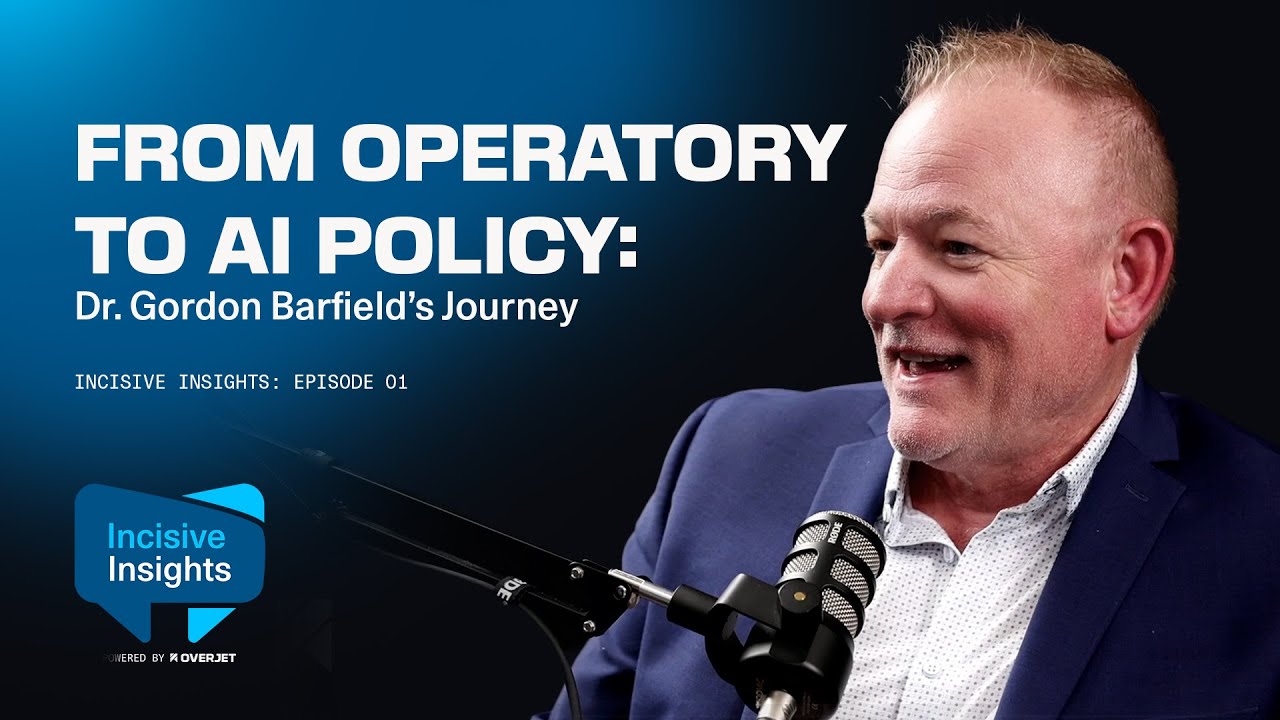
From Operatory to AI Policy: Dr. Gordon Barfield's Journey | Incisive Insights: Episode 1
At a glance
A practicing dentist can move from the operatory to shaping dental AI policy by staying curious, adopting technology early, and translating between clinical reality and product development. Dr. Gordon Barfield retired from high-volume general and orthodontic practice to help Overjet build FDA-cleared AI responsibly—and is finishing a Purdue master's focused on AI policy so organized dentistry has a voice as regulations take shape.
Core topic: Episode 1 of Incisive Insights follows Dr. Gordon Barfield from Air Force and private-practice dentistry through orthodontic retraining at 46 to a clinical leadership role at Overjet and graduate study in AI policy. The conversation returns to three threads: why clinical input is essential when building Class II dental AI, how data reveals society-wide underdiagnosis of oral disease, and what clinicians should do now as AI adoption accelerates logarithmically.Key Takeaways
- Clinical expertise belongs inside dental AI companies, not just on the sales floor. Barfield describes his role as a translator between machine-learning teams and practicing dentists—guiding how Overjet's product is built, deployed, and explained so it serves patients for the right reasons. Overjet employs 15 full-time dentists because the technology is a medical device that requires human judgment in the loop.
- Data is changing what dentistry knows about oral health at scale. Barfield cites evidence that dental disease is grossly underdiagnosed worldwide despite what patients report, and that only a fraction of U.S. dentists currently interact with advanced AI tools. Technology that helps patients see and understand disease—rather than dismiss it unless it hurts—can shift behavior and urgency for care.
- Lifelong learning and informed curiosity are the bridge from chairside to policy. Barfield retrained in orthodontics mid-career, pursued data-science study before joining Overjet, and is completing a Purdue master's in AI with a policy-and-governance track so dental professionals can help shape regulation. His advice to colleagues: do your own research, embrace technology as a better paintbrush—not a replacement—and pursue what makes you get up in the morning.
In this webinar
How did Dr. Barfield go from operatory dentistry to AI policy work?
Barfield followed a family mentor into dentistry, served three years in the Air Force, and built large active practices in Southwest Virginia and later Atlanta—sometimes seeing 35 to 110 patients per day. Mid-career curiosity led him to retrain in orthodontics at age 46. After retiring clinically in 2022, he joined Overjet because he wanted to give back to a profession that had been good to his family. He now travels extensively, works with product and machine-learning teams, and is finishing a Purdue master's in artificial intelligence focused on policy and governance so dentists can participate as AI regulations for healthcare take shape.
What does a former clinician's day look like at a dental AI company?
It is almost nothing like chairside practice. Barfield spends roughly 12 to 14 days per month on the road meeting clinicians while also partnering with Overjet's product organization to guide development decisions. He describes the work as translating an overwhelmingly powerful technology for colleagues who are just beginning to understand what it can do for oral health. Startup pace means long hours—including evenings, weekends, and time on flights—but the mission of reaching millions of patients rather than thousands drives the effort.
Why is he studying AI policy and governance now?
Barfield believes data is the pillar of artificial intelligence and wanted to understand where the technology is ultimately headed in dentistry specifically. Regulations around AI in healthcare are still being written, and he argues organized dentistry should have a seat at that table—not the only voice, but a necessary one. His Purdue program covers project management, advanced data concepts, and governance frameworks that map directly to his daily work explaining what AI is and is not to the profession.
How is AI changing the methodology of dental care?
Dentistry has always blended art and science, but modern computing lets practices analyze outcomes and population-level patterns for the first time. Barfield points to data showing widespread underdiagnosis of caries and periodontal disease, a clinician shortage that cannot meet known need, and patient behavior that ignores problems until they are painful or cosmetic. AI can augment clinicians—like picking up a better handpiece—by making findings visible, helping teams communicate consistently, and moving patients toward care they might otherwise defer.
What should clinicians pay attention to—and what advice does he give peers considering tech careers?
Ignore technology at your peril: AI adoption is growing on a logarithmic curve, and a practice can look entirely different within a few years. Barfield urges informed research rather than floor-talk or magazine headlines, and he frames lifelong learning as a professional core value. For those eyeing industry roles, curiosity is the starting point—find what energizes you and pursue it, because information and opportunity are more accessible than ever. He also notes a shortage of clinicians in the tech sector: companies building medical devices need subject-matter experts along for the ride.
| Figure | What it represents |
|---|---|
| 35–110 | Patients per day in Barfield's high-volume general and orthodontic practices |
| 46 | Age when he retrained in orthodontics |
| ~36 years | Time in dentistry as of the recording |
| 12–14 days | Typical travel days per month in his Overjet role |
| 15 | Full-time dentists on staff at Overjet |
| ~200,000 | Approximate number of dentists in the United States |
| ~10% | Share of U.S. dentists Overjet estimates its tools currently reach |
| Class II | FDA medical-device classification Barfield cites for dental AI |
| 2 years | Time Barfield had been at Overjet as of the conversation—during which the company changed substantially |
Speakers
Dr. Gordon Barfield
Host
Gordon Barfield is a dentist and Senior Clinical Manager at Overjet, and one of the company's full-time clinicians. He focuses on how dental AI supports diagnosis, case acceptance, and standardized care.
View ProfileFrequently Asked Questions
What is Incisive Insights?
Incisive Insights is Overjet's clinician-story series. Episode 1 features Dr. Gordon Barfield discussing his path from operatory practice to clinical leadership and AI policy study at Overjet.
Does Dr. Barfield still practice dentistry clinically?
No. He retired from clinical practice around 2022 after careers in general dentistry and orthodontics. He now works full time at Overjet on product guidance, clinician education, and policy-focused graduate study.
Why do dental AI companies need dentists on staff?
Dental AI is regulated as a medical device and affects real diagnoses, documentation, and patient conversations. Clinicians help ensure software is built and deployed for clinical reasons, keep humans in the loop, and communicate credibly with peers in ways sales teams alone cannot.
Will AI replace dentists?
Barfield frames AI as an augmenting tool—more powerful together with the clinician than either alone—not a replacement for exams, judgment, or patient relationships. The clinician remains responsible for diagnosis and for deciding what patients see and hear.
How can dentists influence AI regulation in dentistry?
Stay informed, participate in professional conversations, and develop expertise in how AI systems are built and governed. Barfield's path—clinical practice, industry product work, and formal policy study—reflects one model for bringing dental voices into regulatory discussions before frameworks harden.
Full transcript
Cady Swindle: Hey everybody, thank you so much for joining in for our first episode of Incisive Insights. An actual brainchild, the name is of our first guest. Uh, but a little play on words with Incisle Insights, if you will, right? Uh, my name is Cady Swindle. I do the channel partnerships here at Overjet. Uh, but really what we wanted to bring home here is the clinician stories that work here. Uh what you probably don't know about Overjet is we actually have 15 full-time dentists on staff. Some of them are cutting teeth, you know, maybe in their free time, but really their their career is now dedicated to uh helping pave the way with AI and dentistry. So, I'm super excited to have Dr. Gordon Barfield here. Hey, Dr. Gordon.
Gordon Barfield: Hey, Cady. What's up?
Cady Swindle: I'm super excited to have you. Thank you for flying down to Tampa.
Gordon Barfield: Yeah, I love it. Great to be here.
Cady Swindle: Um if you will, can you share a little bit about your background um in dentistry? Kind of how it's very interesting. So I don't want to insult you and try to do it myself.
Gordon Barfield: No. No. Okay. Um, of course. Uh, it it is interesting. I agree there. Um, I started out um with a mentor uh in dentistry and it was a person that was in my family uh my extended family if you will uh and was a dentist and I really was a a student of the sciences but really had no interest in dentistry, no interest in medicine at all until I spent some time with this dentist and I realized that uh he had a good life. uh he was able to pick and choose his hours.
Cady Swindle: Golf on Wednesdays,
Gordon Barfield: golf on Wednesdays, golf on Saturdays, church on Sundays. Yeah. And uh it really was a nice lifestyle that I saw and so I actually could pattern myself after him. I could see myself in his shoes and that's really what started me down that path to dentistry. So I studied biology and chemistry when I was in school and loved it and like most science majors had to make a decision on where I wanted to be and what I wanted to do with that that type of information. So that led me into the dental field and uh spent three years in the Air Force practicing dentistry where I did my first residency in comp uh comp general dentistry, hospital dentistry, that type of thing. And then went into private practice and I practiced in Salem, Virginia, Southwest Virginia in the mountains. And you're familiar with the mountains.
Cady Swindle: Oh yeah. Yeah. We're both I don't know if you can hear it in the accents, but we are the probably the most redneck people at Over. So it's amazing that we're kicking this off this way. But yeah, it's it's funny cuz I think like my first day and getting intro and I hear Dr. Gordon and I'm like my people country accents represent, right? But yeah, hey, we got to get scrappy a little bit. So I love you have that background.
Gordon Barfield: Yeah. U so you know practicing in in Virginia, Southwest Virginia, um until about midway in my career when I heard a little voice talking to me and that voice said, "Is this all there is to to dentistry and dental practice for you?" And I answered no. Um because I was curious. I've always been a curious individual in life, uh, as we'll get into in a moment. But, uh, I went back to retrain in orthodontics, believe it or not, and, uh, I was 46 at the time when I did that. So, a very atypical student. Uh, I've remained atypical as a dentist. Uh, I'm kind of tangential to the dental uh, profession, I think, in many, many ways. um and uh practiced ortho in Atlanta, Georgia until 2022 when uh my wife who is a dentist as well allowed me the graciousness of retiring clinically so I let her work and and and I could sit on the couch and read the newspaper and watch football.
Cady Swindle: Nice.
Gordon Barfield: Every man's dream.
Cady Swindle: Yeah, absolutely. Well, the days that you weren't golfing when you were practicing clinically, you know, why we really get into dentistry is, you know, to have those days. Um what did a typical day look like for you? I know you had sort of you've went a lot of different rungs even in just your clinical setting and then even practicing with your wife. So, if you could tell us a little bit about your day-to-day what that looked like.
Gordon Barfield: Absolutely. And it's interesting that it was quite similar from general dentistry to orthodontics because both of my settings required seeing a lot of patients. I was in very large active practices uh anywhere from 35 to 110 patients per day. And so there was a lot of activity. I moved around a lot. I was very busy. We had large staff member, large numbers of patients that we would see in the community. Just a very very very active type practice. Uh and I enjoyed it because uh staying busy is one of my core values. I've always been a person who doesn't sit still very much and that fit with me really well. However, however, um there's some mileage that comes along with that as well. So, uh if you're wondering where my hair went, it was due to being so busy at the chair.
Cady Swindle: Well, you got color still. That's it's kind of blonde. Like we've got the the country, we've got the blonde going. So,
Gordon Barfield: yeah, you can buy the color.
Cady Swindle: Oh, well, don't tell all the secrets yet. Okay. Well, what I love about this is that you're telling the story of so many clinicians that are out there, you know, probably struggling in those career paths and wanting to know what's next, wanting to learn more and Yeah. So, where was that point, that pivotal point for you where it was like, okay, technology?
Gordon Barfield: Yeah, that's a that's a great one. Um I have always because I'm a curious person been interested in science and technology and uh that translated to my dental practices. I was always an early adopter. So when you think about things like digital health record, digital x-rays as an example, um intraoral scanning, we were some of the first uh practices to have those technologies when they came around and certainly 3D CBCT uh in my orthodontic career and now up to AI. So it was a natural progression for me. I just have always been interested in technology and it fits perfectly in with what I'm doing here now at Overjet.
Cady Swindle: Yeah, absolutely. And so what is a day in the life now that you we've talked through your clinical day in the life like what does that look like? And it's funny that I'm asking you this because I think I know what it looks like and there's uh days where it's it's really fast and there's all these things are kind of thrown at you. So like working one at a startup I think is one thing but working and it's such a tech forward and something that we're also passionate about like bringing AI to the dentistry but if you could highlight a little bit of that for maybe our clinical audience that might be thinking you know hey I I want to try something out that's maybe a little bit more tech focused tell them about your day now at Overjet.
Gordon Barfield: Yeah absolutely um and it's really interesting because it is nothing like what you would spend in a dental clinic at all. Uh the two worlds are almost diametrically opposed. Um, I do a fair amount of travel for the company, so I'm a Delta diamond, as they say. Uh, trying to get that first class upgrade every time I can when when when possible. Um, and that keeps me on the road, you know, probably 12 to 14 days a month typically. Um, so busy busy busy there. Um, we also are involved with the product, right? So the clinicians here at Overjet work with the product team as well. And I think this is really important for the audience to know and it's it's one of the most important pieces of work I think that our clinicians do is guiding the development of this amazing technology. Um we want it to be built for the right reasons and the right way. We're committed to that at Overjet and having clinical input into all of the decisions around how the product is built and deployed uh we feel like gives us an edge there and we feel like it commits us to a right path and strategy for this new technology that's going to affect all of us in the profession.
Cady Swindle: Yeah, 100%. Um how what part of this work really gives you the most energy? Is it the clinical conversations, product input, meetings with me, like flying down to Tampa, uh policy implications? I know you've got some things there that we'll share later, but what what gives you energy about being on this side of dentistry?
Gordon Barfield: Well, yeah, it's always cool flying to Tampa to see you. You're you're wonderful, right? Of course. Uh but I think all the above. That's the best way to answer that, Cady. It really is. In in my view, I have one of the best jobs out there because I'm still involved with the clinicians and my colleagues at that level. I see myself as something of a translator. I believe that that's a really important piece of my role sitting, if you will, between this amazingly powerful technology and it's we've never seen anything like this before really in society that's this powerful and then our professional colleagues who are just coming around to learning about its power and what it can do to improve oral health for for society. So, this is an amazing thing. This is why I get up every morning, believe it or not. It can sound a little corny and maybe a little too altruistic, but that's what I have deep inside of my DNA. And so, I get up every morning with with that energy. And um it never lets me down. I enjoy working with a product specialist and machine learning scientists and uh computer engineers here at uh Overjet. And um as well as being out on the road and talking to uh boots on the ground clinicians.
Cady Swindle: Yeah, you bet. I think you put it best with translator because in every facet of what the clinical team is doing at Overjet is translation to some degree. So you I love coming to overjet as a salesperson. I didn't realize the impact that and I really didn't realize how many clinical team members we actually had until it was like on this deck and I was like wait a second and there's so many people you of course I know and then Dr. Baliban we just we have Dr. Perog which we'll highlight all their stories. Dr. Carrie Dolan were just amazing people that are on the forefront and you know in a lot of the things and out and about but there's you know many more that are behind the scenes doing that translation and you know coming from the sales background of like we go to um you know Chicago Benwinner or the Henman and of course we're going to be selling it and you know we try to set the right expectation but it just comes off so differently when it's that clinician to clinician. So um I love that translator piece and then again you do that on the internal side because there's things that we have you know internally that we ask so like sales team or customer service and then of course the product team because you know what I think is really grounded over Jed and you're part of that mission is um you know the ability to have that grounding and have that clinical background and not just say like oh we're going to change the world by doing X but not understanding the history and the foundation.
Gordon Barfield: I think that's absolutely true. And I think that one of the things that um I I really love evangelizing about when I'm out on the road is that this is a clinical company. This is the reason I chose to be here. This is not a company that's just built by a bunch of tech bros and has some cool software, right? We have a mission that's dedicated to clinical care, dedicated to p uh patients and clinicians all around the world ultimately. And being a part of that is amazingly exciting for a uh latter end of your career type of uh role and position. Uh it's it's absolutely thrilling.
Cady Swindle: Yeah. Well, I have self-deprecating humor, of course. So,
Gordon Barfield: of course you do
Cady Swindle: have to. Um the the accent kind of leads me into that because it's like, well, I got to, you know, buffer this a little bit. Got to sandbag some. But it's so funny to see people's faces whenever I'm like, guess what? I'm not going to train you on this product. it's actually going to be a hygienist or a dentist. And like their faces light up because they're like, "Okay, somebody who's been in my shoes, not somebody who really wants to put lipstick on a pig and is going to like sell it, you know, to be something that it's not. You guys understand the clinical application." And so I love that. Uh so just pivoting now because I learned something about you that I didn't know. Um which is well I knew this kind of but I you know I knew you're super smart but
Gordon Barfield: Well, thank you.
Cady Swindle: You're a genius and you have the accent. Dang it. Um, I'll have to work on that. But, um, your studies in policy and what you're doing now, tell me just start from the beginning with your masters and what you're doing there and what you're trying to drive.
Gordon Barfield: Yeah, it's interesting. Um, um, because I have done some study in data science uh, before before coming to Overjet. In fact, um I've always been very very interested in the foundations of data and as you know data really uh serves as the pillar of artificial intelligence. Without the data you don't you don't really have AI. Um and I I began to wonder about where all this is ultimately going and specifically where is it going in dentistry right because dentistry has been my career. Um so I am currently at Purdue University right now finishing up a master's in artificial intelligence. I'm going to take a track that is focused on policy and governance, policy management and governance. And I'm especially interested in being able to have a voice at the table um when the regulations around AI, which will ultimately be coming and changing um are ultimately laid out, right, for for dentistry. That's that's currently taking place now, but it isn't fully vetted out. And so I feel that organized dentistry, dentists, dental professionals should have a voice at that table. Maybe not the only voice, but we certainly should have a voice at that table. So I'm interested in in being a part of that and uh seeing where we can drive this for the most good because as you know, we talk about this a lot. The idea is not just to build something, but to build it for good, right? Build it for something that benefits mankind. And that's what we're doing here. And so uh having the professionals who are involved with utilizing this type of technology in that conversation I feel is crucial.
Cady Swindle: Oh it's huge. And I think so much of the time we think I say we they think healthcare includes dentistry but the reality of it is it it does in the sense but whenever you think about the people at the table it's usually not
Gordon Barfield: often times. That's right.
Cady Swindle: Yeah. And it's usually kind of like the the second thought. So I I feel like that's extremely important because we have to get a grapple of like what what is the impact of this? And what's interesting to me is that I heard this from Dr. Terry Dolan the other day. We were talking about universities and we were talking okay what is the impact and what are we doing? And of course coming from the sales background I'm thinking numbers numbers numbers and and she said you know something that really resonated with me of when we put this in the hands of schools we're teaching people responsibly. It's not just about like, oh, I'm attached now to this brand. It's responsible use of AI. So, I feel like you embody that that same sentiment. And I was like blown away by that that mission of of hers.
Gordon Barfield: Well, I appreciate that, Cady. And um but it's true. It really is true. I think that um one of the things that um rings home at this stage of life is that dentistry has been very very good to me and my family personally. I've reaped so many benefits throughout life um being involved in dentistry. There comes a time for most of us when we kind of wake up, if you will, later in life and think, you know, this would be a good time to give back. And I feel like this is a natural place that I'm going to be able to give back uh to the profession that's given so much to me.
Cady Swindle: Yeah. And what are some of the things that you're getting out of that program now where you think there's going to be an immediate impact?
Gordon Barfield: Oh my goodness. Um, it runs all the way from project management to to advanced data concepts, right? I mean, it it's it's incredibly um linked and relevant to the work that I do every day at Overjet. Amazingly. So, um, learning the the the background of this technology, learning how it's built, learning the history of the technology allows me in my role to go out and to be that translator. you know, if you don't really know the definition of something, it's very hard to teach it, right? If you don't know about something, you can't teach it. So, in my role as a translator, it's essential for me to have a really firm grasp on what AI is and what it's not. And so, um, you know, this this program at Purdue is really helping me with that. Um, I feel like when I come out of there, I'm going to be positioned in a really wonderful place to be able to make that mark with within this profession that I've been in for now 35 going on 36 years.
Cady Swindle: Yeah. And how do you balance all of this? Because I know you you're on the road. I'm asking you to come to Tampa and let's go do TopGolf and do the things, but um, how are you balance just from a time perspective? How do you do both?
Gordon Barfield: Listen, it is not easy. I can tell you that is it is increasingly difficult. That's one of the benefits of not having children at home, right? You don't have to raise kids. Then you have time to do other things. But um to answer that, um really honestly, it's all about a lot of work on the weekends and at nights to be honest with you. Um one of the benefits of uh being a frequent flyer is that you do have some time to be able to actually work. And now that we have decent Wi-Fi on most of our airplanes, uh you can get some school work done on those.
Cady Swindle: Yeah, we need to cut to a Delta commercial cuz their Wi-Fi really is banging. I'll go on a Southwest flight and expect to like buy, you know, we pay freaking $15 for a one-hour flight and I can't get anything. I barely get one slack. And of course, you know, you know, in the world we live in today, that's horrible. And Delta, it's free, you know. So, yeah, I'm sure you're getting a lot of work done on the
Gordon Barfield: Oh, yeah. You get some good reading and and you get um uh a lot of uh research done, things like that. It's kind of quiet time. Put in your AirPods and and and just kind of go to work, you know. And that's not to say that we don't do a lot of work for overjet as well on the on the plane, but you know, if you're on a two to four to even a 5 hour flight sometimes um that's a lot of time to get things done. So
Cady Swindle: yeah, a lot of quiet time too where you're not having to
Gordon Barfield: Yeah. Absolutely.
Cady Swindle: Outside distractions.
Gordon Barfield: Absolutely. And I would I would add here that um this is sort of uh ancillary to that question but you know the advent of Gen AI and LLMs has really really helped us to be able to do research at scale u where before it required so much time just with the basic parts of research. Now we can kind of uh boost that up uh utilize tooling to help us to get our uh work done quicker. And you got to validate it, of course, but um it really has helped us in in terms of getting a quantity of work done in a much shorter period of time.
Cady Swindle: Yeah, a thousand%. I love that that validation piece because that's with everything that I think I've had output from any Claude Chad GBT and it it helps me so much, you know, with the foundation, but of course like putting that final touch and like making sure it all looks good. Uh huge timesaver. And you know that's a great point about like what you're doing with your research and your master's program. Is there anything that's you're studying today that is immediately applicable to overjet?
Gordon Barfield: All of it.
Cady Swindle: All of it.
Gordon Barfield: Every bit of it is. Yeah. Every bit.
Cady Swindle: So are you going to go create laws to help us or
Gordon Barfield: Well, listen, I'm I'm not a lawyer. I play one on TV, right? But uh no, I think that we we need to have uh all of the stakeholders have to have a seat at this table in the discussion around what regulations are um are are going to be needed because the power that resides in the technology as you know is overwhelmingly um amazing. It it is incredible the power that is sitting here and that if used in the wrong way is a real problem for society. Right? So I think that we're going to need some constructs around how it should be constructed, how it should be deployed, how it should be utilized. But if we deploy it properly and we utilize it for good, which is of course what we're doing here at Overjet, then I think that the outputs and the um increases in um really really valuable um things for society and in our case health outputs, oral health outputs um are going to be things that we can all look at and be quite proud of.
Cady Swindle: And that's why I think the governance and the policy piece is super important. Yeah. And if we could zoom out just a little bit, you know, with this intersection of AI, public health, and what you're doing, so if I'm a clinician that's listening to this today, you know, what should I be paying attention to regardless if I'm using AI or not in my practice, like what should I perk up around?
Gordon Barfield: If I'm a clinician, I think that um anyone would be remiss to ignore the concept of technology and its effect on on clinical practice and healthcare because the effect is huge today and it's just getting started. It's going to be much much bigger into the future. It's growing at a logarithmic rate. So I don't think we have the option of maybe burying our head in the sand and saying we've always done it this way. I'm going to reject technology. Technology in general is going to do wonderful things for health outcomes uh both in medicine as well as in dentistry. So I I think for sure um not ignoring technology is critically important. If we think about it from the AI perspective, that's where the growth is the steepest. The growth curve is the steepest here. And um I know it's a it's occurred to me. I've been here at Overjet for 2 years and the company is an entirely different company than when I came on in uh 2023. So, um AI is going to be something that we cannot avoid in our lives in society. Uh we should embrace it. We should look toward where can this tooling help me do what I do and in our case care for patients, right? And then um the ability to utilize it in the proper fashion and to to be able to have it augment what we are already really really great at doing which is caring for patients. This is just like picking up a better paintbrush, right? Or a better dental handpiece or a better dental x-ray if you will.
Cady Swindle: Yeah. It allows you to do so much more. And I think about the time like this is really stupid example but like time it takes me to construct an entire email and like all the thought that goes into it and I want to make it perfect and you know having that ability to leverage AI to at least structure it and you know like it's not that it it could write that email for me and everybody would or wouldn't know it's AI. People would probably know if I just sent it as is. But it's me plus that that makes the output that much better which is what I love about your sediment. You know it's you get to go back to doing what you're good at you know which is patience.
Gordon Barfield: Absolutely. And it augments uh the human right. So we think about in the collaborative perspective the human and the computer more powerful together
Cady Swindle: in your view clinicians that are listening today what can they do to get involved to you know help influence dental technology?
Gordon Barfield: I think the first thing there is is one of the most obvious things. I think they have to understand it and and they I don't believe anyone really has the the option if you will right now to just say it's coming. It's cool but I just want to keep going in the same direction because the rate of change and the rate of growth here is so steep that a person could literally look up in a year, two years, three years and be in an entirely different practice setting than they are today. So I I would I would behoove any of my professional colleagues to make sure that you have a base level knowledge about this technology, understand what it can and it can't do and how it is going to impact your practice moving forward.
Cady Swindle: Yeah. And I think that the sentiment there is, you know, do your own research regardless if you're adopting or not. Like do real informed research. Don't just listen to what you know your colleague is doing or what you hear on the show floor you got a magazine about. like do informed research, determine how you feel about it, because it it is coming. And what I love about this time period that we're in um is that you can have a voice and be impactful no matter what position you're in. I think it's so funny to see like the rise of the dentist on Tik Tok that are like dancing and doing these things and you keep scrolling and there's like this these nuggets of genius and the things that they're doing and they're sharing and there's there's so much information out there and I think people struggle with that and I did I I went to school for accounting. I thought accounting was the only thing I was ever going to do and you know kind of woke up like you one day and needed a pivot and there's so many people that are in that spot but you have the ability to have a voice and to exercise on what you're you've been very tactical about it you went back to school um you got certifications you you pursued overjet and like got really involved and are now even pursuing that further but I know for the normal dummies like me you know it's like we struggle with what is that next step. How do I have that voice? And I love that we live in this world where there is so much access to this information and there's also access to help influence that. So,
Gordon Barfield: absolutely there is. And I think that that just wraps back into the technology thing again. It's super easy to do nowadays for a person who wants to do it. Literally wants to get up and and do whatever it is. Whatever your your your goal is, whatever it it makes you, you know, get up in the morning. It's easy to go do that nowadays. just get up and do it. The other thing I would say I think that's important here that ties into the concept of uh how a person becomes a professional is one of our core values as professionals and it's it's in our DNA is this business about being a lifelong learner. I think that's super super important for any person who doesn't carry that sort of thought process throughout their life. I think they're missing something. I think that they're missing something that's really valuable and really can provide a lot of uh incredible self-worth to any any human being inside that self-learning concept that that lifelong learner concept where you can pick up a book, you can pick up a magazine, you can get on the internet, you can learn claw chat GPT, you can learn to code Python, I did and R and all of those fun cool things if you just open up your mind to be able to do it. So, I think that, you know, you think about the younger graduates as an example. Our our younger folks are training up in our our dental schools with AI. Now, those folks are going to be so well equipped when they come out, but they're also coming up into a society where knowledge is available at the flick of a mouse button. Knowledge is available. It's readily available. And that should be empowering for anybody that wants to utilize that knowledge.
Cady Swindle: Yeah, I love this this mind shift and like your your talk about the adult learning and having that passion and like just continuing on. I think that it falls back to doing what you love and finding those paths. Is there anything that influenced you? Like was there an experience that kind of shifted you where you're like, "Okay, I I'm now a life like how do you get into that? I want to be a life learner now. Like I need to go read."
Gordon Barfield: I I remember telling uh our CEO, Wara, um at one point we were at a meeting and she she kind of looked at me and she said, "A retired orthodontist, what in the world are you doing here?" And I thought, you know, I it was a curious question. It's not the first time I've heard the question. It was just the first time that Warda posed it to me. And I turned to her and I looked at her with with all the seriousness that I could gather and I said, "I've just always been curious, WA. I'm a curious person." And so, um, I I I think it's a that's one of my superpowers, if you will. Um, but it doesn't mean that that can't be developed. I think that, um, you know, for folks who would be interested in any subject matter, today is the best time to pick up, uh, something and start to learn about it, right? Yeah. Uh, if you want to grow a tree, the best time was 20 years, but the second best time is today to plant it, right?
Cady Swindle: Oh. So, how does this change the entire methodology of how we're looking at dental care?
Gordon Barfield: Oh, boy. How does it change? I mean, it's like night and day.
Cady Swindle: Sorry, that's very open-ended.
Gordon Barfield: No, we're it's a great question. I think we are in an era now where just like I mentioned about if you want to learn something, it's at your fingertips. You know, now dentistry is a legacy space as we all know. It's always been about as much art as science, right? Maybe even more art in some in some cases. But you think about the concepts of data, right? Data has been around forever. We've never had computers like we have today though to be able to crunch this data. So we're now able to understand things about our dental practices, our dental patients, their oral health, our outcomes through the lens of data for the first time ever. And we are actually finding some things that we didn't know before. as an example. Um, uh, despite what our patients tell us, we are grossly underdiagnosing dental disease around the world, grossly underdiagnosing it. And that should be concerning for anyone who is or has as a mission to improve folks dental health and oral health, right? And we learn that through data. We didn't learn it just because somebody said it or had a gut feeling. The data shows us that. And so I think that um uh the foundations of data within dentistry and the unique inferences and insights that we're able to get from it are really changing how we view the overall dental health of of society at large. And I think that we're not as healthy from a dental perspective as maybe we thought we were
Cady Swindle: 100%. And you had told me something the other day that was really impactful of that what there's 200,000 dentists in the US
Gordon Barfield: roughly. Y
Cady Swindle: and um there's about 10% we're touching 10% of the world, which to me is terrifying. I am a I want to know everything about what's going on. I try to catch it. I'm such this iPad baby generation. Um how do you think that technology is going to help address that? Like is it is it a labor shortage? Because I to a degree like when I came to overjet I had this realization that I was a part of the problem of as a consumer as somebody who you know goes to the dentist I immediately think how is this going to impact my wallet does this hurt me are my teeth still white and if it didn't check any of those boxes then I'm probably not going to deal with it today. Um it wasn't really till I had more impactful you know reasoning and evidence that I started to really value that. So is it labor? Is it um you know the consumer mindset? Is it a shift? Like what is impacting this 90% gap of where we're catching and diagnosing oral disease?
Gordon Barfield: I think there are a number of things there. I think certainly human behavior is part of it. I think there is a bit of a a labor uh shortage as well. We we don't have enough oral health clinicians certainly in the United States to be able to take care of the dental need that we know is there based upon the data. And then I think the other thing is leveraging technology and in this case we think about AI to actually move patients understanding of what their disease is right so to take them from a position of as you said if it's if it's not pretty or hurting you know I don't really care too much about it right it's not important but it is important we know it is and can we utilize technology to be able to move the patients needle on understanding and then ultimately driving urgency for them to be able to accept and request care that we as clinicians know that they should get for a number of different reasons, right? Not the least of which is that dentistry and oral health of course is affecting our entire body and uh that that's not refutable in 2025. So there are very important reasons why we can leverage things like AI to be able to have outputs that aren't just getting treatment but that are including things like changing behaviors.
Cady Swindle: And so if we're just kind of like looking back a little bit, I feel like we could dive into all of the uh deals with the industry today and what we want to change about it. But you know, I want to talk a little bit more about you cuz I think your story is so interesting. You're scaring me.
Gordon Barfield: Sorry.
Cady Swindle: So, if anything, what do you miss about clinical practice now that you're on the tech side?
Gordon Barfield: I'll tell you, I I do miss um interactions with patients and their families, particularly long-term ones. Uh th those are very important things. And since I've been out of practice now for going on three years, I realize that I miss my interactions with my staff a lot as well. And it's not that we don't build wonderful friendships uh here in industry here at Overjet. uh you and I have come to become very very good friends in the last two years. We joined at about the same time. Um but it's a unique relationship that you carry with your patients and then then with your staff as well. So I miss those things. I do not miss seeing a 100 patients per day. I don't miss an aching back or an aching neck. Right. Those are the things that
Cady Swindle: Delta takes care of you for that.
Gordon Barfield: Yeah. Right. Delta uh but that you know dentistry is tough. It's a it's a very very difficult profession for those who don't know about it. And um I won't miss those types of things. But I I also on the other side of that fence find so much energy in the knowledge that what we're building here uh with artificial intelligence and what I have a very tiny tiny hand in helping to build doesn't affect tens of thousands of patients who I treated in my career very successfully with wonderful outcomes but it now affects and potentially affects millions of people. That thought, that notion is incredibly powerful and it certainly does drive me every day to get up and go to work and to put in the effort.
Cady Swindle: Yeah, I love that. Um, and if if you're looking at, you know, a clinician that wants to make that swap, you know, do you have any advice for them if they want to go clinical into tech or tech policy, what's your advice to them?
Gordon Barfield: Well, I would say, um, it goes back to the curiosity piece. you have to um be interested in something to to want to really go go toward it, to drive toward it, if you will. And so I would say find um what makes you tick. Find what you're really really interested in and then get up off the couch and pursue the thing. Just go do it. It's it literally is that simple. Particularly in this era where we have information at our fingertips, right? So absolutely, just go do it.
Cady Swindle: I'm scared to ask this one, but
Gordon Barfield: I'm scared to answer.
Cady Swindle: If somebody were to shadow you for a day, like a dentist or whoever, what would be the one thing that you do during your day at Overjet that would surprise them most?
Gordon Barfield: There are a couple things, but I think what would probably shock them is the number of hours that that we put in and our clinical team puts in uh in in pursuit of this building this technology. Um, of course you mentioned earlier that we work for a startup and startups are difficult by nature. It's a really, really tough job. But the difference between doing dentistry for three days a week, which I probably average three maybe three and a half days a week in my entire career, versus working full-time, sometimes seven days a week, not all the time, but sometimes we're seven days a week at this at Overjet because the mission just, you know, it needs it. You have to uh get done what needs to get done. um probably would surprise most people. I think that most people would also be surprised to know that there are there's the need for clinical expertise in the tech sector that there exists. I remember having an interview uh well before I joined. I was uh doing my rounds of Zoom meetings with dentists and you remember this story that I could identify uh were in the in the tech sector because I was so curious about that and one of them was a um a product manager and I asked the question to this product manager do they even need dentists in in the tech sector and the answer astounded me she said not only do we need them we can't find them there's a shortage of clinicians so I think we're in this era now where um technology is going to be um rapidly accelerating its pace of development in every single area, right? And especially with AI. And we need to have dedicated clinicians, subject matter experts along for the ride because the the consequences if we get this wrong can be significant, right? That we're not just selling software. This stuff is a medical device. It's classified that way. And so we do need to have and I uh I really congratulate the founders of Overjet for this vision is that putting and positioning this as a clinical product right and making sure that it's built the right way for the right reasons and we needmemes to be able to come along that ride. Uh it's not possible to do to do without the clinical expertise.
Cady Swindle: Yeah. And that's that's really why I wanted to bring you in here today because you you have such an amazing story. So, thank you so much for sharing that and offering up all your advice to, you know, people. I took a lot back, of course, but I I know a lot of clinical team members and we get a lot of DMs and things of like, what do I do next or I'm interested in this? So, everything you've shared here today, like I think is very tactical information for not just clinical teams, but those around the world that really want to continue this life of learning. And
Gordon Barfield: I I think that's exactly right. and I feel those those questions as well and certainly always happy to to answer them and and and to share my journey. It is it is a unique one. It's different. It's not the typical dentist journey. Um I've threatened to write a book around this, but I haven't gotten started yet. And I'm hoping maybe that I can utilize some LLMs to help me get that book off the ground. But right now, I've got too many hours dedicated to to Overjet and also finishing up this uh masters over at Purdue.
Cady Swindle: Yeah. Well, everybody, you heard it here first. It's going to be www. gordonthoughts.com kind of like on the office or it's just a word. Anyways, just kidding. Um, but thank you so much Gordon for spending time with us. It's been a pleasure. Um, you guys, I I really encourage you if you're out there clinically and thinking about what are the next steps. uh follow along in this series because we're going to highlight each of the clinicians journey here at Overjet and they're all so different but you know I think the end message here is that they have a passion for making an impact in this industry and that doesn't just stop whenever you're there chairside like you can do that with what you're doing today but uh we're really excited to continue on this journey and thank you so much Dr. Gordon for spending the last few minutes with us.
Gordon Barfield: Yeah, Cady, you bet. It's always wonderful to see you as well.