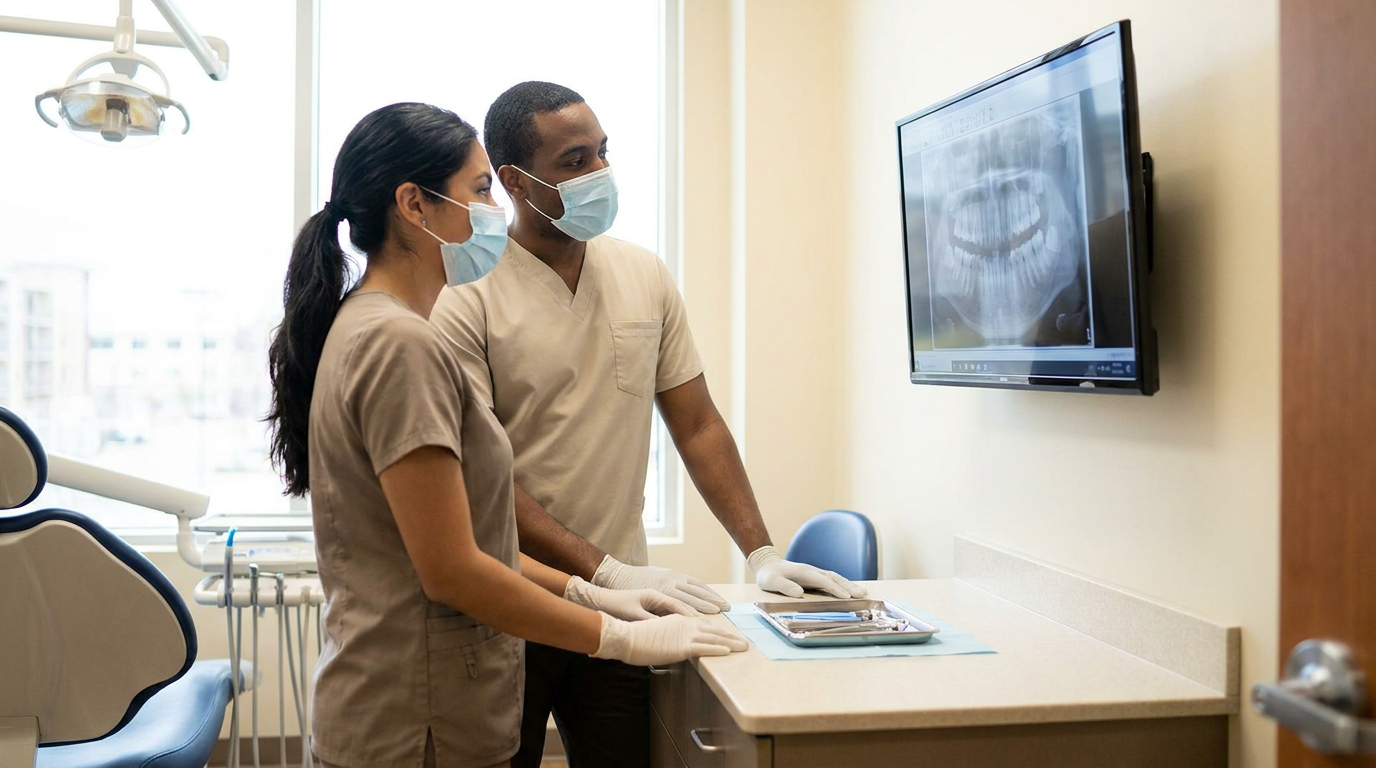






Overjet’s FDA-cleared technology provides objective standards for oral health decisions.
Administrative work consumes up to 40% of dental staff time, hours spent on insurance calls, manual data entry, and claim follow-ups that pull your team away from patient careOverjet’s FDA-cleared AI powers comprehensive diagnosis and improves patient education The cost shows up in delayed treatments, staff burnout, slower revenue cycles, and patients who feel like just another number in the queue.
Automation and AI can eliminate the busywork that bogs down your practice. This guide covers proven strategies to reduce administrative burden, from real-time insurance verification and AI-powered claims to digital intake and smart scheduling that runs itself.
Explore Overjet's Dental AI Software
Biggest Time Drains in Dental Administration
Administrative tasks in dental practice include all non-clinical work required to keep the office running, insurance verification, appointment scheduling, patient documentation, billing, claims processing, and referral coordination. Digital systems and automation platforms can cut the time staff spend on repetitive manual processes like eligibility checks, data entry, and claim follow-ups.
The most time-consuming manual processes create bottlenecks that limit how many patients a practice can see:
Insurance verification: Staff spend hours on hold with carriers to confirm eligibility, understand benefits breakdowns, and check frequency limitations for specific procedures.
Paper chart updates: Manual charting and scanning paper forms into digital records consume front-office time.
Appointment confirmations: Repeated phone calls to confirm, reschedule, and fill last-minute cancellations tie up phone lines.
Referral coordination: Tracking inbound and outbound referrals across fax, email, and phone creates gaps in communication.
Claim follow-ups: Chasing payers for claim status, correcting coding errors, and resubmitting denials extend the revenue cycle.
These tasks don’t require clinical expertise, yet they pull staff away from patient-facing work that builds loyalty and drives case acceptance.
How Manual Processes Hurt Revenue and Patient Experience
Manual administrative work creates hidden costs that erode both dental practice profitability and patient satisfaction. Delayed insurance approvals push treatment start dates further out, giving patients time to reconsider or abandon care plans. Staff burnout from repetitive, low-value tasks increases turnover, which drives up training costs and disrupts continuity of care.
Patients experience long wait times, repeated paperwork requests, and communication gaps that damage trust. Avoidable claim denials from incomplete documentation or missed eligibility details slow cash flow and increase accounts receivable aging. When your team spends hours on insurance calls, they can’t schedule additional patients or support treatment coordination.
The cumulative effect is a practice operating below its potential, with providers seeing fewer patients and staff stretched too thin to deliver excellent service.
Strategy Framework to Eliminate Low-Value Tasks
A systematic approach reduces administrative burden without disrupting patient care or clinical workflows. Start with a baseline audit of current processes, then implement solutions iteratively with continuous team feedback.
1. Identify Tasks With High Touch and Low Complexity
Target work that is repetitive, rule-based, and time-intensive but doesn’t require clinical judgment. Data entry, transcribing patient demographics, insurance details, and paper forms into digital systems, tops the list. Appointment reminders and confirmations follow standard scripts across text, email, and phone channels.
Basic insurance checks for eligibility, procedure frequencies, and waiting periods involve navigating payer portals or phone trees with predictable steps. Document gathering for claims and preauthorizations often means collecting the same radiographs, narratives, and perio charts repeatedly.
2. Map Current Workflow and Bottlenecks
Diagram each administrative process from start to finish, noting the owner, required inputs, outputs, and handoffs between team members. Track time spent per task for two weeks to pinpoint the top time drains with actual data rather than assumptions.
Note rework rates, how often tasks need to be redone, and common error types that trigger delays or denials. Prioritize fixes by impact, calculated as hours saved multiplied by frequency, and feasibility, measured as effort required to change the workflow or adopt new tools.
3. Select Automation Tools With PMS Integration
Require native integration or certified APIs for your practice management system to ensure real-time, bidirectional data sync across patients, insurance, appointments, ledgers, and images. Look for role-based permissions that control access by job function, audit trails that track every change, and automatic write-back to charts so updates flow seamlessly.
Evaluate reliability through uptime SLAs, support responsiveness, and implementation services that include configuration and training. Poor integration creates more work than it eliminates, data silos, duplicate entry, and reconciliation headaches.
4. Train Team and Iterate Processes
Communicate the reasons behind changes and the expected benefits for both staff workload and patient experience. Secure frontline champions who can troubleshoot and encourage adoption during the transition. Pilot new tools in one location or with one team first, collect feedback on pain points, and refine workflows before expanding.
Provide short, role-specific training sessions and quick-reference guides rather than lengthy manuals. Roll out in phases, monitor KPIs monthly, and iterate based on real usage patterns and outcomes.
Automate Insurance Verification and Claim Review
Insurance administration represents one of the heaviest administrative burdens in dental practice, automation can eliminate phone calls, reduce denials, and accelerate payment cycles. Overjet’s AI-powered claim automation capabilities streamline claim review, documentation support, and payer-facing evidence by connecting clinical findings directly to administrative requirements.
Real-Time Eligibility Checks
Automated eligibility systems query payers in real time to retrieve coverage status, benefits, procedure frequencies, and waiting period limitations without staff intervention. Staff no longer need to call insurance carriers or log into multiple payer portals. The system surfaces actionable benefits information at scheduling and check-in, preventing downstream denials by validating coverage before treatment starts.
AI-Driven Claim Adjudication Flags
Claim adjudication is the payer’s decision process on whether and how much to reimburse for submitted services. AI can pre-screen claims to flag missing attachments, incomplete narratives, coding inconsistencies, and medical-necessity gaps before submission.
Overjet’s diagnostic AI provides clinically supported evidence and annotated radiographs that strengthen claims and preauthorizations by demonstrating clear clinical findings. This documentation reduces payer pushback and appeals, particularly for higher-value procedures like crowns, perio therapy, and extractions.
Reduced Denials and Faster Payment Cycles
Accurate first-time claim submissions reduce rework, appeals, and write-offs that drain staff time and delay revenue. Clean claims accelerate payment cycles, improving cash flow and reducing days in accounts receivable.
Use AI Imaging to Sync Clinical Findings With Documentation
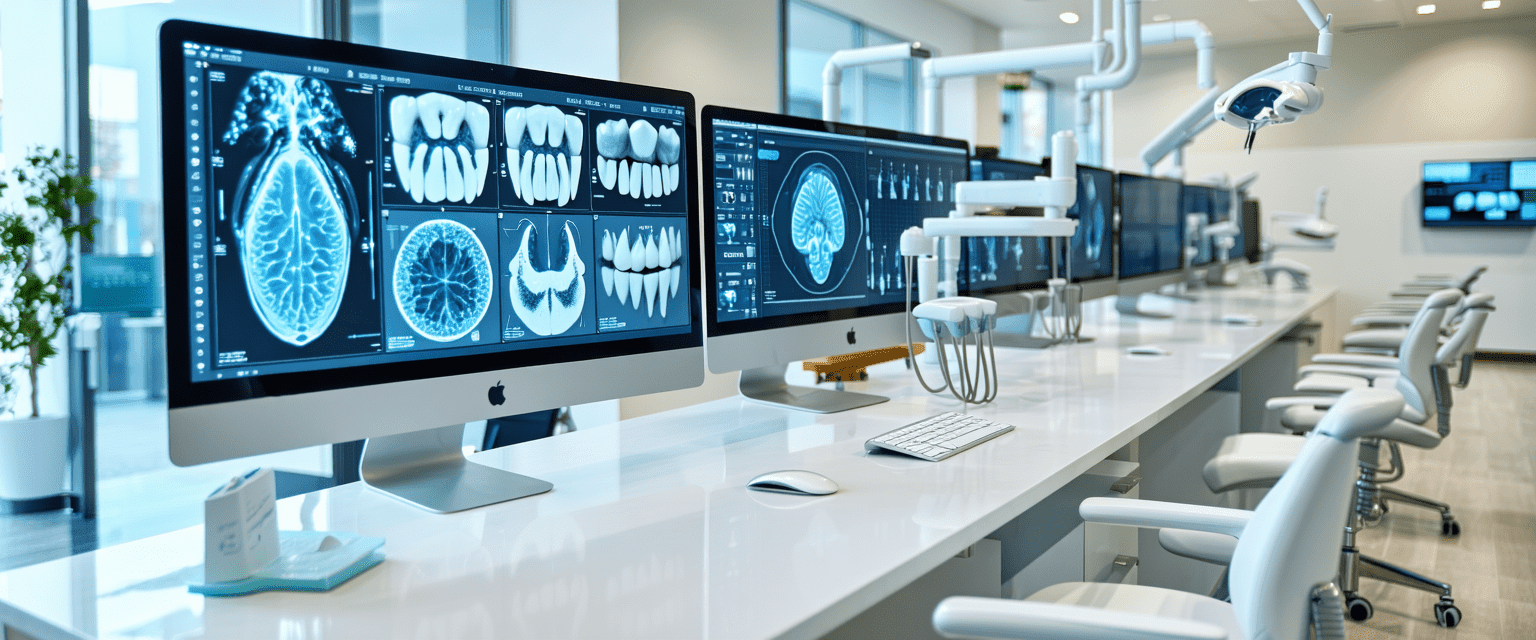
AI diagnostic imaging ties clinical evidence directly to documentation and claims, eliminating the gap between what the provider sees and what gets recorded in the chart. Overjet’s FDA-cleared solutions automate disease detection and documentation, bridging clinical and administrative workflows in a way that saves time and improves accuracyOverjet is the only dental AI technology FDA-cleared to measure bone levels, detect caries, identify calculus, and outline decay. Clinical studies show Overjet’s AI measurements have an average difference of only 0.3mm compared to dentist consensus.
Sources:
Overjet Earns FDA Clearance to Enhance Dental Images with AI
Overjet’s FDA-Cleared Dental AI Named to Fast Company’s 2023 World Changing Ideas Awards
Overjet Expands Dental AI Detection Capabilities with New FDA Clearance
Automatic Disease Detection on Radiographs
AI identifies caries, bone level measurements, calculus deposits, periapical radiolucencies, and other conditions on radiographs with high precision and consistency. This automated detection supports diagnosis, treatment planning, and payer documentation without requiring providers to manually annotate every image. Consistent, objective findings reduce variability across providers and strengthen clinical justification for recommended treatments.
One-Click Chart Notes and Attachments
Generate chart notes, clinical narratives, and required image attachments from AI findings with minimal manual input, often a single click. Staff no longer spend time manually updating charts and assembling claim packets with the right radiographs, measurements, and annotations. Instead, they can focus on patient communication and coordination rather than administrative paperwork.
Visual Aids That Boost Case Acceptance
Patient-friendly, annotated images make oral health conditions and their urgency immediately clear to patients who may not understand clinical terminology. Improved understanding leads to higher treatment acceptance rates and fewer deferred cases, which directly impacts practice productionOverjet’s AI helps catch dental problems earlier and improves patient understanding of treatment recommendations. When patients see visual evidence of decay or bone loss, they’re more likely to move forward with recommended carePractices using Overjet see an average 27% increase in case acceptance, with 85% of patients more likely to accept care when they can visualize their conditions.
Sources:
Digitize Patient Intake and Health Histories
Paperless workflows save front desk time, reduce data entry errors, and improve the patient experience by eliminating clipboard forms in the waiting room. Digital intake also creates a cleaner, more organized record that integrates seamlessly with your practice management system.
Mobile Forms and E-Signatures
Send mobile-friendly intake forms, health histories, and consent documents to patients before their appointments via text or email. Support e-signatures and automatic reminders for incomplete forms so patients arrive with paperwork already finished.
Front desk staff can focus on greeting patients and handling more complex questions rather than chasing down missing information. Wait times at check-in decrease, and the appointment starts on schedule.
Auto-Population Into PMS
Automatically write patient-entered data into your practice management system to eliminate double entry and transcription errors. Standardize required fields and validation rules, like proper date formats, insurance ID structures, and complete addresses, to minimize missing or incorrect data. Clean data from the start reduces claim rejections and improves scheduling accuracy.
HIPAA-Compliant Data Security
Use platforms with encryption at rest and in transit, role-based access controls, and comprehensive audit logs that track every interaction with patient data. Verify business associate agreements, compliance certifications like HITRUST or SOC 2, and data retention and disposal policies before implementation.
Smart Scheduling and Recall Rules That Run Themselves
Optimize appointment-related administration with automation that adapts in real time based on patient behavior, appointment type, and practice capacity. Intelligent scheduling reduces no-shows, fills last-minute gaps, and maximizes provider productivity without constant manual intervention.
Predictive No-Show Risk Scoring
AI algorithms score no-show risk based on patient history, demographics, appointment type, and external factors like weather or local events. Overbook or require confirmations for high-risk slots, and consider offering incentives like flexible rescheduling or prepayment options for patients with poor attendance records.
Automated Reminders and Confirmation Workflows
Multi-channel reminders via text, email, and voice calls with two-way confirmation links reduce phone tag and manual follow-up. Patients can confirm, cancel, or reschedule with a single click, and the system updates your PMS instantly. Automated workflows also trigger escalating reminders, first at seven days out, then three days, then 24 hours, to catch patients before they forget.
On-The-Fly Schedule Optimization
Dynamic waitlists and backfill logic automatically fill last-minute cancellations by notifying patients who requested earlier appointments or have flexible schedules. Rules-based scheduling balances hygiene and doctor time to hit production goals while maintaining appropriate buffer times for complex procedures.
Streamline Referral Management End to End
Reduce friction and lost information across referring and specialty practices with centralized digital platforms that replace fax machines, scattered emails, and phone calls. Efficient referral management improves patient continuity and strengthens relationships with referring providers.
Centralized Referral Inbox
A digital referral platform receives, tracks, and manages all referrals in one place, no more hunting through fax queues or email threads to find patient information. Automated routing assigns referrals to the appropriate specialist or location based on procedure type, insurance, and availability.
Status Tracking for Patients and Providers
Automatic status updates notify referring providers when referrals are accepted, scheduled, and completed, reducing follow-up calls and improving patient continuity. Patients receive updates directly, eliminating confusion about next steps and reducing no-shows for specialty appointments.
Secure File and Image Sharing
Exchange clinical notes, radiographs, photos, and treatment plans securely with role-based access controls and encryption. Replace physical mail and fax with encrypted digital transfer that’s faster, more reliable, and easier to audit.
Track KPIs to Prove ROI of Admin Automation
Measure outcomes to validate your investment and guide continuous improvements, compare baseline metrics to 30, 60, and 90 days post-implementation. Quantifiable results build buy-in for further automation and help justify technology budgetsOverjet’s AI delivers a 90% reduction in administrative work for Utilization Review.
Key metrics to track:
Admin hours saved per month: Track time spent on eligibility checks, confirmations, documentation, and claim follow-ups, then convert hours to dollar savings using fully loaded labor costs.
Claim cycle days outstanding: Measure days from submission to payment; consistent reductions indicate improved first-pass acceptance and fewer denials.
Production per provider lift: Monitor provider production and chair utilization, reduced administrative friction translates to more treatment time and higher production.
Move From Busywork to Patient Care With AI-Powered Workflows
Removing low-value administrative tasks frees your team to focus on patient relationships, education, and high-quality care delivery. AI and automation unify clinical evidence, documentation, and payer requirements, cutting delays, denials, and frustration while improving both staff satisfaction and practice profitability.
Modern dental practices compete on experience and outcomes, not just clinical skill. When your team spends less time on hold with insurance companies and more time explaining treatment options, patients notice. When claims submit cleanly the first time, cash flow improves and financial stress decreases.
All claims in this article are attributed to Overjet’s approved materials and published sources, such as Overjet’s official website and FDA clearance announcements.
Ready to See Overjet's Dental AI in Action?
Frequently Asked Questions (FAQs)
How long does dental office admin automation take to implement?
Most practices complete implementation in 2–4 weeks, including system configuration, data migration, and staff training. Larger multi-site groups or practices with complex technology stacks may require additional time for custom integrations and workflow design.
What staff training do dental teams need for AI automation software?
Modern AI platforms are designed for ease of use with intuitive interfaces that require minimal training. Short role-based sessions, typically 1–2 hours per role, and a few days of hands-on practice usually achieve proficiency.
Will admin automation replace dental office staff positions?
Automation reallocates staff time from repetitive work to higher-value activities like patient communication, care coordination, treatment planning support, and practice growth initiatives. Practices often redeploy admin time toward patient education, recall outreach, and same-day treatment coordination, activities that directly increase production and patient loyalty.
How do dental practices ensure HIPAA compliance with cloud-based automation platforms?
Choose vendors with HIPAA-compliant architectures, encryption in transit and at rest, role-based access controls, comprehensive audit trails, and signed business associate agreements. Verify certifications like HITRUST or SOC 2, review security testing practices including penetration testing and vulnerability assessments, and understand data retention and disposal policies before implementation.